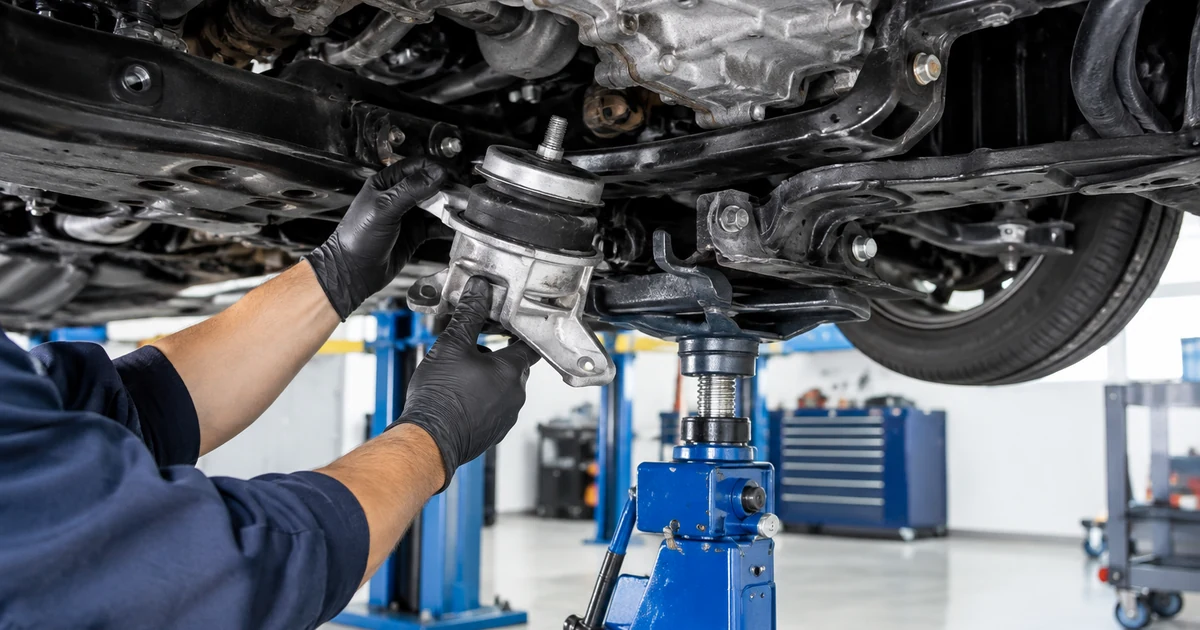
Motor Mount Replacement Cost by Vehicle
The table shows replacing one engine mount at an independent shop with quality aftermarket or OEM-equivalent parts. These are estimates for common model years and engines; hydraulic or electronically controlled mounts, hard-to-reach mounts and dealer labor cost more.
| Vehicle | Parts | Labor | Total |
|---|---|---|---|
| Ford F-150 | $100 – $300 | $350 – $700 | $450 – $1,000 |
| Chevrolet Silverado 1500 | $80 – $220 | $300 – $500 | $380 – $720 |
| Toyota Camry | $100 – $280 | $250 – $450 | $350 – $730 |
| Toyota RAV4 | $100 – $280 | $250 – $450 | $350 – $730 |
| Toyota Corolla | $80 – $250 | $250 – $450 | $330 – $700 |
| Honda Civic | $80 – $250 | $220 – $400 | $300 – $650 |
| Honda Accord | $100 – $280 | $220 – $400 | $320 – $680 |
| Honda CR-V | $100 – $300 | $250 – $450 | $350 – $750 |
| Nissan Altima | $70 – $220 | $200 – $350 | $270 – $570 |
| Chevrolet Equinox | $80 – $250 | $250 – $450 | $330 – $700 |
| Jeep Wrangler | $60 – $200 | $250 – $450 | $310 – $650 |
| Jeep Grand Cherokee | $80 – $250 | $300 – $500 | $380 – $750 |
| BMW 3 Series | $150 – $400 | $300 – $550 | $450 – $950 |
Most vehicles have three or four mounts holding the engine and transmission in place. Front-wheel-drive cars typically use side mounts plus front and rear torque mounts, while rear-wheel-drive trucks use two engine mounts and a transmission mount. Prices vary a lot depending on which mount failed, because some are right on top and others require supporting the engine and removing other parts.
Cost Breakdown: Parts vs. Labor
A basic rubber mount costs roughly $50 to $150. Hydraulic (fluid-filled) and electronically controlled active mounts cost more, and OEM mounts for luxury cars can run several hundred dollars. Labor is usually the bigger share: 1 to 4 hours per mount depending on access, or about $200 to $500 at independent shop rates.
| Job (independent shop) | Parts | Labor | Total |
|---|---|---|---|
| One engine mount | $60 – $300 | $200 – $500 | $350 – $800 |
| Transmission mount | $40 – $200 | $150 – $400 | $250 – $600 |
| Two mounts | $120 – $550 | $350 – $700 | $550 – $1,200 |
| All mounts (3–4, incl. transmission) | $180 – $800 | $550 – $1,000 | $800 – $1,800 |
Rubber vs. hydraulic vs. active mounts
Simple rubber mounts are cheapest. Many modern cars use hydraulic mounts that are filled with fluid to absorb more vibration, and some luxury and V6 or V8 models use electronically controlled active mounts. When a hydraulic mount fails you may see fluid residue under it. Replacing a hydraulic or active mount with a cheap solid rubber part can make the cabin noticeably noisier, so match the original design.
Engine mount vs. transmission mount
The transmission mount supports the back of the drivetrain and does the same job as an engine mount, so the symptoms are similar: clunks when shifting and extra vibration. On rear-wheel-drive trucks it is often easy to reach under the car and cheaper to replace than an engine mount. On front-wheel-drive cars, the transmission-side mount can sit under the battery tray or air box, which adds some labor. A good quote names the exact mount, such as front torque mount or driver-side transmission mount.
Dealer vs. independent vs. DIY
| Option | One engine mount | Notes |
|---|---|---|
| Independent shop | $350 – $800 | Aftermarket or OEM parts |
| Dealership | $455 – $1,040 | OEM parts, higher labor rate |
| DIY (parts only) | $140 – $320 | Easy mounts only; engine must be supported |
What Affects the Price
Vehicle type and engine layout
Mount location is the biggest factor. A top-side mount on a four-cylinder car can be a quick job, while a lower mount that requires removing the subframe support, exhaust parts or an axle takes much longer. Trucks and V8s have heavier parts, and some mounts can only be reached from below.
Part quality and type
Aftermarket rubber mounts are inexpensive, but quality varies. OEM hydraulic and active mounts cost more but restore the original smoothness. Cheap mounts may fail again sooner.
Shop type
Dealer labor rates are often $150 to $220 an hour versus about $110 to $150 at independent shops, so the same job commonly costs around 30% more at the dealer.
Region
Labor rates are highest in large coastal metro areas and lowest in parts of the South and Midwest. Use the region setting in the estimator above.
How many mounts are replaced
Each additional mount adds parts and some labor, but less than a separate visit because the engine is already supported and parts are already removed.
Symptoms of a Bad Motor Mount
- Excess vibration in the cabin, steering wheel or seats, often worst at idle or in Drive at a stop.
- Clunking or banging when accelerating, shifting between Drive and Reverse, or letting off the gas.
- Engine rocks or lurches visibly when someone revs it or shifts gears with the hood open.
- Cracked, torn or separated rubber in the mount on inspection.
- Fluid residue around a hydraulic mount.
- Engine sits lower or at an angle than normal in severe cases.
Vibration at idle can also be caused by an engine misfire, so if the check engine light is on, see our P0300 misfire code guide and spark plug replacement cost. A clunk that happens when turning or accelerating on front-wheel drive cars can also come from a worn CV axle.
Can You Drive With a Bad Motor Mount?
With one worn mount, usually yes for a short time, but don’t ignore it. The extra engine movement puts stress on the other mounts, the exhaust, hoses, wiring and axles, and on some vehicles it can damage the transmission linkage or throttle components. If the engine is visibly lurching, you hear heavy banging when shifting, or a mount has completely broken, stop driving and have the car inspected: an engine that moves too far can pull on hoses or cables and create a real safety problem.
DIY vs. Taking It to a Shop
Difficulty: 3 out of 5 for an easy-to-reach top mount, 4 to 5 out of 5 for lower or hidden mounts. You need a floor jack with a wood block or an engine support bar, jack stands, a socket set with extensions, a breaker bar and a torque wrench. An easy mount can take 1 to 2 hours; a hard one can take most of a day.
The engine must be safely supported the whole time, and it is heavy. If a mount requires lowering a subframe or removing other components, leave it to a shop. Mounts should be tightened to the factory torque spec with the engine in its normal position.
Is It Worth Fixing?
In most cases, yes. A motor mount job typically costs a few hundred dollars and protects more expensive parts such as the exhaust, axles and transmission from extra movement. On a very old car with multiple worn mounts and a low market value, the cost of all mounts can approach a noticeable share of what the car is worth, so get a full inspection and prioritize the mount that has actually failed.
How to Save Money on Motor Mount Replacement
- Get a second quote and confirm exactly which mount is being replaced and why.
- Use an independent shop rather than the dealer for out-of-warranty vehicles.
- Choose quality aftermarket or OEM-equivalent mounts that match the original type (rubber, hydraulic or active).
- Replace mounts together when more than one is worn, to share labor.
- Bundle it with other work that removes the same parts, such as transmission work or an axle replacement.
- Check your warranty: engine mounts are covered by some powertrain and extended warranties.
Learn more about how we estimate costs.
Frequently Asked Questions
How many motor mounts does a car have?
Most cars and trucks have three or four mounts, including the transmission mount. Front-wheel-drive cars often have side mounts plus torque mounts, while rear-wheel-drive trucks usually have two engine mounts and one transmission mount.
Should all motor mounts be replaced at the same time?
Not necessarily. Replace the mount that has failed, but have the others checked. On a high-mileage vehicle the others may be worn too, and replacing them together saves on labor.
How long do motor mounts last?
Many motor mounts last around 60,000 to 100,000 miles or roughly seven years, but heavy towing, aggressive driving, heat and oil leaks can wear them out sooner.
How long does it take to replace a motor mount?
Anywhere from about 1 hour for an easy top mount to 4 hours or more for a hard-to-reach lower mount. Replacing all mounts is often a full-day job.
Can a bad motor mount cause vibration?
Yes. Excess vibration at idle or in gear is one of the most common signs. However, engine misfires can feel similar, so rule them out if the check engine light is on.
Can a bad motor mount damage other parts?
It can. Extra engine movement stresses the other mounts, exhaust, hoses, wiring and axles. Fixing a failed mount promptly helps avoid more expensive repairs.