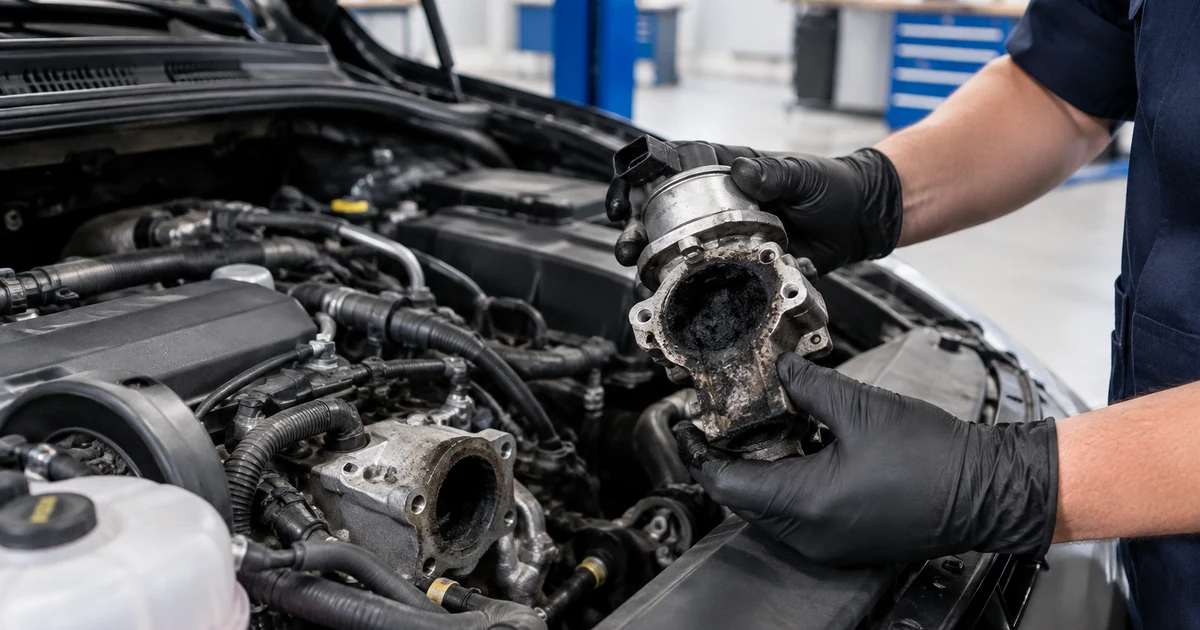
What the P0401 Code Means
P0401 stands for “Exhaust Gas Recirculation (EGR) Flow Insufficient Detected.” The EGR system sends a small, controlled amount of exhaust back into the intake. That inert gas lowers combustion temperatures, which cuts nitrogen oxide (NOx) emissions and helps prevent engine knock.
The engine computer opens the EGR valve under certain conditions, usually steady cruising or deceleration, and checks whether the expected flow shows up. Depending on the vehicle, it watches a pressure sensor (such as Ford’s DPFE sensor), an EGR temperature sensor, the manifold pressure (MAP) sensor or the fuel trims. If the change is smaller than expected, it decides too little exhaust is flowing and sets P0401. On many vehicles the fault has to appear on two drives in a row before the light comes on.
In plain terms: something is blocking or failing to open the path for exhaust gas. On gasoline engines, that something is most often carbon.
Common Causes of P0401
| Cause | Likelihood | Typical repair cost |
|---|---|---|
| Carbon-clogged EGR passages or ports | Most common | $150 – $500 (cleaning) |
| EGR valve stuck closed or failed | Very common | $300 – $650 |
| Faulty DPFE sensor or its hoses (mostly Ford) | Common on Fords | $90 – $220 |
| Faulty EGR control solenoid / vacuum switching valve | Occasional | $90 – $250 |
| Cracked, loose or misrouted vacuum hose | Occasional | $100 – $250 |
| Faulty EGR temperature sensor | Less common | $125 – $300 |
| Faulty MAP sensor | Less common | $140 – $300 |
| Clogged EGR ports that require intake removal (some Honda V6s) | Model-specific | $400 – $1,000 |
| Wiring fault or engine computer software | Rare | $100 – $550 |
Go-Parts ranks clogged EGR passages and a faulty or stuck EGR valve as the most frequent causes, with the DPFE sensor common on Fords. Samarins lists model-specific patterns: DPFE sensors and their hoses on Fords, clogged EGR ports on several 1998–2003 Honda and Acura V6 engines, and the EGR vacuum switching valve on older Toyota Camry and Corolla models. On 2010–2012 Prius models, Toyota issued a service bulletin calling for an updated EGR valve when failure is confirmed.
Symptoms of P0401
- Check engine light on, often the only sign
- Failed emissions or smog test
- Pinging or knocking when accelerating or climbing a hill
- Less power or sluggish acceleration in some cases
- Slightly lower fuel economy
- Rarely, a rough idle or stalling if carbon also keeps the valve from sealing
Many drivers notice no change in how the car runs. Pinging under load is the symptom to take most seriously, because it means combustion is running hotter than it should.
Is It Safe to Drive With P0401?
Usually, yes, in the short term. P0401 doesn’t affect brakes or steering, and most cars drive normally. It’s still worth fixing within a few weeks:
- Engine knock. Without EGR, combustion temperatures rise. Jerry’s guide warns that this can lead to pre-ignition that, over time, may damage valves and pistons. If you hear pinging, avoid heavy acceleration and towing until it’s fixed.
- Emissions. NOx output goes up, and states that check stored codes will fail the car.
- Hidden problems. While P0401 keeps the light on, you won’t notice if a new, more serious code sets.
Stop driving and have the car checked if the check engine light starts flashing, the engine knocks loudly, or it begins to stall or run very rough. A flashing light means a severe misfire, covered in our guide to a flashing check engine light.
How to Diagnose P0401
An OBD2 scanner confirms P0401, shows any companion codes and lets you watch live data. Related codes such as P0402 (excessive flow), P0403 (EGR circuit) or a DPFE sensor code change the direction of the diagnosis.
- Read all codes and freeze-frame data. Note the speed and load when the code set.
- Inspect hoses and connectors. On vacuum-operated valves, check that the hoses aren’t cracked, collapsed or swapped. Samarins notes that Ford DPFE hoses are sometimes reversed during repairs, and that the sensor and its hoses should hold vacuum.
- Command the EGR valve open at idle. With a capable scan tool, or by applying vacuum to the valve on older engines, open the valve with the engine idling. The engine should stumble or nearly stall. If nothing changes, the valve is stuck or the passages are blocked.
- Test the sensors. Check that the DPFE sensor voltage changes when vacuum is applied, and that the MAP and EGR temperature sensors read sensibly.
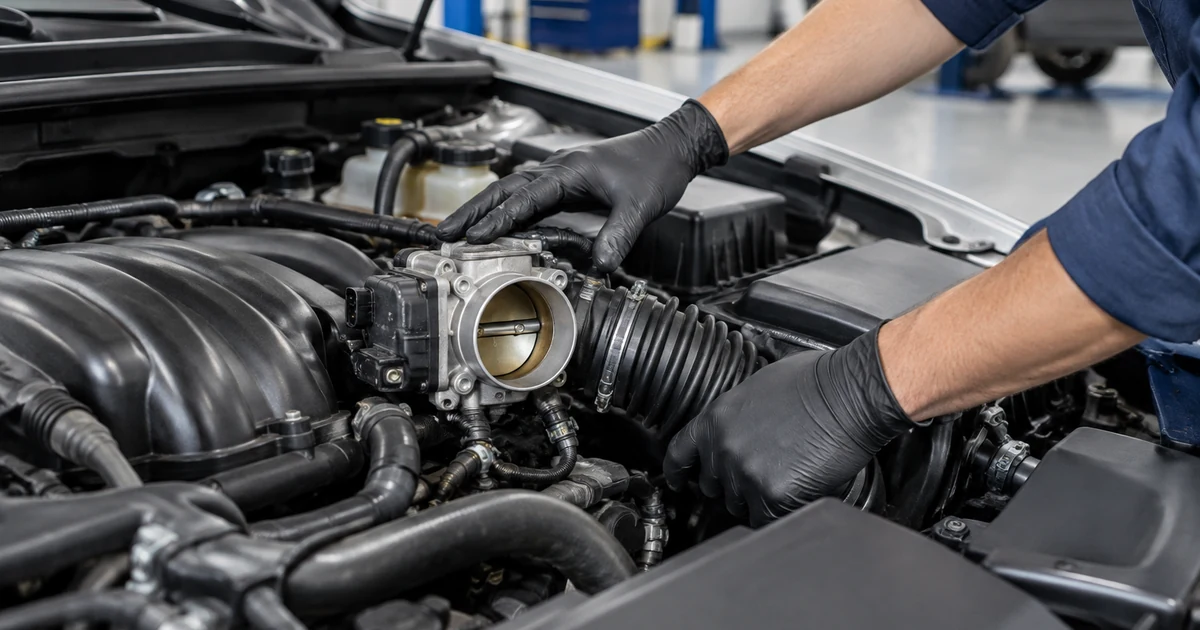
- Remove and inspect the EGR valve. Heavy carbon on the valve usually means the passages behind it are clogged too. RepairPal recommends checking and cleaning the EGR passages whenever the valve is off.
A shop diagnosis usually costs $100 to $200, and many shops credit it toward the repair.
How to Fix P0401
Start with the cheapest checks and move up:
- Repair any cracked, loose or misrouted vacuum hose. On Fords, replace the brittle DPFE hoses first; they’re inexpensive.
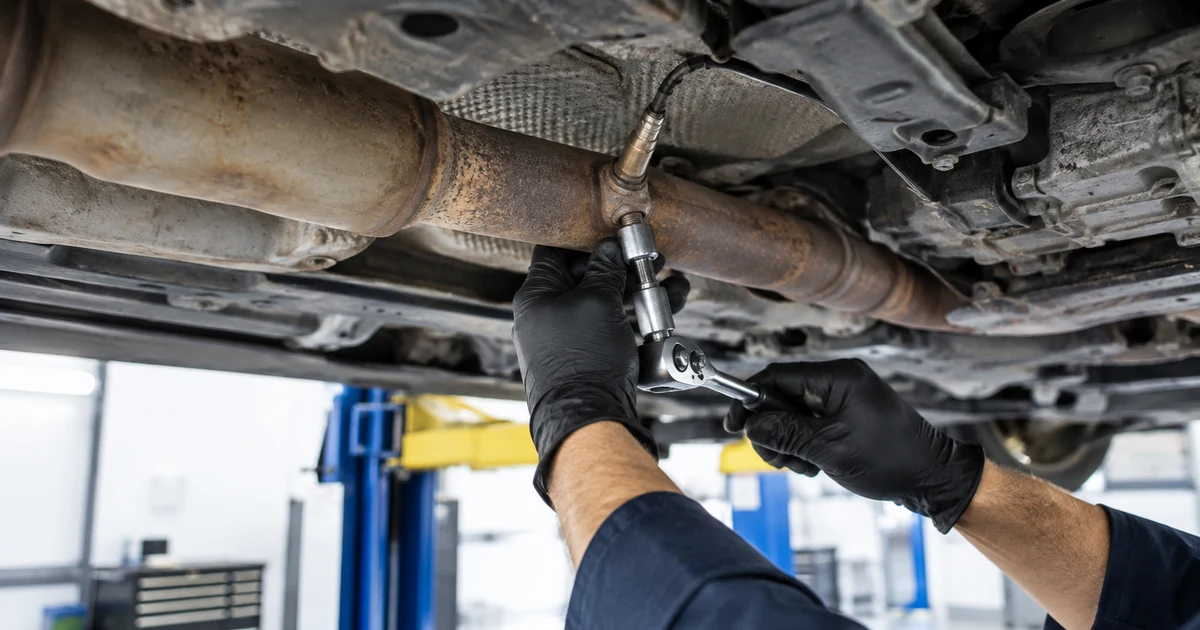
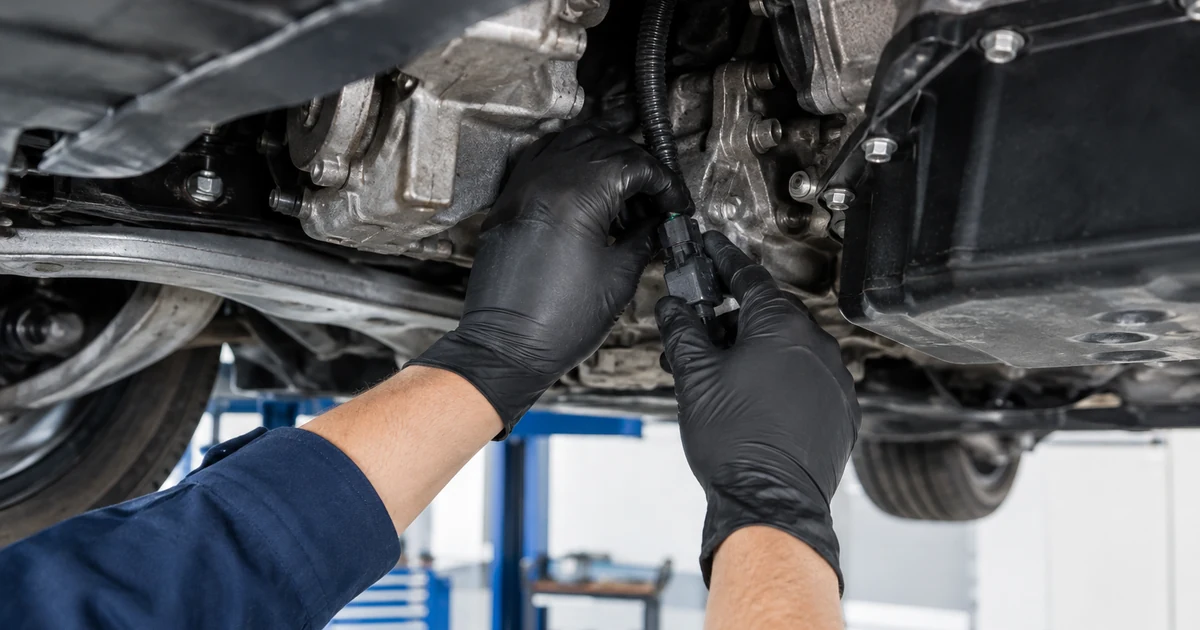
- Replace the DPFE sensor or EGR control solenoid if testing shows it has failed.
- Clean the EGR valve and passages. Remove the valve, scrape and soak away the carbon, and clear the port it bolts to. Samarins notes that many mechanics replace the valve during this job because a heavily carboned valve may keep sticking even after cleaning.
- Replace the EGR valve if it doesn’t open when commanded, fails its position test or is badly carboned.
- Clean internal ports on engines where the EGR channels run through the intake manifold. On affected Honda V6 engines, that means removing the intake and clearing the ports, with new gaskets.
- Clear the code and confirm the fix with a road test that includes steady highway cruising, which is when most EGR monitors run.
Cost to Fix P0401 by Cause
The cost to fix P0401 runs from about $90 for a DPFE sensor or hose to $1,000 when the intake has to come off. Most drivers pay about $310 to have the EGR valve and passages cleaned; a new EGR valve installed typically costs $300 to $650.
| Repair | Parts | Labor | Total at a shop |
|---|---|---|---|
| Diagnosis with scan | — | $100 – $200 | $100 – $200 |
| DPFE sensor (Ford) | $40 – $120 | $50 – $100 | $90 – $220 |
| EGR control solenoid / vacuum switching valve | $40 – $100 | $50 – $150 | $90 – $250 |
| Vacuum hose repair | $10 – $50 | $90 – $200 | $100 – $250 |
| EGR temperature sensor | $50 – $150 | $75 – $150 | $125 – $300 |
| MAP sensor | $50 – $180 | $60 – $120 | $140 – $300 |
| Clean EGR valve and passages | $10 – $30 | $150 – $470 | $150 – $500 |
| EGR valve replacement | $120 – $400 | $130 – $265 | $300 – $650 |
| Intake removal to clear EGR ports | $60 – $200 | $340 – $800 | $400 – $1,000 |
RepairPal puts the average EGR valve replacement at about $489 to $632, with model examples from roughly $257 to $337 on a Nissan Altima to $684 to $840 on a Toyota Camry. Go-Parts lists $150 to $500 in labor for cleaning the valve and passages, and MechanicBase gives $300 to $450 for an EGR valve and $220 to $400 for a pressure sensor. The intake-removal figure is an estimate based on typical intake labor, consistent with our intake manifold gasket cost guide.
On diesels and some hybrids, a clogged EGR cooler can also cause P0401. That’s a larger job priced by the vehicle, so get a written quote.
What Affects the Price
Valve location and engine layout
Some EGR valves bolt on top of the engine and come off in minutes. Others hide behind the intake or under other parts. RepairPal notes that access varies widely and some models need special tools.
How much carbon there is
A lightly fouled valve cleans up quickly. Ports packed solid with carbon, especially internal passages, add hours of labor.
Vacuum vs. electronic valve
Older vacuum-operated valves and their solenoids are cheap. Newer electronic EGR valves with built-in position sensors cost more, and OEM units are often the safer choice.
Shop type and region
Dealers charge more per hour but know the model-specific bulletins. A good independent shop is usually the best value. Labor rates run highest in the Northeast and on the West Coast.
DIY vs. Taking It to a Shop
Replacing a DPFE sensor, hose or EGR solenoid is about 2 out of 5 with hand tools. Removing, cleaning and replacing an accessible EGR valve is 2 to 3 out of 5; rusted bolts are the usual headache, so soak them with penetrating oil first, and work only on a cold engine. Jobs that require removing the intake manifold are 4 out of 5 and better left to a shop.
If the valve opens when commanded and the passages look clear, stop guessing and have a shop test the sensors before buying more parts.
Is It Worth Fixing?
Yes, in most cases. The common fixes cost a few hundred dollars, and in emissions-testing states you can’t pass inspection with P0401 stored. Fixing it also protects the engine from knock on hot days and under load. Only a $1,000 intake job on a very low-value car in a non-testing state might be worth weighing against the car’s value.
How to Save Money on P0401
- Check the cheap parts first. Vacuum hoses, DPFE hoses and solenoids cost far less than a valve.
- Clean before replacing when the valve itself still moves freely.
- Make sure passages are cleaned along with any new valve, so you don’t pay twice.
- Search for service bulletins for your model; some, like Toyota’s Prius bulletin, specify an updated part.
- Check the emissions warranty. Federal rules cover many emissions parts on newer vehicles for 2 years or 24,000 miles, and some for longer.
- Use an independent shop and ask whether the diagnostic fee is credited.
- Bundle intake work. If the intake comes off, ask about spark plugs on engines where they’re easier to reach then.
Related Codes
- P0400 — EGR flow malfunction
- P0402 — EGR flow excessive
- P0403 — EGR control circuit malfunction
- P0404 — EGR circuit range or performance problem
- P1401 / P1405 / P1406 — Manufacturer-specific EGR and DPFE codes (often Ford)
- P0420 — Catalyst efficiency below threshold, another emissions code; see our P0420 guide
Frequently Asked Questions
What does code P0401 mean?
P0401 means “Exhaust Gas Recirculation Flow Insufficient Detected.” The engine computer opened the EGR valve and didn’t see the expected change from its sensors, so it concluded too little exhaust is being recirculated into the intake.
What is the most common cause of P0401?
Carbon buildup in the EGR passages or on the EGR valve is the most common cause on gasoline engines. On Fords, a failed DPFE sensor or cracked DPFE hoses is also very common, and some Honda V6 engines are known for clogged EGR ports inside the intake.
How much does it cost to fix a P0401 code?
A DPFE sensor, solenoid or vacuum hose usually costs $90 to $250 at a shop. Cleaning the EGR valve and passages runs about $150 to $500, and a new EGR valve installed costs $300 to $650. Jobs that require removing the intake manifold can reach about $1,000.
Can I drive with a P0401 code?
Usually yes, for a short time. The car will often feel normal, but combustion runs hotter, which can cause pinging under load and may damage the engine over time. Avoid towing and hard acceleration, and stop driving if the check engine light flashes or the engine knocks loudly.
Can I clean the EGR valve instead of replacing it?
Often, yes, if the valve still moves freely and only has carbon on it. Clean the port it bolts to as well. If the valve sticks, fails its electrical test or is heavily carboned, replacement is the more reliable fix.
Will P0401 cause me to fail an emissions test?
Yes, in states that check stored codes and readiness monitors. EGR reduces nitrogen oxide emissions, so the car needs the fault fixed and the EGR monitor to complete before it can pass.