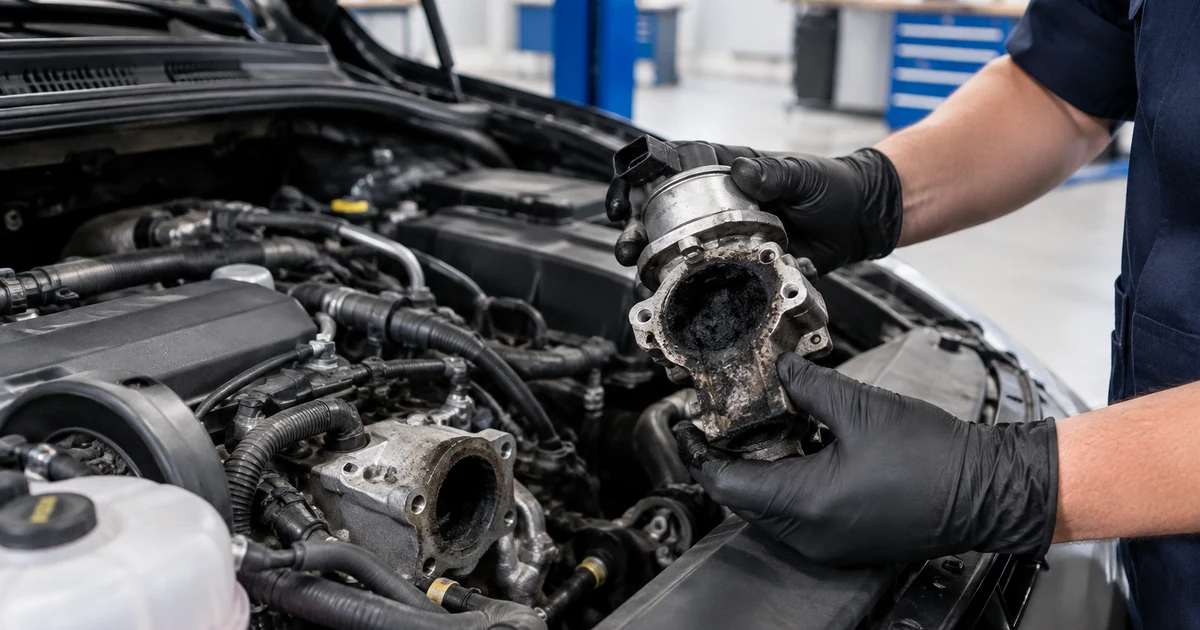
What the P0335 Code Means
P0335 stands for “Crankshaft Position Sensor A Circuit Malfunction.” The crankshaft position sensor reads a toothed wheel (called a reluctor or tone ring) on the crankshaft or harmonic balancer. Every tooth that passes the sensor creates a pulse, and the engine computer turns those pulses into engine speed and the exact position of each piston.
The computer relies on that signal to time the spark and the fuel injectors. When the signal is missing, erratic or doesn’t make sense compared with the camshaft sensor, the computer sets P0335. Edmunds and RepairPal both describe the same logic: the computer saw an irregular signal or no signal at all from the sensor circuit.
Note the word “circuit.” The code doesn’t prove the sensor itself is bad. It tells you the computer didn’t get a usable signal, which can come from the sensor, its wiring and connector, the tone ring it reads, or (rarely) the computer itself. RepairPal warns that just replacing the sensor may not fix the underlying problem.
Common Causes of P0335
| Cause | Likelihood | Typical repair cost |
|---|---|---|
| Failed crankshaft position sensor (heat, age, internal failure) | Most common | $170 – $420 (easy access) |
| Damaged, oil-soaked or corroded wiring or connector | Common | $100 – $400 |
| Sensor hard to reach (behind starter, exhaust or on the bellhousing) | Depends on engine | $300 – $650 |
| Sensor inside the timing cover | Some engines | $500 – $900 |
| Damaged reluctor ring or loose harmonic balancer | Occasional | $250 – $800 (external) |
| Timing belt or chain jumped or stretched | Less common | $500 – $3,500 |
| Engine computer (PCM) fault or software | Rare | $250 – $2,500 |
Mechanicbase lists the same suspects: a failed sensor, damaged wiring or connector, a broken reluctor ring, a bad timing belt or chain, and rarely the PCM. Sensors sitting low on the engine get hit by heat, oil leaks and road debris, so wiring problems are more common than many drivers expect.
Symptoms of P0335
- Check engine light on, sometimes with a tachometer that drops to zero or jumps around
- Engine cranks but won’t start, or starts only after cooling down
- Stalling while driving or at idle, often when the engine is hot
- Hesitation, surging or bucking on acceleration
- Rough idle or misfires
- Hard starting and lower fuel economy
An intermittent sensor often fails when hot and works again once cold. That pattern (stall, wait 20 minutes, restart) is a classic sign of a crankshaft position sensor on its way out.
Is It Safe to Drive With P0335?
No, not for long. RepairPal rates P0335 as urgent, and Edmunds advises against driving because the vehicle may stall or fail to start. Without a crankshaft signal, the engine computer can’t fire the spark plugs or injectors, so the engine can shut off with no warning.
- Stalling in traffic is the real danger. When the engine dies, you lose power assist for the steering and, after a few presses, the brakes. That can be dangerous on a highway, in an intersection or while turning across traffic.
- You may get stranded. A car with an active P0335 can refuse to restart, so budget for a possible tow ($75 to $150 locally).
- A timing problem can wreck the engine. If the code appeared with a rattle, a slapping noise or a sudden loss of power, the timing belt or chain may have slipped. On many engines a failed belt lets pistons hit valves. Stop and have it towed.
If the car still runs normally and the code set only once, drive it gently and only as far as a shop. Avoid highways and rush-hour traffic until it’s fixed.
How to Diagnose P0335
An OBD2 scanner is the first step. It confirms P0335, shows companion codes (such as P0336 for a signal out of range or P0340 for the camshaft sensor), and lets you watch engine RPM in live data while cranking.
- Read all codes and freeze frame data. Note whether the code set while cranking, idling or driving, and at what engine temperature.
- Watch RPM while cranking. If the RPM reads zero while the engine is clearly turning over, the computer isn’t seeing the crankshaft signal.
- Inspect the sensor and wiring. Look for a cracked connector, oil inside the plug, melted insulation near the exhaust, or wires chewed by rodents. Mechanicbase recommends this visual check before buying any parts.
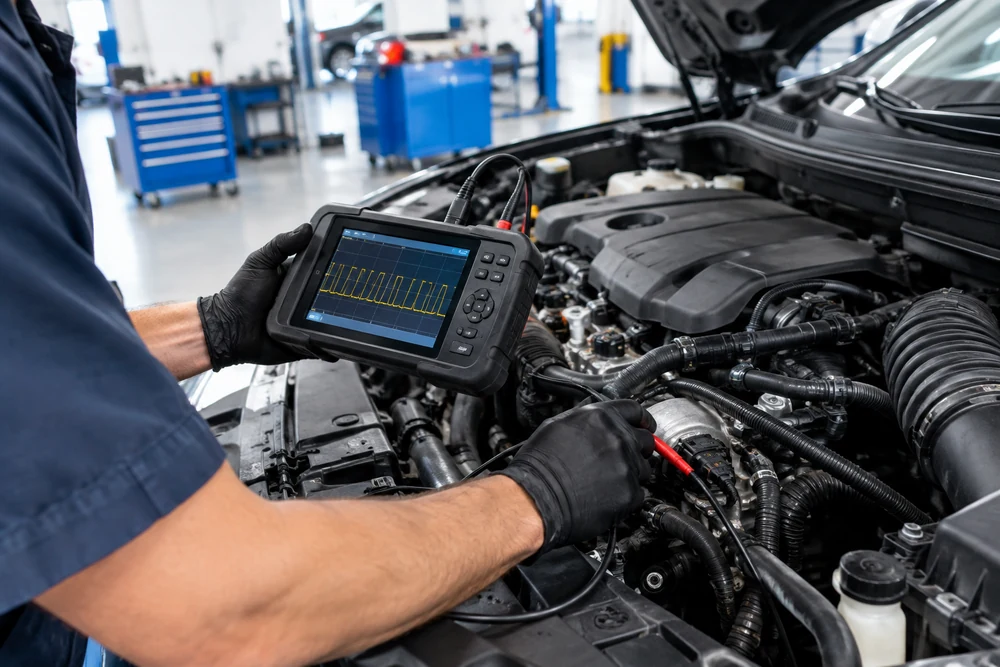
- Test the sensor. Depending on design, a shop checks the reference voltage and ground, then looks at the signal with a lab scope. A healthy digital sensor shows a clean square wave pattern; the service manual gives the exact spec.
- Check the tone ring and timing. If the sensor and wiring test good, a mechanic looks at the reluctor ring and checks crank-to-cam timing for a stretched chain or jumped belt.
Diagnosis usually runs $100 to $180 at an independent shop, and many shops credit it toward the repair.
How to Fix P0335
Work from the simple to the expensive:
- Repair the wiring or connector if the inspection finds damage. Clean an oil-soaked connector and fix the oil leak that caused it, or the problem returns.
- Replace the crankshaft position sensor if it fails testing. Use a quality aftermarket or OEM sensor; cheap sensors are a common reason the code comes back.
- Replace a damaged reluctor ring or harmonic balancer if the sensor is good but the signal is still erratic.
- Repair the timing system if crank and cam timing don’t match. This is a much bigger job.
- Update or replace the PCM only after everything else tests good. Some manufacturers release software updates for crank signal issues.
- Clear the code and road test. Some vehicles need a crankshaft position “relearn” with a scan tool after the sensor or computer is replaced. Skipping it can leave a misfire code or a rough idle.
Cost to Fix P0335 by Cause
The cost to fix P0335 ranges from about $100 for a wiring repair to $3,500 if the timing chain is to blame. Most drivers pay about $280, because the usual fix is a crankshaft position sensor that’s easy to reach.
| Repair | Parts | Labor | Total at a shop |
|---|---|---|---|
| Diagnosis | — | $100 – $180 | $100 – $180 (often credited) |
| Wiring or connector repair | $10 – $80 | $90 – $320 | $100 – $400 |
| Crankshaft position sensor, easy access | $40 – $200 | $130 – $230 | $170 – $420 |
| Sensor behind starter or exhaust | $40 – $200 | $250 – $450 | $300 – $650 |
| Sensor inside the timing cover | $40 – $200 | $450 – $700 | $500 – $900 |
| Reluctor ring or harmonic balancer | $80 – $350 | $150 – $450 | $250 – $800 |
| Timing belt kit | $150 – $450 | $350 – $1,000 | $500 – $1,500 |
| Timing chain | $300 – $800 | $900 – $2,000 | $1,200 – $3,500 |
| PCM update or replacement | $0 – $1,500 | $100 – $500 | $250 – $2,500 |
Published estimates line up. Mechanicbase lists $100 to $375 for a crankshaft position sensor and $50 to $550 for wiring repairs, and RepairPal’s model-specific estimates, such as $241 to $286 for a Hyundai Ioniq, fall in the same window. Add $75 to $150 for a tow if the car won’t start.
What Affects the Price
Where the sensor is mounted
This is the biggest factor. On many four-cylinder engines and V8 trucks the sensor sits on the front or side of the block and comes out with one bolt. On others it hides behind the starter, near the exhaust or on the transmission bellhousing, and on a few engines it sits behind the timing cover.
Vehicle type
Luxury and European models cost more for parts and labor. Trucks are usually close to average because the sensor is often easy to reach.
Part quality
Crankshaft sensors are a part where quality matters. An OEM or reputable aftermarket sensor costs a little more but is less likely to set the same code again a few months later.
Shop type and region
Dealers typically charge $150 to $220 an hour versus about $110 to $150 at independent shops. Labor rates run highest in the Northeast and on the West Coast.
Related work
If an oil leak ruined the sensor connector, fixing the leak adds cost but prevents a repeat failure. If the timing system is involved, the job becomes a timing belt or chain repair.
DIY vs. Taking It to a Shop
Replacing an easy-access crankshaft position sensor is about a 2 out of 5 job: one bolt, one connector, often reached from under the car with basic hand tools and jack stands. Sensors behind the starter or exhaust are a 3 out of 5. Sensors inside the timing cover, reluctor rings and timing work are 4 to 5 out of 5 and best left to a shop.
The hard part is diagnosis, not the swap. If you can confirm with a scanner that RPM drops to zero when the engine stalls and the wiring looks good, a DIY sensor replacement is reasonable. If the code returns, a shop with a lab scope is cheaper than guessing.
Is It Worth Fixing?
Almost always. A sensor or wiring repair costs a few hundred dollars and turns an unreliable car that can stall in traffic back into a safe one. Even on an older, high-mileage car worth only a few thousand dollars, a $280 repair makes sense. The math changes only when the root cause is a failed timing chain on a car worth less than the repair; then compare the quote with the car’s value before deciding.
How to Save Money on P0335
- Pay for a proper diagnosis first. A sensor swap without testing can miss a broken wire or tone ring.
- Ask if the diagnostic fee is credited toward the repair.
- Use an independent shop for out-of-warranty work; the sensor is a routine job.
- Buy a quality sensor, not the cheapest one, so you don’t pay twice.
- Check for recalls and service bulletins. Some models have known crank sensor or software issues covered by the manufacturer.
- Bundle timing-cover work. If the sensor is inside the timing cover and the timing belt is due, do both at once to avoid paying the labor twice.
- Get a second quote on any timing chain or PCM recommendation.
Related Codes
- P0336 — Crankshaft position sensor A circuit range/performance
- P0337 / P0338 — Crankshaft position sensor A circuit low / high input
- P0339 — Crankshaft position sensor A circuit intermittent
- P0340 — Camshaft position sensor circuit; see our camshaft position sensor cost guide
- P0016 — Crankshaft/camshaft position correlation, often a timing chain or belt issue
- P0300 — Random misfire, which a weak crank signal can trigger; see our P0300 guide
Frequently Asked Questions
What does code P0335 mean?
P0335 means “Crankshaft Position Sensor A Circuit Malfunction.” The engine computer saw no signal or an irregular signal from the crankshaft position sensor, which it needs to time the spark and fuel injection. The cause can be the sensor, its wiring, the tone ring it reads, or rarely the computer.
Can I drive with a P0335 code?
It isn’t recommended. Without a crankshaft signal the engine can stall without warning, and you lose power steering assist and, after a few presses, brake assist. If the car still runs, drive it gently and only as far as a repair shop, and avoid highways.
How much does it cost to fix P0335?
Most drivers pay about $280 for an easy-access crankshaft position sensor, with a typical range of $170 to $420. Wiring repairs run $100 to $400, hard-to-reach sensors $300 to $900, and timing belt or chain repairs $500 to $3,500 when the timing has jumped.
Will a bad crankshaft position sensor cause a no-start?
Yes. On most modern engines, no crankshaft signal means no spark and no fuel injection, so the engine cranks but won’t start. A failing sensor often works when cold and quits when hot, which causes stalling and then a restart after the engine cools.
Do I need to do a relearn after replacing the crankshaft sensor?
On some vehicles, yes. Many GM, Ford and other models need a crankshaft position variation relearn with a scan tool after the sensor is replaced. Skipping it can cause a misfire code or a rough idle, so check the service procedure for your vehicle.
What is the difference between P0335 and P0340?
P0335 points to the crankshaft position sensor circuit, while P0340 points to the camshaft position sensor circuit. If both appear together, look for a shared cause such as a damaged harness, a shared 5-volt reference wire or a timing problem before replacing both sensors.