Rear Main Seal Replacement Cost by Vehicle
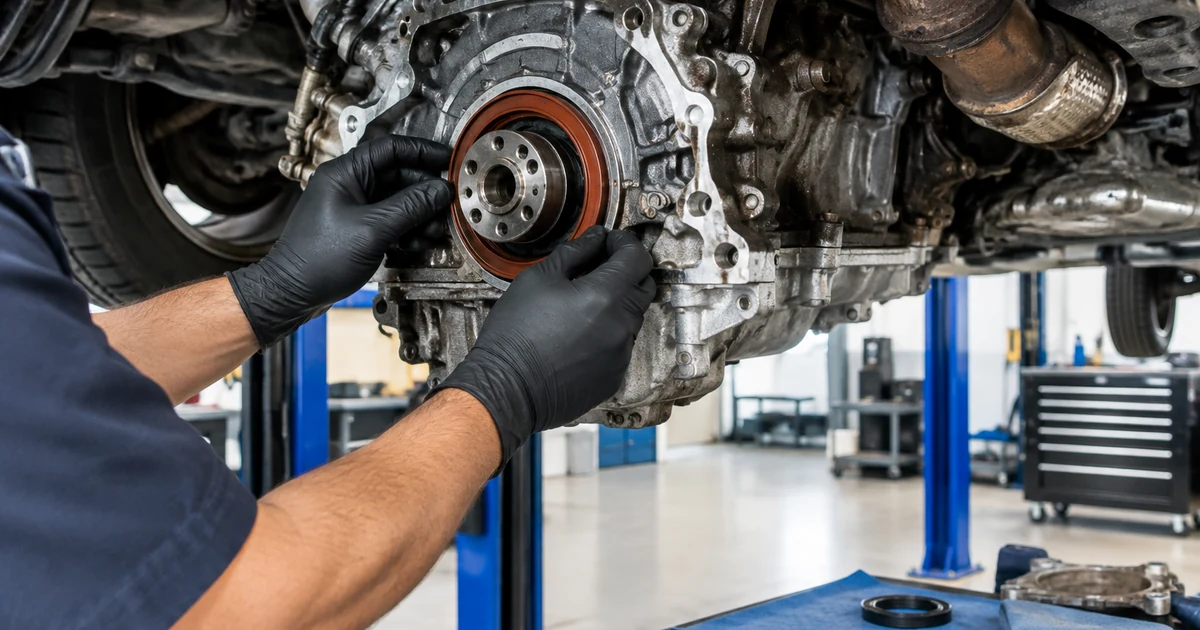
The rear main seal is a round rubber seal at the back of the engine, where the crankshaft meets the transmission. The seal often costs less than $50. The expense is getting to it: on almost every car, the transmission (and on manual cars, the clutch and flywheel) has to come out first.
| Vehicle (common years/engine) | Parts | Labor | Total |
|---|---|---|---|
| Toyota Corolla | $30 – $120 | $670 – $1,180 | $700 – $1,300 |
| Honda Civic | $30 – $120 | $670 – $1,180 | $700 – $1,300 |
| Toyota Camry | $30 – $130 | $770 – $1,370 | $800 – $1,500 |
| Honda Accord | $30 – $130 | $770 – $1,370 | $800 – $1,500 |
| Nissan Altima | $30 – $130 | $770 – $1,370 | $800 – $1,500 |
| Honda CR-V (AWD) | $30 – $150 | $870 – $1,550 | $900 – $1,700 |
| Toyota RAV4 (AWD) | $30 – $150 | $870 – $1,550 | $900 – $1,700 |
| Chevy Equinox | $30 – $150 | $870 – $1,450 | $900 – $1,600 |
| Jeep Wrangler / Grand Cherokee | $40 – $150 | $860 – $1,650 | $900 – $1,800 |
| Ford F-150 | $40 – $150 | $860 – $1,650 | $900 – $1,800 |
| Chevy Silverado 1500 | $40 – $150 | $860 – $1,650 | $900 – $1,800 |
| BMW 3 Series | $60 – $200 | $1,140 – $2,200 | $1,200 – $2,400 |
These are estimates for common model years and engines with automatic transmissions at an independent shop. 4WD and AWD versions usually cost more because the transfer case or driveshafts must also come out.
Cost Breakdown: Parts vs. Labor
This is one of the most labor-heavy repairs relative to part cost. AutoZone notes that a professional replacement can run $600 to $1,500 or more in labor alone, because the transmission has to be removed. TheCostGuys puts the average total at around $1,100, with seal prices from about $5 to $110 and labor from about $350 to $2,000. For a typical car, truck or SUV at an independent shop, about $1,100 is a realistic middle.
Parts
- Rear main seal: usually $10 to $100. Some engines use a seal pressed into a housing, which costs more.
- Transmission fluid, gaskets and bolts: $30 to $100 once the transmission has been removed.
- OEM vs. aftermarket: because the seal is so cheap and the labor so high, most mechanics recommend an OEM or top-quality seal. Saving $20 on a seal is not worth risking a repeat leak.
Labor
Book time ranges from roughly 4 hours on some rear-wheel-drive trucks to 10 or more hours on tight front-wheel-drive, all-wheel-drive and European cars. At $110 to $150 per hour at an independent shop, most jobs fall between $600 and $1,500 in labor. On a handful of vehicles, the engine has to come out or the subframe has to be dropped, which pushes totals past $2,000.
| Where | Typical total | Notes |
|---|---|---|
| Independent shop | $750 – $1,500 | OEM or quality seal, $110–$150/hr |
| Dealer | $1,000 – $2,000 | OEM seal, $150–$220/hr |
| DIY | $50 – $150 | Seal, fluids, gaskets; transmission removal required |
Replace It With the Clutch or Transmission
The best time to replace a rear main seal is when the transmission is already out for another reason. The labor overlaps almost completely, so the seal adds only the part and a little time.
- Manual transmission: if your clutch is worn, do both at once. The clutch and flywheel have to come off to reach the seal anyway. See our clutch replacement cost guide.
- Automatic transmission: if the transmission is being rebuilt or swapped, ask for a new rear main seal. See our transmission replacement cost guide.
- Add-on cost: usually about $50 to $250 when the transmission is already out, compared with $750 to $1,500 on its own.
Many mechanics replace the rear main seal as a matter of routine during a clutch job on higher-mileage cars, even with no leak, because it is so cheap to do at that point.
What Affects Rear Main Seal Replacement Cost
Drivetrain and engine layout
Rear-wheel-drive trucks often have the most direct access: remove the driveshaft and transmission, and the seal is right there. Front-wheel-drive cars need axles, subframe parts and a sideways transaxle removed. AWD and 4WD add a transfer case or extra driveshafts.
Transmission type
Manual transmissions add the clutch and flywheel to the teardown. Automatic transmissions add the torque converter and cooler lines, and are heavier to handle.
Vehicle type
Luxury and European cars tend to have tighter packaging and more components in the way. Heavy-duty trucks have larger transmissions but often better access.
Shop type and region
With labor making up most of the bill, the hourly rate matters a lot. One independent repair shop’s cost guide cites a Jeep Wrangler JK example of about $1,780 at a dealer versus about $650 at an independent shop, a good reminder to compare quotes.
Related parts replaced at the same time
A worn clutch, a warped flywheel, a leaking transmission front pump seal or a worn pilot bearing are common add-ons. If the oil pan gasket is also leaking, some engines let the shop reseal it during the same visit.
Symptoms of a Bad Rear Main Seal
- Oil dripping from where the engine and transmission meet
- Oil puddle under the middle of the car, near the bell housing
- Low oil level between oil changes
- Oil on the bottom of the transmission bell housing or on the flywheel inspection cover
- Slipping clutch on manual cars if oil reaches the clutch disc
- Burning oil smell if oil reaches the exhaust
Many “rear main seal leaks” turn out to be something higher up, such as a valve cover gasket, oil pressure sender or oil pan leak running down the back of the engine. A careful shop cleans the area and uses UV dye to confirm the source before recommending transmission removal.
Can You Drive With a Leaking Rear Main Seal?
Often, yes, for a while. A slow rear main seal leak is one of the most common oil leaks on older engines, and many drivers top off the oil for months or years. The real risks are running the engine low on oil, oil dripping on hot exhaust parts, and oil soaking a clutch. Check the oil level every fill-up. If you are adding more than about a quart between oil changes, if the oil pressure light comes on, or if a manual clutch starts slipping, get it repaired. Never drive with the oil pressure warning on.
DIY vs. Taking It to a Shop
Difficulty: 4 to 5 out of 5.
- Time: a full weekend or more for most DIYers.
- Tools: a lift or tall jack stands, a transmission jack, full socket set, torque wrench and a seal installer or careful technique to press the seal in straight.
- Savings: about $50 to $150 in parts versus $750 to $1,500 at a shop.
- Watch out for: dropping a heavy transmission, damaging the crankshaft sealing surface, installing the seal crooked, and misaligning the torque converter or clutch on reinstall.
Transmission removal is dangerous without the right equipment. Unless you already have a lift and transmission jack, this is a job for a shop.
Is It Worth Fixing?
It depends on the leak and the car. A slow seep on an older, high-mileage car is often cheaper to manage with regular top-offs than to fix for $1,000 or more. A heavy leak, oil on the clutch, or oil dripping onto the exhaust is worth fixing. On a car worth only a couple of thousand dollars, many owners wait until the clutch or transmission needs work and do the seal then.
How to Save Money on a Rear Main Seal Replacement
- Confirm the leak source with cleaning and UV dye before approving transmission removal.
- Combine it with a clutch or transmission job so you pay the labor only once.
- Get two or three quotes and compare labor hours. The spread can be large.
- Use an independent shop for out-of-warranty vehicles.
- Check your powertrain warranty. Rear main seals are often covered on newer cars.
- Try a seal conditioner on a slow seep before paying for the full job.
- Keep the oil topped off while you plan the repair.
Frequently Asked Questions
How much does it cost to replace a rear main seal?
Most drivers pay $600 to $1,800 at a shop, and about $1,100 is typical. If the transmission is already out for a clutch or transmission job, adding the seal usually costs only $50 to $250.
Why is rear main seal replacement so expensive?
The seal usually costs $10 to $100, but it sits between the engine and transmission. The transmission, and on manual cars the clutch and flywheel, must be removed to reach it, which takes 4 to 10 or more hours of labor.
How long can you drive with a leaking rear main seal?
A slow seep can often be managed for months or even years if you check and top off the oil regularly. Fix it sooner if you are losing a lot of oil, oil is dripping on the exhaust, or it is contaminating a manual clutch.
Should I replace the rear main seal when replacing the clutch?
Yes, on most higher-mileage cars. The seal is right behind the flywheel, so it adds very little labor during a clutch job, and it avoids paying to remove the transmission again later.
Do rear main seal stop-leak additives work?
They can help a slow seep from a seal that has hardened with age by softening the rubber. They will not fix a torn, worn-through or badly installed seal. They are a cheap first try, not a guaranteed fix.
How do I know if it is the rear main seal leaking?
Oil dripping from where the engine meets the transmission is the classic sign. Leaks from higher up can run down to the same spot, so a shop should clean the area and use UV dye to confirm the source before quoting a full repair.