CV Axle Replacement Cost by Vehicle
These prices are for one CV axle at an independent shop using a new aftermarket axle. They are estimates for common model years and drivetrains. OEM parts, dealer labor and some late-model vehicles can cost two to three times as much, as explained below.
| Vehicle | Parts | Labor | Total |
|---|---|---|---|
| Ford F-150 (4WD front) | $120 – $300 | $200 – $350 | $320 – $650 |
| Chevrolet Silverado 1500 (4WD front) | $120 – $300 | $200 – $350 | $320 – $650 |
| Toyota Camry | $90 – $250 | $170 – $300 | $260 – $550 |
| Toyota RAV4 | $100 – $260 | $180 – $300 | $280 – $560 |
| Toyota Corolla | $80 – $220 | $160 – $280 | $240 – $500 |
| Honda Civic | $80 – $220 | $160 – $280 | $240 – $500 |
| Honda Accord | $90 – $250 | $170 – $300 | $260 – $550 |
| Honda CR-V | $100 – $260 | $170 – $300 | $270 – $560 |
| Nissan Altima | $90 – $250 | $170 – $300 | $260 – $550 |
| Chevrolet Equinox | $100 – $260 | $170 – $300 | $270 – $560 |
| Jeep Grand Cherokee | $130 – $320 | $200 – $350 | $330 – $670 |
| Tesla Model 3 (rear half shaft) | $150 – $400 | $180 – $320 | $330 – $720 |
| BMW 3 Series | $200 – $500 | $220 – $380 | $420 – $880 |
Front-wheel-drive cars and crossovers have two front CV axles. All-wheel-drive vehicles add rear axles, and 4WD pickups use CV axles in the front only. Rear-wheel-drive and electric cars such as the Tesla Model 3 use half shafts with CV joints at the driven wheels.
Cost Breakdown: Parts vs. Labor
A new aftermarket CV axle usually costs $60 to $300, with most common cars around $80 to $250. OEM axles often run $300 to $600 or more per side. Labor is typically $170 to $350, based on about 1.5 to 3 hours per side.
Why some estimates look much higher
You may see national averages above $1,000. RepairPal’s CV axle estimate, for example, is about $1,283 to $1,381, driven almost entirely by parts priced around $1,075, which reflects OEM pricing. At an independent shop with a quality aftermarket axle, most drivers pay far less. If your quote is over $1,000 on an ordinary car, ask which part is being used.
New aftermarket vs. remanufactured vs. OEM
- New aftermarket: the most common choice. Many come with long or lifetime parts warranties. Quality varies by brand, and cheap axles are known for vibration or early boot failure.
- Remanufactured: an original axle rebuilt with new joints and boots. Often a good fit for older or less common vehicles.
- OEM: the factory part. Best fit and feel, and sometimes the only choice for certain AWD or performance models, but usually about twice the price of aftermarket.
Dealer vs. independent vs. DIY
| Option | One front axle | Notes |
|---|---|---|
| Independent shop | $300 – $850 | Aftermarket or reman axle |
| Dealership | $620 – $1,770 | OEM axle and dealer labor rate |
| DIY | $90 – $260 | Parts only; needs a breaker bar and axle-nut socket |
What Affects the Price
Vehicle type and drivetrain
Compact FWD cars are the cheapest. 4WD trucks, AWD rear axles, and luxury cars need pricier parts and more labor. Some vehicles require removing suspension parts or draining transmission fluid to get the inner joint out.
Part quality
The difference between an aftermarket and an OEM axle can be several hundred dollars per side. A mid-priced aftermarket axle from a reputable brand is usually the best value.
Shop type
Dealers charge higher labor rates and typically install OEM axles, which is why dealer quotes can pass $1,000 or even $1,500 per side.
Region
Independent shop labor rates range from roughly $85 to $105 an hour in the cheapest states to $155 to $175 in California. The estimator’s region setting reflects this.
Related parts replaced at the same time
A leaking transmission or differential axle seal is often replaced while the axle is out, and some shops top off transmission fluid. Seized axle nuts, rusted hubs, or a worn wheel bearing can add time. If the shop also has to separate a tie rod or ball joint, an alignment check (about $100) may be recommended. If fluid is leaking from the transmission itself rather than the seal, see our transmission repair cost guide.
Symptoms of a Bad CV Axle
- Clicking or popping when turning, especially in tight turns or parking lots. This is the classic sign of a worn outer CV joint.
- Grease on the inside of the wheel or splattered on suspension parts, from a torn CV boot.
- Vibration while accelerating, often from a worn inner joint.
- Clunk when shifting between drive and reverse or when getting on and off the gas.
- Knocking or humming that changes with speed.
A humming noise that grows steadily with speed and changes when you change lanes is more often a wheel bearing. See our wheel bearing replacement cost guide. CV axles often last 70,000 to 130,000 miles, but a torn boot lets grease out and dirt in, which can finish a joint much sooner.
Can You Drive With a Bad CV Axle?
With a torn boot or light clicking, you can usually drive gently for a short time while you book the repair. Do not ignore it for long. A CV joint that fails completely can leave the car unable to move, and in rare cases a broken axle can damage nearby parts or affect control. If you hear loud clunking, feel heavy vibration, or the car does not move when in gear, stop and have it towed.
DIY vs. Taking It to a Shop
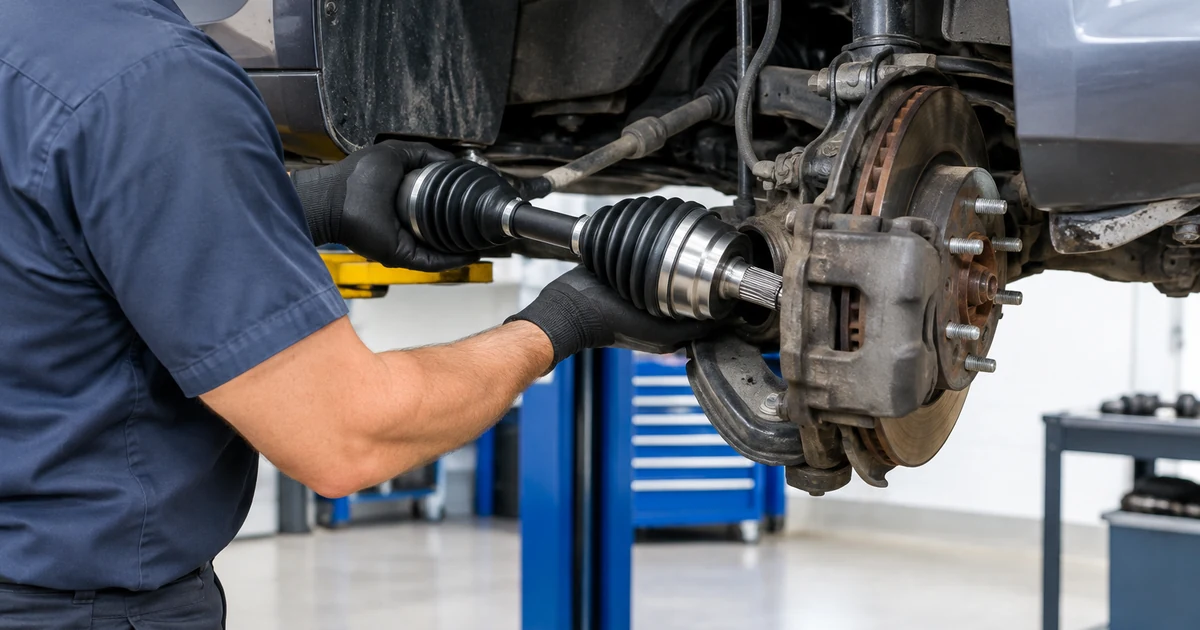
Difficulty: 3 out of 5 on most FWD cars; 4 out of 5 on AWD and 4WD vehicles. The basic steps: remove the wheel and axle nut, separate the lower ball joint or tie rod, pull the outer joint from the hub, and pop the inner joint out of the transmission. Expect 2 to 4 hours for a first-timer.
Tools: jack and jack stands, breaker bar and axle-nut socket, torque wrench, pry bar, ball joint separator or pickle fork, a drain pan for fluid, and sometimes a slide hammer. Axle nuts need a specific high torque, and a new nut is often required. If the inner joint is stuck in the transmission, or you have to disconnect steering parts, a shop may be the smarter choice.
Is It Worth Replacing a CV Axle?
Almost always. At $300 to $850 per side at an independent shop, a CV axle is a mid-sized repair that keeps a car driveable. On an old car with a low value, consider a quality aftermarket or reman axle rather than OEM. If the car also needs a transmission or engine, compare the total repair bill with the car’s value before spending.
How to Save Money on CV Axle Replacement
- Ask which axle is quoted (OEM, aftermarket or reman); it is the biggest cost variable.
- Get a second quote from an independent shop if the first is from a dealer.
- Choose a reputable aftermarket axle with a solid warranty instead of the cheapest option.
- Catch torn boots early; a quiet joint with a torn boot can sometimes be saved.
- Replace only the bad side unless both are clicking or leaking.
- Bundle related work like an axle seal or a tie rod that needs attention, so you only pay for disassembly and alignment once.
- Check warranty coverage; CV axles are often covered under powertrain or extended warranties.
Want to know where our numbers come from? See how we estimate costs.
Frequently Asked Questions
How much does it cost to replace a CV axle?
At an independent shop with a new aftermarket axle, expect about $300 to $850 per side, and about $550 on a typical midsize car. Dealer service with an OEM axle often costs $1,000 or more.
Is it cheaper to replace the CV boot or the whole axle?
A boot-only repair is usually $200 to $500, because the labor is almost the same as replacing the axle. Since a new aftermarket axle comes with new joints and boots, many shops recommend the full axle unless the joint is still in perfect shape.
How long does it take to replace a CV axle?
About 1.5 to 3 hours per side at a shop. AWD rear axles and 4WD trucks can take longer, and replacing all four axles on an AWD vehicle is a much bigger job.
Should both CV axles be replaced at the same time?
Not necessarily. Replace the axle that is clicking, vibrating or leaking grease. If both sides have torn boots or noise, doing them together can save a bit of labor.
How long do CV axles last?
Many last roughly 70,000 to 130,000 miles. The rubber boot is the weak point: once it tears, grease leaks out and dirt gets in, and the joint can wear out quickly.
Does a CV axle replacement need an alignment?
Usually not, if the shop only removes the axle. If tie rods, ball joints or other suspension parts are separated or replaced, an alignment check is a good idea.