Intake Manifold Gasket Replacement Cost by Vehicle
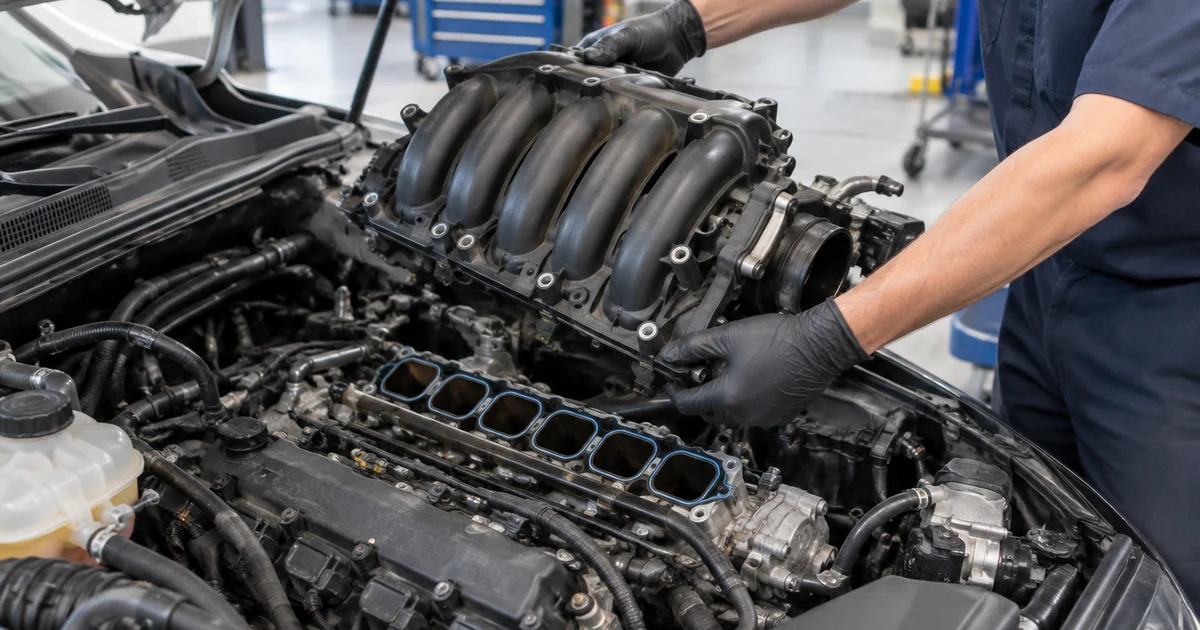
The intake manifold bolts to the cylinder head and feeds air to each cylinder. Its gaskets seal that joint. Price depends mainly on engine layout: a four-cylinder with a plastic manifold on top of the engine is fairly quick, while a V6 or V8 with a manifold nestled between the cylinder heads takes much longer.
| Vehicle (common years/engine) | Parts | Labor | Total |
|---|---|---|---|
| Toyota Corolla | $40 – $150 | $310 – $450 | $350 – $600 |
| Honda Civic | $40 – $150 | $310 – $450 | $350 – $600 |
| Toyota Camry (4-cyl) | $50 – $180 | $400 – $470 | $450 – $650 |
| Honda Accord | $50 – $180 | $400 – $520 | $450 – $700 |
| Honda CR-V | $50 – $180 | $400 – $520 | $450 – $700 |
| Toyota RAV4 | $50 – $180 | $400 – $520 | $450 – $700 |
| Nissan Altima | $60 – $200 | $440 – $600 | $500 – $800 |
| Chevy Equinox | $60 – $200 | $440 – $650 | $500 – $850 |
| Jeep Grand Cherokee / Wrangler (3.6L V6) | $80 – $300 | $570 – $800 | $650 – $1,100 |
| Ford F-150 (V8) | $100 – $300 | $700 – $800 | $800 – $1,100 |
| Chevy Silverado 1500 (V8) | $80 – $250 | $620 – $850 | $700 – $1,100 |
| BMW 3 Series | $100 – $350 | $600 – $950 | $700 – $1,300 |
These are estimates for common model years and engines at an independent shop. Your quote can differ with the exact engine, whether the lower or upper intake gasket is leaking, and local labor rates.
Cost Breakdown: Parts vs. Labor
Sources agree on the middle of the market. RepairPal puts the national average at about $683 to $834, including roughly $370 in parts and $313 to $459 in labor, with model examples from about $464 to $624 for a Camry to $818 to $972 for an F-150. AutoNation Mobile Service quotes $550 to $700, and FIXD lists $555 to $613 at a mechanic with 2 to 3 hours of labor. For a typical car or SUV at an independent shop, about $700 is a realistic middle.
Parts
- Intake manifold gasket set: about $20 to $150 for most engines.
- Related seals: throttle body gasket, fuel injector O-rings and vacuum hoses, often $20 to $100.
- Coolant: $30 to $80 on engines where coolant runs through the intake (common on older V6 and V8 engines).
- New intake manifold (if cracked): $150 to $600 or more. Plastic manifolds can warp or crack with age.
- OEM vs. aftermarket: quality aftermarket gasket sets are fine for most engines. Many shops prefer OEM gaskets on engines known for repeat leaks.
Labor
Most jobs take 1.5 to 3 hours on four-cylinder engines and 3 to 6 hours on V6 and V8 engines, especially when the lower intake has to come off. At $110 to $150 per hour at an independent shop, that is about $300 to $850 in labor.
| Where | Typical total | Notes |
|---|---|---|
| Independent shop | $500 – $950 | Aftermarket or OEM gaskets, $110–$150/hr |
| Dealer | $650 – $1,250 | OEM parts, $150–$220/hr |
| DIY | $50 – $250 | Gasket set, seals, coolant if needed |
What Affects Intake Manifold Gasket Replacement Cost
Engine layout: upper vs. lower intake
Many V6 and V8 engines have a two-piece intake. The upper intake (plenum) comes off fairly quickly. The lower intake sits in the valley between the cylinder heads and often carries coolant, so replacing its gaskets means draining coolant, removing fuel rails and injectors, and more careful cleanup. Older GM 3.1L and 3.4L V6 engines are well known for lower intake gasket coolant leaks.
Vehicle type
Trucks and large SUVs usually have V6 or V8 engines with more parts to remove. Luxury and European cars often have tightly packed engine bays with more sensors and wiring on the manifold.
Part quality and manifold condition
If the manifold is warped or cracked, the gasket alone will not fix it. Replacing the manifold can add several hundred dollars.
Shop type and region
Dealers charge more per hour and use OEM parts. Labor rates are highest in the Northeast and on the West Coast.
Related parts replaced at the same time
With the intake off, shops often replace injector O-rings, the throttle body gasket and cracked vacuum hoses. On many V6 engines the rear spark plugs sit under the upper intake, so it can be a good time to change them. If an injector is sticking, replacing it now saves labor later; see our fuel injector replacement cost guide. A leaking valve cover gasket nearby is another common add-on.
Symptoms of a Bad Intake Manifold Gasket
- Check engine light with lean codes such as P0171 or P0174
- Rough idle or a hissing sound from the top of the engine
- Misfires, especially at idle
- Poor acceleration and lower fuel economy
- Coolant loss with no visible leak, or coolant seeping near the intake
- Engine overheating on engines where coolant passes through the intake
- Milky oil in rare cases, if coolant leaks into the engine internally
A vacuum leak from the intake gasket is one of the common causes of a lean code. Our P0171 code guide explains how shops tell it apart from a dirty MAF sensor or a weak fuel pump.
How a Shop Diagnoses It
RepairPal notes that technicians usually connect a smoke machine to the intake with the engine off. Smoke escaping at the gasket joint confirms a vacuum leak. For coolant leaks, the shop pressure-tests the cooling system and checks the oil for contamination. Expect a diagnostic fee of about one hour of labor, often credited toward the repair.
Can You Drive With a Bad Intake Manifold Gasket?
A small vacuum leak is usually drivable for a short time, but the engine runs lean, which can cause misfires and, over time, stress the catalytic converter. A coolant leak is more serious. If coolant is leaking into the engine or the temperature gauge rises, stop driving. Coolant mixed into the oil can destroy engine bearings, and overheating can damage the head gasket. Milky oil, white exhaust smoke or steady coolant loss all mean the car should be towed, not driven.
DIY vs. Taking It to a Shop
Difficulty: 3 out of 5 on many four-cylinder engines with a plastic upper intake, 4 out of 5 on V6 and V8 lower intakes.
- Time: 2 to 4 hours on an easy engine; a full day for a lower intake on a V-engine.
- Tools: socket set with extensions, torque wrench, gasket scraper (plastic for aluminum surfaces), labeled bags for bolts and a camera for hose routing.
- Savings: about $50 to $250 in parts versus $500 to $950 at a shop.
- Watch out for: debris falling into the intake ports, a missed torque sequence, reused injector O-rings and relieving fuel pressure safely before removing the fuel rail.
RepairPal considers this a professional job on most vehicles. If you have not done top-end engine work before, a shop is the safer choice.
Is It Worth Fixing?
Usually, yes. A $500 to $1,000 repair restores smooth running and prevents lean-running damage or coolant contamination. The exception is an old, high-mileage car where coolant has already mixed with the oil for a long time or the engine has overheated badly. In that case, have the engine checked for bearing or head gasket damage before paying for gaskets.
How to Save Money on an Intake Manifold Gasket Replacement
- Confirm the leak with a smoke test before replacing parts.
- Get two quotes and ask whether the price covers upper, lower or both gaskets.
- Use an independent shop for out-of-warranty cars.
- Bundle nearby work like spark plugs, injector seals or a valve cover gasket while everything is apart.
- Fix it early. A vacuum leak is cheap next to a damaged catalytic converter or contaminated oil.
- Check warranties and service bulletins. Some engines have known intake gasket issues.
Frequently Asked Questions
How much does it cost to replace an intake manifold gasket?
Most drivers pay $400 to $1,200 at a shop, and about $700 is typical. Four-cylinder engines with an easy-to-reach plastic intake are often under $600, while lower intake gaskets on V6 and V8 engines can reach $1,000 to $1,500.
How long does it take to replace an intake manifold gasket?
About 1.5 to 3 hours on most four-cylinder engines and 3 to 6 hours on V6 and V8 engines, especially when the lower intake has to come off.
Can I drive with a leaking intake manifold gasket?
A small vacuum leak is usually drivable for a short time, but the engine runs lean and may misfire. If coolant is leaking, the engine is overheating or the oil looks milky, stop driving and have it towed.
Can a bad intake manifold gasket cause a lean code?
Yes. A leaking intake gasket lets unmetered air into the engine, which commonly sets P0171 or P0174. A smoke test is the usual way to confirm it.
What is the difference between the upper and lower intake gasket?
Many V-engines use a two-piece intake. The upper plenum gasket seals air only and is easier to reach. The lower intake gasket often seals both air and coolant passages, and replacing it takes much more labor.
Does the intake manifold have to be replaced too?
Usually not. Most repairs only need new gaskets. The manifold is replaced if it is cracked, warped or has broken ports, which is more common on older plastic manifolds.