Water Pump Replacement Cost by Vehicle
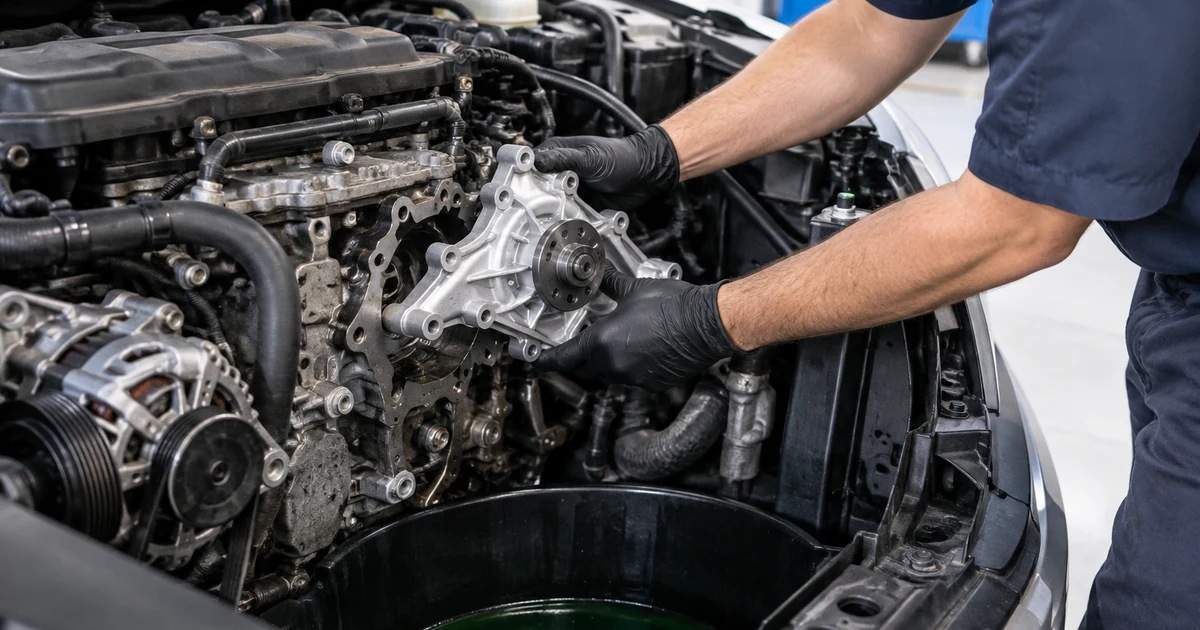
Water pump prices depend less on the pump itself and more on where it sits. A pump bolted to the front of the engine is a few hours of work. A pump behind the timing belt, or inside the engine, is a much bigger job.
| Vehicle (common years/engine) | Parts | Labor | Total |
|---|---|---|---|
| Toyota Corolla | $220 – $270 | $260 – $340 | $480 – $610 |
| Toyota Camry | $280 – $360 | $350 – $450 | $630 – $810 |
| Toyota RAV4 | $270 – $380 | $330 – $470 | $600 – $850 |
| Honda Civic | $290 – $360 | $350 – $450 | $640 – $810 |
| Honda Accord | $340 – $450 | $420 – $560 | $760 – $1,010 |
| Honda CR-V | $390 – $510 | $470 – $620 | $860 – $1,130 |
| Nissan Altima | $280 – $350 | $350 – $420 | $630 – $770 |
| Chevy Equinox | $270 – $430 | $330 – $520 | $600 – $950 |
| Ford F-150 | $490 – $580 | $490 – $570 | $980 – $1,150 |
| Chevy Silverado 1500 | $540 – $720 | $540 – $720 | $1,080 – $1,440 |
| Jeep Wrangler / Grand Cherokee (3.6L V6) | $290 – $500 | $360 – $600 | $650 – $1,100 |
| Ford Explorer (2011–2019, 3.5L V6, internal pump) | $380 – $750 | $1,120 – $2,250 | $1,500 – $3,000 |
| BMW 3 Series (electric pump) | $540 – $900 | $360 – $600 | $900 – $1,500 |
These are estimates for common model years and engines, including coolant. Your quote can differ with the exact engine and local labor rates.
Cost Breakdown: Parts vs. Labor
National figures cluster in the $600 to $1,100 range for most cars. Independent shops often land around $800, while dealers commonly charge $1,000 or more. Kelley Blue Book quotes a lower $400 to $800 range for simpler, belt-driven pumps.
Parts
- Water pump: about $50 to $300 for most mechanical pumps. Electric pumps on some newer and European cars cost more.
- Gasket, sealant and coolant: roughly $20 to $80. Many modern cars need a specific coolant type.
- OEM vs. aftermarket: OEM pumps cost more but match the original exactly. Good aftermarket pumps are common at independent shops. Remanufactured pumps exist for some models but are less common than for alternators or starters.
Labor
- Easy access: about 1.5 to 3 hours.
- Moderate access: about 3 to 5 hours.
- Driven by the timing belt: 4 to 6 hours or more, and the belt is normally replaced too.
- Internal pumps: can take 8 hours or more.
| Where | Typical total | Notes |
|---|---|---|
| Independent shop | $550 – $1,100 | Aftermarket or OEM pump, $110–$150/hr |
| Dealer | $750 – $1,450 | OEM pump, $150–$220/hr |
| DIY | $70 – $380 | Pump, gasket and coolant; easy-access pumps only |
Water Pump and Timing Belt Replaced Together
On many Honda, Acura, Subaru, older Toyota V6 and Hyundai/Kia engines, the timing belt turns the water pump. To reach the pump, the mechanic has to remove the belt anyway. That is why shops sell the two as a package, usually $650 to $1,250 at an independent shop for a belt kit plus pump, compared with paying for two separate teardowns.
If your pump is behind the timing belt and fails before the belt is due, do the belt at the same time. If the belt is due and the pump is still fine, most mechanics will still recommend replacing the pump, because a pump that starts leaking later means paying the same labor again. It is a reasonable recommendation, not an upsell.
On engines where the pump is driven by the serpentine belt, there is no such link. The pump can be replaced on its own, and the belt is usually swapped too because it is off anyway and costs little.
What Affects Water Pump Replacement Cost
Pump location and drive type
This is the biggest factor. Belt-driven pumps on the outside of the engine are the cheapest to replace. Pumps driven by the timing belt are more work, but the job makes sense to combine with a belt replacement. A few engines, such as the 3.5L V6 used in the 2011–2019 Ford Explorer, have the pump inside the engine, driven by the timing chain, which is a much more expensive repair.
Mechanical vs. electric pump
Some BMWs and other newer cars use electric water pumps. They are often easier to reach, but the part costs more.
Part quality
A pump is not a place to buy the cheapest option, especially behind a timing belt. A failed cheap pump can take the belt with it.
Shop type and region
Dealers charge more per hour and use OEM parts. Labor rates in the Northeast and on the West Coast run noticeably above the national average.
Related parts replaced at the same time
The thermostat, timing belt kit, serpentine belt, coolant hoses and a coolant flush are all common add-ons. They share the same labor, so adding them now costs less than doing them later.
Symptoms of a Bad Water Pump
- Coolant leak at the front of the engine, often from the pump’s weep hole. Look for green, orange or pink drips or crusty residue.
- Engine running hot or the temperature gauge climbing
- Whining or grinding noise from a worn pump bearing
- Wobbling pump pulley
- Low coolant warning or having to top off coolant often
- Steam from under the hood
Many water pumps last 60,000 to 100,000 miles or more, but there is no fixed interval unless the pump is part of a timing belt service.
Can You Drive With a Bad Water Pump?
A small weep can be monitored for a short time if you keep the coolant full and watch the gauge closely. But once the engine starts to overheat, stop driving. Pull over, shut the engine off, and let it cool before opening anything. Driving an overheating engine can warp the cylinder head or blow the head gasket, turning an $800 repair into a $2,000-plus one. Never open a hot radiator cap.
DIY vs. Taking It to a Shop
Difficulty: 3 out of 5 for an external pump, 4 to 5 out of 5 behind a timing belt or inside the engine.
- Time: 2 to 6 hours for an accessible pump; much longer if the timing belt comes off.
- Tools: socket set, torque wrench, drain pan, gasket scraper, the correct coolant, and a spill-free funnel for bleeding air from the system.
- Savings: parts only run about $70 to $380, compared with $550 to $1,100 at a shop.
- Risks: air pockets left in the cooling system can cause overheating. Dispose of old coolant properly; it is toxic to pets and children.
Is It Worth Fixing?
A water pump is almost always worth replacing. The engine cannot run without coolant flow, and the repair usually costs far less than the car is worth. The exception is an older, low-value car with an internal pump or signs of head gasket damage. If the engine has already overheated badly, have a shop test for head gasket failure before paying for the pump. Common checks are a cooling system pressure test and a combustion gas (block) test, which together usually cost far less than guessing wrong on a major repair.
How to Save Money on a Water Pump Replacement
- Combine it with a timing belt job if the pump is belt-driven. See our timing belt replacement cost guide.
- Replace the thermostat at the same time. It is cheap and often in the same area. Our thermostat replacement cost guide has the numbers.
- Get at least two quotes and ask for the pump brand and labor hours.
- Use an independent shop instead of the dealer if your car is out of warranty.
- Check your powertrain warranty. Water pumps are often covered on newer cars.
- Catch leaks early. A small leak fixed now avoids an overheating repair later.
- Replace a worn drive belt during the job. See our serpentine belt cost guide.
Frequently Asked Questions
How much does it cost to replace a water pump?
Most drivers pay $450 to $1,300, and about $800 is typical at an independent shop. Dealers often charge $1,000 or more. Pumps driven by the timing chain inside the engine can cost $1,500 to $3,000.
Should I replace the timing belt with the water pump?
Yes, if the pump is driven by the timing belt. The labor to reach the pump is almost the same as a belt job, so doing both together usually costs much less than doing them separately. Most shops recommend it.
How long does it take to replace a water pump?
Easy-access pumps take about 1.5 to 3 hours. Pumps behind the timing belt often take 4 to 6 hours. Internal pumps can take 8 hours or more.
How long does a water pump last?
Many water pumps last 60,000 to 100,000 miles or more. Old or contaminated coolant shortens their life. On timing-belt engines, pumps are usually replaced along with the belt.
Can a bad water pump damage the engine?
Yes. If the pump stops circulating coolant, the engine overheats. Continued driving can warp the cylinder head or blow the head gasket, which costs far more than the pump.
Can I drive with a leaking water pump?
Only briefly, with the coolant topped off and the temperature gauge watched closely. If the gauge rises or you see steam, stop immediately. Get the pump replaced soon, because small leaks tend to grow.