Thermostat Replacement Cost by Vehicle
A thermostat itself is a small, inexpensive part. What changes the price is whether it comes with a housing, whether it is electronically controlled, and how much has to be removed to reach it.
| Vehicle (common years/engine) | Parts | Labor | Total |
|---|---|---|---|
| Toyota Corolla | $130 – $160 | $190 – $250 | $320 – $410 |
| Toyota Camry | $180 – $220 | $210 – $280 | $390 – $500 |
| Toyota RAV4 | $160 – $220 | $190 – $280 | $350 – $500 |
| Honda Civic | $180 – $230 | $220 – $280 | $400 – $510 |
| Honda Accord | $180 – $220 | $230 – $270 | $410 – $490 |
| Honda CR-V | $190 – $220 | $230 – $270 | $420 – $490 |
| Nissan Altima | $190 – $220 | $230 – $270 | $420 – $490 |
| Chevy Equinox | $180 – $280 | $170 – $270 | $350 – $550 |
| Jeep Wrangler / Grand Cherokee (3.6L V6) | $200 – $320 | $200 – $330 | $400 – $650 |
| Ford F-150 | $360 – $400 | $290 – $330 | $650 – $730 |
| Chevy Silverado 1500 | $390 – $420 | $310 – $350 | $700 – $770 |
| BMW 3 Series (electronic thermostat) | $300 – $520 | $250 – $430 | $550 – $950 |
These are estimates for common model years and engines, including coolant. Your quote can differ with the exact engine and local labor rates.
Cost Breakdown: Parts vs. Labor
Estimates vary more for this repair than most. AutoZone puts shop replacement at roughly $150 to $500, while RepairPal’s national average is higher, around $600 to $700, because many newer engines use a thermostat built into a plastic housing, and trucks cost more. For a typical car at an independent shop, about $400 is a realistic middle.
Parts
- Thermostat only (with gasket): about $10 to $60 for most cars.
- Thermostat and housing assembly: often $50 to $250. Many modern engines use this one-piece design.
- Electronic thermostats (common on BMW and some other European cars): can cost $150 to $400 or more.
- Coolant: $20 to $60 to refill what drains out. Some cars need a specific type.
- OEM vs. aftermarket: many mechanics prefer OEM thermostats because the opening temperature is exactly right. Aftermarket units cost less.
Labor
Most thermostat jobs take 1 to 2.5 hours, including draining, refilling and bleeding air from the cooling system. That is about $110 to $375 at an independent shop. On some V6 and V8 engines the thermostat sits under the intake or behind other components, which can push labor to 3 hours or more.
| Where | Typical total | Notes |
|---|---|---|
| Independent shop | $280 – $560 | Aftermarket or OEM part, $110–$150/hr |
| Dealer | $360 – $730 | OEM part, $150–$220/hr |
| DIY | $40 – $200 | Thermostat or housing plus coolant |
What Affects Thermostat Replacement Cost
Engine layout and access
On many four-cylinder engines, the thermostat housing is right on top or at the end of the engine and takes about an hour. On some V6, V8 and turbo engines, parts such as the intake, air box or brackets come off first.
Thermostat design
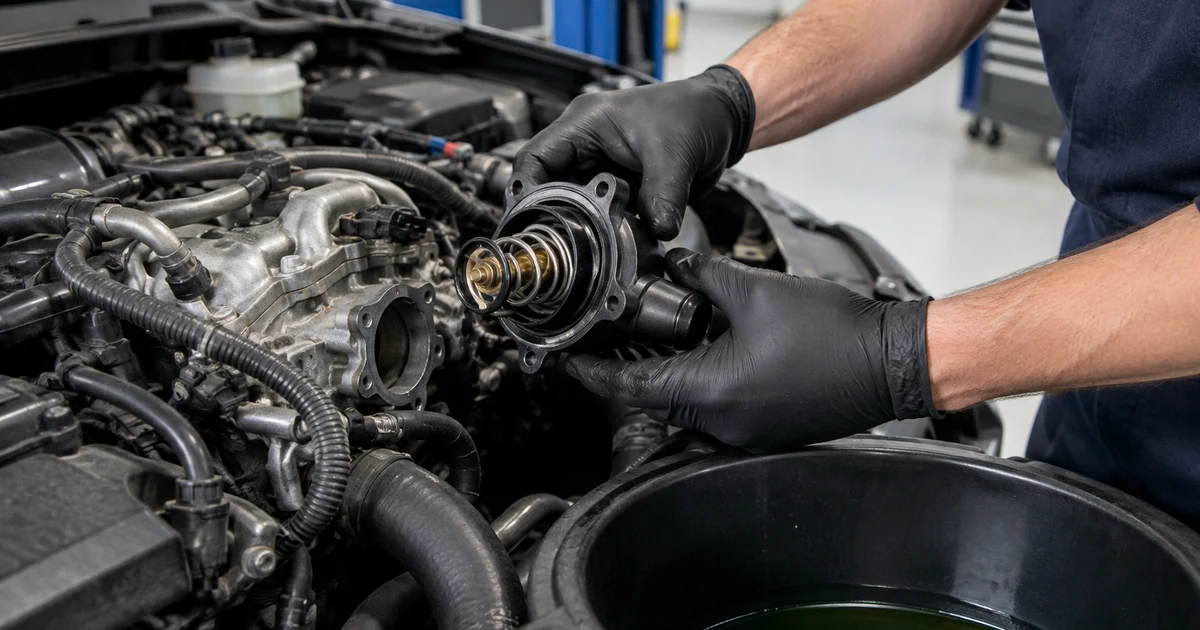
A simple drop-in thermostat is cheap. A housing assembly costs more, and an electronic thermostat with a heater element and connector costs the most.
Shop type and region
Dealers charge more per hour and use OEM parts only. Labor in the Northeast and on the West Coast is higher than in the South and Midwest.
Related parts replaced at the same time
A coolant flush, radiator hoses, or the water pump are common add-ons. If your coolant is old or dirty, a flush protects the new thermostat. On engines where the thermostat sits next to the pump, replacing both saves labor later. See our water pump replacement cost guide.
Symptoms of a Bad Thermostat
- Engine overheating soon after startup (thermostat stuck closed)
- Engine running cold or taking a long time to warm up (stuck open)
- Weak or no cabin heat in winter
- Temperature gauge that swings up and down
- Coolant leaking around the thermostat housing
- Check engine light, often code P0128 (coolant temperature below thermostat regulating temperature)
- Worse fuel economy if the engine never reaches normal temperature
There is no fixed replacement interval for most thermostats. Many last 100,000 miles or more, but old or neglected coolant, corrosion and heat cycles can make them stick earlier. Plastic housings on newer engines can also crack and leak with age. Some owners replace the thermostat as a precaution during a water pump or timing belt job, since the coolant is already drained and the extra cost is small.
How a Shop Confirms a Bad Thermostat
Overheating and poor heat have several possible causes, so a good shop checks before replacing parts. Typical steps:
- Check the coolant level with the engine cold. Low coolant alone can cause overheating and poor heat.
- Read codes and live data with a scan tool. A slow warm-up or a P0128 code points toward a thermostat stuck open.
- Feel or measure the upper radiator hose. It should stay cool while the engine warms up, then get hot once the thermostat opens. A hose that stays cool while the engine overheats suggests the thermostat is stuck closed.
- Check the cooling fan and temperature sensor, since either can mimic a thermostat problem.
- Pressure-test the system if coolant is disappearing.
If the thermostat checks out, the next suspects are usually the water pump, radiator or fan. A diagnostic fee of about one hour of labor is common and is often applied to the repair.
Can You Drive With a Bad Thermostat?
It depends on how it failed. A thermostat stuck open is not an emergency. The engine runs cool, heat is weak and fuel economy drops, but you can usually drive to a shop. A thermostat stuck closed is serious. Coolant cannot reach the radiator and the engine can overheat within minutes. If the temperature gauge climbs into the red, pull over and shut the engine off. Overheating can blow the head gasket or warp the cylinder head, repairs that cost thousands. Never open the radiator cap on a hot engine.
DIY vs. Taking It to a Shop
Difficulty: 2 out of 5 on most four-cylinders, 3 to 4 out of 5 when the thermostat is buried.
- Time: 1 to 3 hours for most DIYers.
- Tools: socket set, drain pan, gasket scraper, the correct coolant, and a spill-free funnel for bleeding air.
- Savings: about $40 to $200 in parts versus $280 to $560 at a shop.
- Watch out for: installing the thermostat backward, a pinched gasket, and air pockets left in the cooling system. Trapped air can make the engine overheat even with a new thermostat.
Old coolant is toxic to pets and children. Collect it and take it to a parts store or recycling center.
Is It Worth Fixing?
Yes, nearly always. A thermostat is one of the cheaper cooling-system repairs, and a bad one can cause overheating or poor heat and fuel economy. Even on an older car, a $300 to $500 repair is worth it to protect the engine. The only exception is if the engine has already overheated badly and shows signs of head gasket failure, such as white exhaust smoke, milky oil or coolant loss with no visible leak. Have that checked before spending on smaller parts.
How to Save Money on a Thermostat Replacement
- Confirm the diagnosis. Low coolant, a bad temperature sensor or a failing fan can mimic a bad thermostat.
- Get two quotes and ask whether the price includes a housing, coolant and bleeding the system.
- Use an independent shop for out-of-warranty cars.
- Do it yourself if the thermostat housing is easy to reach.
- Bundle it with a coolant flush or water pump job to share the labor.
- Check your warranty. Newer cars may still be covered.
Frequently Asked Questions
How much does it cost to replace a thermostat in a car?
Most drivers pay $200 to $700 at a shop, and about $400 is typical. Simple thermostats on easy-to-reach engines can be under $250. Trucks, electronic thermostats and hard-to-reach housings push the price toward $700 or more.
How long does it take to replace a thermostat?
Most shops need 1 to 2.5 hours, including refilling and bleeding the cooling system. Some V6 and V8 engines take longer if the thermostat is under the intake.
Can a bad thermostat cause overheating?
Yes. A thermostat stuck closed blocks coolant from reaching the radiator, and the engine can overheat quickly. Stop driving if the gauge reaches the red zone.
What happens if a thermostat is stuck open?
The engine runs cooler than it should. You may notice weak cabin heat, lower fuel economy and a check engine light such as P0128. It is not an emergency, but it should be fixed.
Should I replace the thermostat housing too?
On many modern engines, the thermostat comes as part of a plastic housing and has to be replaced as one unit. If your housing is separate but cracked or leaking, replace it at the same time. The added parts cost is usually small.
Can I replace a car thermostat myself?
On many cars, yes. It is a beginner-to-intermediate job that takes 1 to 3 hours. The key steps are installing it the right way, using the correct coolant, and bleeding all the air out of the system.