Serpentine Belt Replacement Cost by Vehicle
For most cars and trucks this is a short job. The belt costs little, and a shop usually bills less than an hour of labor.
| Vehicle | Parts | Labor | Total |
|---|---|---|---|
| Ford F-150 | $50 – $60 | $90 – $120 | $140 – $180 |
| Chevy Silverado 1500 | $50 – $60 | $80 – $110 | $130 – $170 |
| Toyota Camry | $60 – $80 | $90 – $120 | $150 – $200 |
| Toyota RAV4 | $50 – $80 | $80 – $120 | $130 – $200 |
| Honda Civic | $40 – $60 | $70 – $110 | $110 – $170 |
| Honda Accord | $50 – $80 | $80 – $120 | $130 – $200 |
| Honda CR-V | $50 – $70 | $80 – $120 | $130 – $190 |
| Nissan Altima | $50 – $80 | $80 – $120 | $130 – $200 |
| Chevy Equinox | $50 – $80 | $80 – $130 | $130 – $210 |
| Jeep Wrangler | $50 – $70 | $70 – $120 | $120 – $190 |
| Jeep Grand Cherokee | $50 – $80 | $90 – $140 | $140 – $220 |
| BMW 3 Series | $80 – $140 | $120 – $210 | $200 – $350 |
These are estimates for common model years and engines, for the belt only. Add roughly $150 to $330 if the tensioner is replaced too. Note that fully electric cars such as the Tesla Model 3 have no serpentine belt at all.
Cost Breakdown: Parts vs. Labor
National averages put a serpentine belt replacement at about $120 to $210 at a shop. Parts usually run $25 to $85, and labor about $75 to $130.
Parts
- Serpentine belt: about $20 to $90 for most vehicles. EPDM rubber belts are the modern standard and last longer than older neoprene belts.
- Belt tensioner: the spring-loaded arm that keeps the belt tight. Installed, a tensioner job adds roughly $180 to $330.
- Idler pulley: a smooth guide pulley. Replacing one typically adds about $120 to $160.
- OEM vs. aftermarket: major aftermarket belt brands are widely used and work well. OEM belts cost somewhat more. There are no remanufactured belts.
Labor
Book time is usually about 0.3 to 1 hour. At $110 to $150 an hour, that is often a minimum charge of $75 to $130. Some tight engine bays, especially transverse V6 engines, require removing a wheel liner or engine mount, which can double the labor.
| Where | Belt only | Belt + tensioner |
|---|---|---|
| Independent shop | $110 – $210 | $280 – $480 |
| Dealer | $150 – $280 | $380 – $650 |
| DIY | $25 – $90 | $100 – $200 |
What a fair quote should include
A good shop quote for a belt job lists the belt part number or brand, the labor time, and whether the tensioner and pulleys were inspected. If the quote includes a tensioner or pulley, ask what failed: a wobbling pulley, a grinding bearing, or a tensioner arm that no longer holds tension. Those are real reasons. “It’s a good idea while we’re in there” can be fair on a high-mileage car, but it is optional.
Serpentine belt vs. older V-belts
Most vehicles built in the last 30 years use a single serpentine belt that snakes around every pulley. Some older vehicles and a few current engines use two or three separate V-belts or a second short belt for the A/C or water pump. Each extra belt adds a little to the parts cost, and replacing all of them at once usually costs only a bit more in labor than doing one.
What Affects Serpentine Belt Replacement Cost
Engine layout and access
On most four-cylinder cars and pickup trucks, the belt is right at the front and easy to reach. On many front-wheel-drive V6 cars and minivans, the belt is jammed against the inner fender, which adds time.
Tensioner and pulleys
A weak tensioner or noisy idler pulley is the most common reason a simple belt job becomes a $300 to $600 repair. A shop should check them before installing a new belt, because a bad tensioner will wear out the new belt quickly.
Shop type and region
Dealers charge more per hour and often have a one-hour minimum. Quick-lube shops and chain stores may advertise low belt prices. Regional labor rates move the price by 10% to 20% either way.
Related parts replaced at the same time
The serpentine belt drives the alternator, water pump on many engines, A/C compressor and power steering pump. If one of those is being replaced, a new belt is usually installed at the same time for little or no extra labor.
Symptoms of a Bad Serpentine Belt
- Squealing or chirping at startup, when turning the wheel, or when the A/C kicks on
- Visible cracks, fraying, glazing or missing chunks on the ribbed side
- Battery warning light or a dimming electrical system (the alternator is not spinning)
- Heavy steering on cars with a belt-driven power steering pump
- A/C blowing warm air
- Engine temperature climbing if the belt drives the water pump
Many belts last 50,000 to 100,000 miles. AutoZone suggests inspecting the belt around 60,000 miles and replacing it by about 90,000 miles even if it looks fine.
Can You Drive With a Bad Serpentine Belt?
With a squealing but intact belt, you can drive for a short time while you arrange a replacement. If the belt breaks, stop as soon as it is safe. You lose the alternator, so the car runs on battery power until it dies. On many engines the water pump stops too, and the engine can overheat within minutes. Power steering, if hydraulic, also goes heavy. Driving with an overheating engine can damage the head gasket, which costs far more than a belt.
DIY vs. Taking It to a Shop
Difficulty: 2 out of 5. On most cars and trucks, a serpentine belt is one of the easiest DIY jobs.
- Time: 15 to 60 minutes for most vehicles.
- Tools: a serpentine belt tool or long breaker bar to release the tensioner, a socket set, and the correct belt for your engine.
- Savings: about $75 to $130 in labor.
- Watch out for: incorrect routing, a belt that is one size off, or a tensioner that does not spring back.
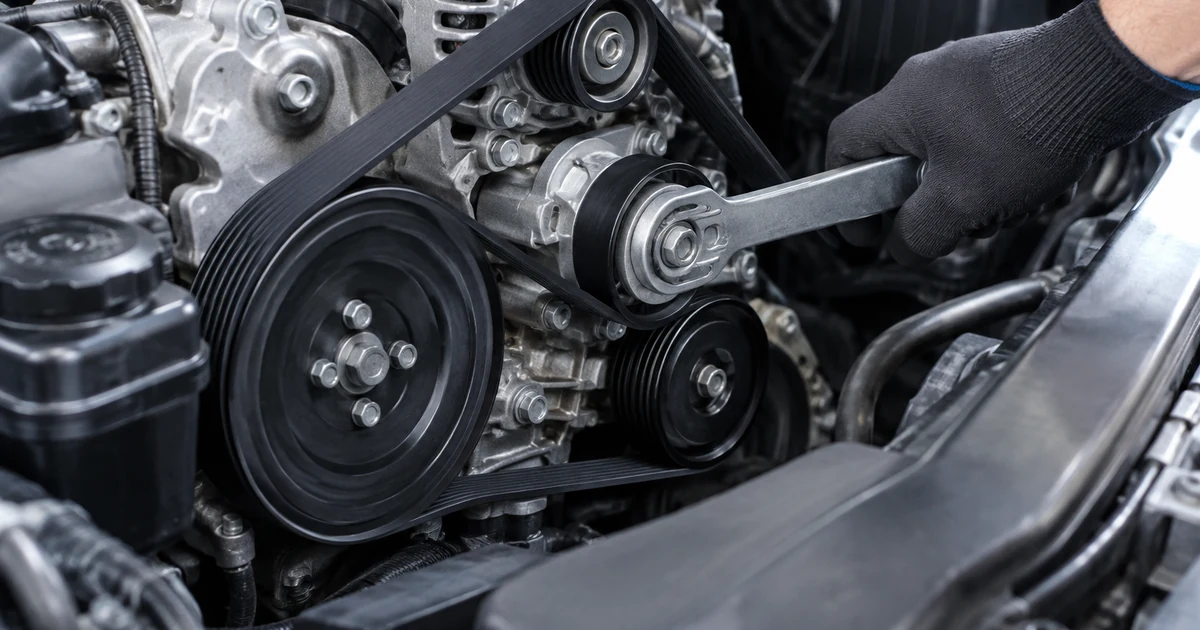
The basic steps are simple: note the routing, rotate the tensioner with the tool to take the tension off, slip the belt off one smooth pulley, and remove it. Before installing the new belt, spin each pulley by hand. It should turn smoothly and quietly with no wobble. Then route the new belt, release the tensioner slowly, and check that every rib sits in its groove. Start the engine and watch the belt for a minute.
If the belt is buried behind a mount or wheel liner, the shop labor may be worth paying.
Is It Worth Fixing?
Almost always. A serpentine belt is cheap, and a broken one can strand you or overheat the engine. Even on an old, low-value car, a $150 belt is worth it to keep the charging and cooling systems working. The only time to think twice is if the belt keeps failing because of a larger problem, such as a seized pulley or failing alternator, where you should budget for that part too.
How to Save Money on a Serpentine Belt Replacement
- Do it yourself if the belt is easy to reach. It is a good first repair to learn.
- Buy the belt yourself and ask a local shop to install it, if they allow customer parts.
- Replace the tensioner only if needed. Ask the shop to show you the wobble, noise or weak spring.
- Bundle it with other belt-driven work, such as a water pump replacement or an alternator.
- Replace the accessory belts during a timing belt job, when they have to come off anyway. See our timing belt replacement cost guide.
- Compare two quotes. Prices for this job vary a lot between shops.
Frequently Asked Questions
How much does it cost to replace a serpentine belt?
Most drivers pay $100 to $250 at a shop, and about $160 is typical. The belt itself usually costs $20 to $90. Labor is typically under an hour.
How much does a serpentine belt and tensioner replacement cost?
Replacing the belt and tensioner together usually costs $280 to $480 at an independent shop. Dealers can charge more. Adding an idler pulley brings the total to roughly $380 to $620.
How often should a serpentine belt be replaced?
Many belts last 50,000 to 100,000 miles. A common guideline is to inspect it around 60,000 miles and replace it by about 90,000 miles. Replace it sooner if you see cracks, fraying or glazing.
What happens if the serpentine belt breaks while driving?
The alternator stops charging, and on many engines the water pump stops too. Your battery light will come on, steering may get heavy, and the engine can overheat quickly. Pull over safely and have the car towed or repaired.
Can I replace a serpentine belt myself?
Yes, on most vehicles it is a beginner-to-intermediate job that takes 15 to 60 minutes. You need a belt tool or breaker bar and the routing diagram. Tight V6 engine bays can be harder.
Is the serpentine belt the same as the timing belt?
No. The serpentine belt is outside the engine and drives accessories like the alternator and A/C. The timing belt is behind a cover and keeps the engine’s valves and pistons in sync. A timing belt job costs several times more.