What the P0128 Code Means
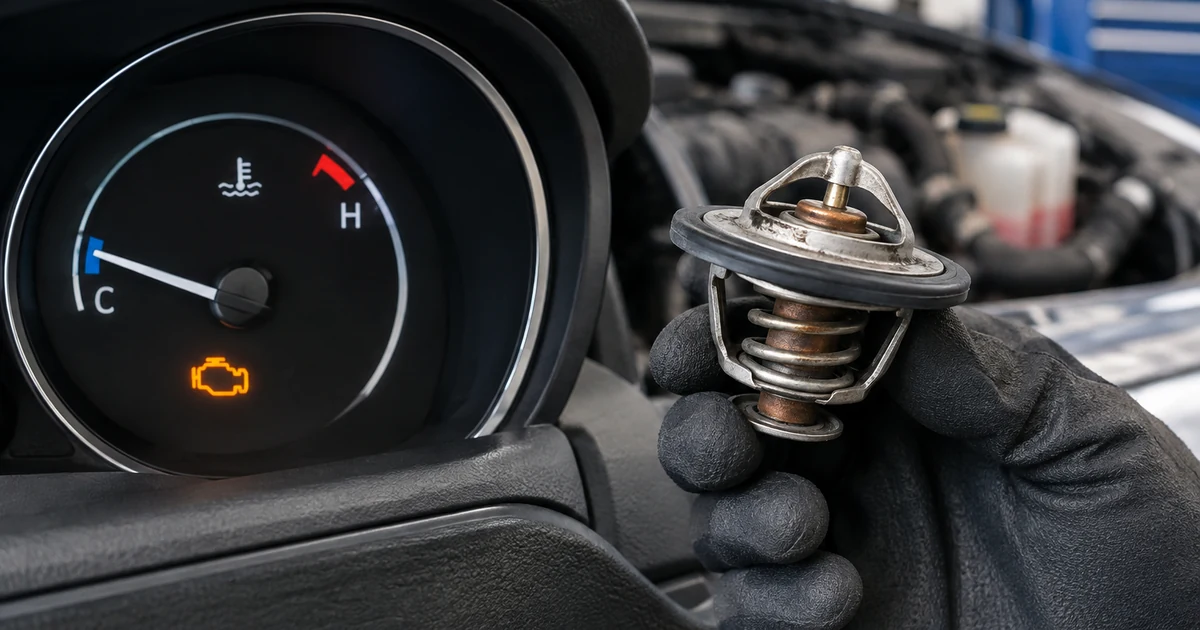
P0128 stands for “Coolant Thermostat (Coolant Temperature Below Thermostat Regulating Temperature).” In plain terms, your engine isn’t warming up to normal operating temperature as fast as the engine computer expects.
After a cold start, the thermostat stays closed so coolant stays in the engine and heats up quickly. Once it reaches the thermostat’s opening point, it opens and lets coolant flow to the radiator. Most modern engines run at roughly 195–220°F. The computer uses the coolant temperature sensor, outside air temperature and how long the engine has run to predict when that point should be reached. If the coolant stays too cool for too long, it sets P0128.
CarParts.com notes it’s typically a two-trip fault: the computer sees the problem once, then sets the code and turns on the light if it happens again on a later drive. That’s why the light may appear a day or two after the problem starts.
Common Causes of P0128
| Cause | Likelihood | Typical repair cost |
|---|---|---|
| Thermostat stuck open or opening too early | Most common | $200 – $700 |
| Faulty coolant temperature sensor, wiring or connector | Common | $150 – $550 |
| Low coolant or air trapped in the system | Occasional | $50 – $150 (plus any leak repair) |
| Cooling fan running all the time (relay, sensor or fan control) | Occasional | $100 – $750 |
| Faulty intake air temperature sensor | Rare | $100 – $250 |
| Engine computer software or fault | Rare | Varies; get a second opinion first |
YourMechanic estimates that the thermostat is behind most P0128 codes, with roughly 1 in 10 cases caused by the coolant temperature sensor instead. FIXD and CarParts.com add low coolant, a cooling fan stuck on and, rarely, the intake air temperature sensor or engine computer.
Symptoms of P0128
- Check engine light on
- Temperature gauge reads lower than usual or takes a long time to climb
- Weak or lukewarm heat from the vents, especially in winter
- Lower fuel economy (a cold engine runs a richer fuel mixture)
- Gauge drops while cruising on the highway, then rises in town
The code shows up more often in cold weather, because a stuck-open thermostat lets the radiator overcool the engine when outside air is cold.
Is It Safe to Drive With P0128?
Usually yes. FIXD says it’s acceptable to keep driving for a week or two, but not to put off the repair. P0128 means the engine runs too cold, not too hot, so there’s no immediate risk of overheating damage.
Ignoring it for months has real costs. YourMechanic and CarParts.com point out that an engine that never fully warms up can collect moisture in the oil and build sludge over time. You also burn more fuel, may fail an emissions test, and in winter you may not get enough heat to keep the windshield clear, which is a safety issue on its own.
Stop driving if the temperature gauge ever climbs toward hot, coolant is leaking, or the engine stalls or hesitates. Those point to a different, more urgent cooling problem.
How to Diagnose P0128
An OBD2 scanner with live data makes this code easy to narrow down, because you can watch the coolant temperature reading as the engine warms up.
- Check the coolant level with the engine cold. Low coolant can fool the sensor and the thermostat. Look for leaks if it’s low.
- Read all codes and freeze-frame data. Other coolant sensor codes (P0115–P0119) point to the sensor or its wiring rather than the thermostat.
- Watch coolant temperature on live data from a cold start. It should climb steadily and settle near the normal range. A reading that stalls around 160–180°F, or drops on the highway, suggests a thermostat stuck open.
- Feel the upper radiator hose carefully as the engine warms. YourMechanic’s test: if the hose warms gradually from the start, coolant is flowing too early and the thermostat is open; if it stays cool and then gets hot suddenly, the thermostat is working.
- Compare the sensor reading to reality. An infrared thermometer aimed at the thermostat housing should roughly match the scanner reading. A big gap points to the sensor or wiring.
- Check the cooling fan. It shouldn’t run on a cold engine unless the A/C or defroster is on.
How to Fix P0128
- Top off or correct the coolant and bleed any trapped air if the level was low. Find and fix the leak that caused it.
- Repair a damaged sensor connector or wiring if the reading jumps or doesn’t match an infrared check.
- Replace the coolant temperature sensor only if testing proves it’s reading wrong.
- Replace the thermostat if it’s stuck open or opening early, the fix for most P0128 codes. Use the correct temperature rating for your engine, and replace the gasket or seal. On many modern cars, the thermostat comes as a housing assembly.
- Fix a fan that runs constantly (often a relay or control problem).
- Check for software updates or service bulletins for your model if the parts test fine.
- Clear the code and drive through several cold starts to confirm it stays off.
Cost to Fix P0128 by Cause
The cost to fix P0128 ranges from about $50 for a coolant top-off to $900 or more for a hard-to-reach or electronic thermostat. Because the thermostat is the usual cause, most drivers pay about $400 for a thermostat replacement at an independent shop.
| Repair | Parts | Labor | Total at a shop |
|---|---|---|---|
| Diagnosis | — | $100 – $180 | $100 – $180 (often credited to repair) |
| Coolant top-off and bleed | $15 – $40 | $35 – $110 | $50 – $150 |
| Coolant temperature sensor | $15 – $350 | $60 – $230 | $150 – $550 |
| Thermostat + gasket, easy access | $20 – $80 | $110 – $300 | $180 – $380 |
| Thermostat with housing assembly | $60 – $250 | $150 – $375 | $280 – $560 |
| Hard-to-reach or electronic thermostat | $100 – $400 | $250 – $550 | $450 – $950 |
| Cooling fan relay or fan motor | $20 – $450 | $80 – $300 | $100 – $750 |
For comparison, RepairPal’s national average for a thermostat replacement is about $616–$716, and FIXD’s P0128 cost data puts a thermostat at about $505–$545 at a shop. Those national averages mix in dealer pricing and harder-to-reach designs, so where your car lands depends mostly on how its thermostat is mounted. Coolant temperature sensor averages from RepairPal ($499–$585) and FIXD ($400–$445) are also driven mostly by parts cost, while CarParts.com notes the sensor itself can cost as little as $10 on some vehicles.
See our thermostat replacement cost guide for prices by vehicle.
What Affects the Price
Thermostat location and design
Some thermostats sit right at the end of the upper or lower radiator hose. Others are under the intake manifold, behind accessories, or built into an electronically controlled housing, which can double or triple the labor.
Vehicle type
Trucks, large SUVs and luxury or European models tend to have pricier housing assemblies and more crowded engine bays.
Coolant
Replacing a thermostat drains some coolant. Shops refill with the correct type, and some recommend a full coolant flush if the old coolant is dirty or overdue.
Related work
On engines where the thermostat sits next to the water pump, some owners replace both together on a high-mileage car to save on labor later. It isn’t required to fix P0128, so ask the shop whether the pump shows any leaks first. Our water pump replacement cost page covers that job.
DIY vs. Taking It to a Shop
On engines with an easy-to-reach thermostat, this is a 2-out-of-5 DIY job: drain some coolant, remove the housing, swap the thermostat and gasket, refill and bleed air. Plan on 1–2 hours with basic hand tools, a drain pan and the correct coolant. Electronic or buried thermostats are a 4 out of 5 and are better left to a shop. Bleeding air properly matters: trapped air can cause overheating, which is worse than P0128. Never open the cooling system on a hot engine.
Is It Worth Fixing?
Yes. P0128 fixes are usually affordable, and a thermostat stuck open costs you fuel, heat in winter and, over the long term, oil condition. Even on an older, high-mileage car, a $200–$500 thermostat job is almost always worth doing.
How to Save Money on P0128
- Check the coolant level first. It costs nothing.
- Confirm the cause with live data before buying a thermostat or sensor.
- Use an independent shop for out-of-warranty work; dealer labor rates are higher.
- Choose a quality aftermarket thermostat with the correct temperature rating on engines where OEM isn’t required.
- Do it yourself if your thermostat is easy to reach and you can bleed the system correctly.
- Bundle a coolant service with the thermostat job if your coolant is due anyway, since the system is already partly drained.
- Get a second quote if you’re told you need an engine computer; that cause is rare.
Related Codes
- P0125 — Insufficient coolant temperature for closed-loop fuel control
- P0115–P0119 — Engine coolant temperature sensor circuit faults
- P0116 — Coolant temperature sensor range or performance problem
- P0126 — Insufficient coolant temperature for stable operation
- P0480 — Cooling fan control circuit problem
Frequently Asked Questions
What does code P0128 mean?
P0128 means “Coolant Temperature Below Thermostat Regulating Temperature.” The engine computer expected the coolant to reach normal operating temperature within a certain time after a cold start, and it didn’t.
How much does it cost to fix a P0128 code?
Most P0128 repairs are a thermostat replacement, which costs about $200 to $700 at a shop, with most drivers paying around $400. A coolant temperature sensor runs about $150 to $550, and a simple coolant top-off can be $50 to $150.
Can I drive with a P0128 code?
Usually yes, for a week or two. The engine runs cold rather than hot, so there’s no immediate overheating risk. Get it fixed soon, because it hurts fuel economy, cabin heat and, over time, oil condition.
Can low coolant cause P0128?
Yes. Low coolant or air trapped in the system can keep the sensor from reading the true temperature. Always check the level with the engine cold before replacing parts.
Is P0128 always the thermostat?
No, but usually. YourMechanic estimates roughly 1 in 10 cases come from the coolant temperature sensor or its wiring. A fan that runs constantly or low coolant can also cause it.
Why does P0128 show up more in winter?
A thermostat that’s stuck partly open lets cold outside air overcool the engine through the radiator. In warm weather the engine may still reach temperature, so the code often appears when temperatures drop.
- Edmunds — P0128: Coolant thermostat (coolant temperature below thermostat regulating temperature)
- YourMechanic — P0128 OBD-II trouble code
- FIXD — P0128 engine code
- CarParts.com — P0128 coolant temperature below thermostat regulating temperature
- RepairPal — Thermostat replacement cost estimate
- RepairPal — Engine coolant temperature sensor replacement cost