Heater Core Replacement Cost by Vehicle
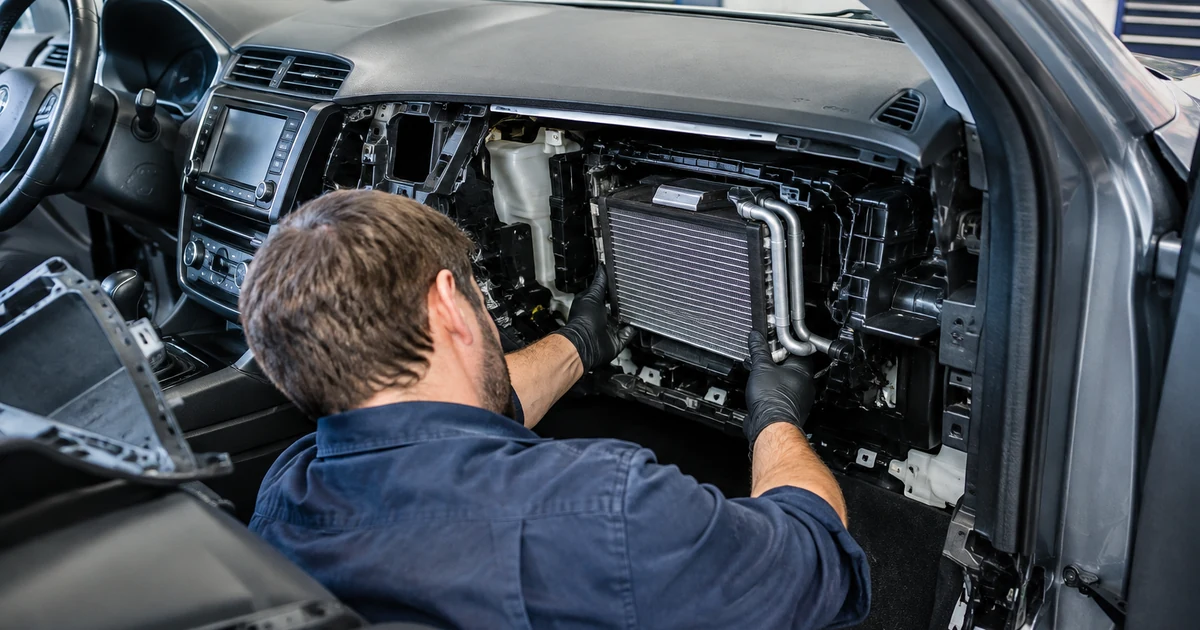
The heater core itself is a small radiator that often costs a few hundred dollars. The bill is high because, on most modern cars, it sits deep inside the HVAC box behind the dashboard. How much of the dash has to come out decides most of the price.
| Vehicle (common years/engine) | Parts | Labor | Total |
|---|---|---|---|
| Toyota Corolla | $150 – $400 | $650 – $1,100 | $800 – $1,500 |
| Honda Civic | $150 – $400 | $700 – $1,150 | $850 – $1,550 |
| Toyota Camry | $200 – $450 | $800 – $1,300 | $1,000 – $1,750 |
| Honda Accord | $200 – $450 | $800 – $1,300 | $1,000 – $1,750 |
| Honda CR-V | $200 – $450 | $750 – $1,250 | $950 – $1,700 |
| Toyota RAV4 | $200 – $450 | $750 – $1,250 | $950 – $1,700 |
| Nissan Altima | $200 – $450 | $750 – $1,250 | $950 – $1,700 |
| Chevy Equinox | $200 – $500 | $800 – $1,300 | $1,000 – $1,800 |
| Jeep Wrangler / Grand Cherokee | $200 – $500 | $850 – $1,400 | $1,050 – $1,900 |
| Ford F-150 | $250 – $550 | $900 – $1,450 | $1,150 – $2,000 |
| Chevy Silverado 1500 | $250 – $550 | $900 – $1,450 | $1,150 – $2,000 |
| BMW 3 Series | $300 – $700 | $1,000 – $1,700 | $1,300 – $2,400 |
These are estimates for common model years and engines, including coolant. Labor hours vary a lot between generations of the same model, so ask for the book time on your exact vehicle.
Cost Breakdown: Parts vs. Labor
AutoZone puts most heater core replacements at $800 to $1,500, with passenger cars at $800 to $1,000, trucks and SUVs at $1,000 to $1,200 and luxury cars at $1,200 to $1,500 or more. RepairPal’s national average is higher, about $1,375 to $1,912, with $886 to $1,300 of that in labor. RepairPal lists about $1,530 to $2,020 for an F-150 and $1,230 to $2,020 for a Camry. For a typical car or SUV at an independent shop, about $1,300 is a realistic middle.
Parts
- Heater core: about $100 to $400 for most vehicles, sometimes more for OEM or luxury parts.
- Coolant: $30 to $80 to refill the system.
- Seals, O-rings and clips: small but important, often $20 to $60.
- OEM vs. aftermarket: aftermarket heater cores are cheaper and fine for most popular models. OEM cores cost more but fit exactly, which matters when so much labor is at stake.
Labor: why the dashboard has to come out
Labor is usually 60% to 80% of the bill. AutoZone notes mechanics typically need 4 to 10 hours. On many cars the technician must disconnect airbags, remove the steering column, instrument cluster, center console and dashboard, then open the HVAC box. At $110 to $150 per hour at an independent shop, that is roughly $600 to $1,400 in labor. A few older trucks and some cars allow access from under the dash or the engine bay, which can cut the time in half.
| Where | Typical total | Notes |
|---|---|---|
| Independent shop | $950 – $1,750 | Aftermarket or OEM core, $110–$150/hr |
| Dealer | $1,250 – $2,300 | OEM core, $150–$220/hr |
| DIY | $150 – $500 | Core, coolant, seals; 6–12+ hours of work |
What Affects Heater Core Replacement Cost
Vehicle design and dashboard removal
This is the biggest factor by far. If the core is behind the full dashboard, labor can reach 8 to 10 hours or more. Designs with a service panel under the dash take far less time.
Vehicle type
Trucks and large SUVs often have bigger HVAC boxes and more trim to remove. Luxury cars with dual-zone or rear climate systems, heavy wiring and many sensors add time and risk.
Part quality
The part is a smaller share of the bill here, so choosing OEM adds less in percentage terms than it does on other repairs.
Shop type and region
Because labor is so large, the hourly rate matters a lot. A dealer at $180 per hour versus an independent shop at $120 can mean a difference of several hundred dollars on the same job.
Related parts replaced at the same time
Heater hoses, blend-door actuators and the cabin air filter are cheap to replace while everything is apart. AutoZone suggests budgeting about $50 to $200 for this kind of preventive work. If the old core failed from dirty coolant, a coolant flush helps protect the new one.
Symptoms of a Bad Heater Core
- Sweet coolant smell inside the cabin
- Foggy windows with a greasy film that is hard to wipe off
- Wet or damp carpet on the passenger-side floor
- Little or no heat from the vents, often from a clogged core
- Coolant loss with no visible leak under the car
- Engine running hot when coolant is escaping inside the car
No heat does not always mean a bad heater core. Low coolant, a stuck-open thermostat, air in the system or a broken blend-door actuator can all cause it, and those fixes are far cheaper. A good shop checks them first.
Can You Drive With a Bad Heater Core?
A clogged core that just gives weak heat is mostly a comfort and defrost problem. A leaking core is more serious. Coolant vapor fogs the windshield and can make it hard to see, the fumes are unpleasant to breathe, and coolant loss can lead to overheating. If the temperature gauge climbs, stop driving. Overheating can damage the head gasket and turn a $1,300 repair into a much bigger one. Poor defrosting in winter is also a real safety issue.
Heater core bypass as a temporary fix
A shop can connect the two heater hoses to each other so coolant skips the leaking core. AutoNation Mobile Service puts this at about $100 to $300. It stops the leak and keeps the engine cooled, but you will have no cabin heat and weak defrost. It is a stopgap in warm weather, not a long-term fix where you need defrost to see.
DIY vs. Taking It to a Shop
Difficulty: 4 to 5 out of 5 on most modern cars.
- Time: AutoZone suggests setting aside 6 to 12 hours and possibly spreading the work over a few days.
- Tools: full socket and Torx sets, trim tools, drain pan, the correct coolant and a way to bleed air from the system.
- Savings: about $150 to $500 in parts versus $950 to $1,750 at a shop.
- Watch out for: airbag handling, broken trim clips, pinched wiring and lost bolts. On some cars the A/C system must be discharged and recharged by a certified shop.
This is not a first DIY project. If your car does not have a service panel for the heater core, most owners are better off paying for the labor.
Is It Worth Fixing?
On a car you plan to keep, usually yes. Working heat and defrost matter for safety, and a leaking core can cause overheating. On an older car worth only a couple of thousand dollars, a $1,300 to $1,800 repair is a tougher call. In a warm climate, some owners live with a bypass for a while. In a cold climate, defrost is essential, so fixing it properly or replacing the car are the realistic options.
How to Save Money on a Heater Core Replacement
- Confirm the diagnosis. Rule out low coolant, air in the system, the thermostat and blend doors before paying for dash removal.
- Get two or three quotes and compare the labor hours, not just the total.
- Use an independent shop. With this much labor, the hourly rate difference adds up fast.
- Choose a quality aftermarket core for common models to trim the parts cost.
- Bundle cheap parts like heater hoses and actuators while the dash is out.
- Check warranties and service bulletins. Some models have known heater core issues that may be covered.
- Keep the coolant fresh to protect the new core.
Frequently Asked Questions
How much does it cost to replace a heater core?
Most drivers pay $800 to $2,000 at a shop, and about $1,300 is typical. Cars with a service panel can be under $900, while trucks and luxury cars that need full dash removal often pass $2,000.
Why is heater core replacement so expensive?
The part is usually $100 to $400, but on most cars it sits inside the HVAC box behind the dashboard. Removing the dash, airbags and steering column takes 4 to 10 hours, so labor is 60% to 80% of the bill.
How long does it take to replace a heater core?
Most shops need 4 to 10 hours of labor, which often means leaving the car for one or two days. Some trucks with a service panel take only 2 to 3 hours.
Can I bypass a heater core?
Yes, as a temporary fix. A shop can connect the heater hoses together for about $100 to $300 so coolant skips the core. You will lose cabin heat and defrost, so it is not a safe long-term option in cold weather.
Can a clogged heater core be flushed instead of replaced?
Sometimes. If the core is clogged but not leaking, a heater core flush can restore heat for much less. A leaking core needs to be replaced.
Can a bad heater core cause overheating?
Yes. A leaking core lets coolant escape, and a low coolant level can make the engine overheat. Watch the gauge and stop driving if it climbs toward red.