What the P0455 Code Means
P0455 stands for “Evaporative Emission Control System Leak Detected (Large Leak).” Your EVAP system catches gasoline vapor from the fuel tank, stores it in a charcoal canister, and later sends it into the engine to be burned instead of venting it into the air. Because it’s supposed to be sealed, the engine computer tests it for leaks on its own.
During that self-test, the computer closes the vent valve, pulls the system into a slight vacuum (or pressurizes it with a pump on some models), and watches whether the reading holds. With a large leak, the system can’t build or hold vacuum at all, so the computer sets P0455. Go-Parts describes the threshold as a hole about 0.040 inch across or larger, which is why a missing or loose gas cap is the classic trigger.
P0455 is the “big leak” member of the EVAP leak family. P0442 flags a smaller leak and P0456 a very small, pinhole-size leak. The good news: a bigger leak is usually easier to find than a tiny one.
Common Causes of P0455
| Cause | Likelihood | Typical repair cost |
|---|---|---|
| Missing, loose, wrong or damaged gas cap | Most common, check first | $0 – $60 |
| Vent valve (canister vent solenoid) stuck open | Common | $150 – $450 |
| Disconnected, split or chewed EVAP hose | Common | $100 – $300 |
| Leaking or stuck purge valve | Common | $120 – $400 |
| Faulty fuel tank pressure sensor | Occasional | $180 – $400 |
| Rusted or cracked fuel filler neck | Less common | $250 – $800 |
| Cracked charcoal canister | Less common | $450 – $900 |
Go-Parts puts the gas cap behind more than half of P0455 codes, and CarParts.com also lists it as the most common cause. After the cap, the usual suspects are a vent valve stuck open, a hose that has come off its fitting, and a purge valve that no longer seals. The cost ranges match our P0456 guide, since the same parts are involved.
Symptoms of P0455
- Check engine light on, often a few days after a fill-up
- A “check fuel cap” or “loose fuel cap” message on cars that have one
- Fuel smell around the car, more noticeable than with small-leak codes
- Failed emissions or smog inspection
- Rarely, a slight drop in fuel economy or rough running after refueling if a purge valve is stuck open
For most drivers the car feels completely normal. That’s expected: P0455 is an emissions fault, not an engine-performance fault.
Is It Safe to Drive With P0455?
Usually, yes. CarParts.com describes the code as not immediately dangerous, and it doesn’t affect your brakes, steering or engine power. Plan to fix it within a few weeks, and sooner if an inspection is due.
Take these situations seriously:
- A strong raw-gas smell, dripping fuel or a wet spot under the tank means liquid fuel is leaking, not just vapor. That’s a fire risk. Don’t drive the car, and have it inspected.
- The gas cap is missing. Get a replacement right away. An open filler lets vapor escape and lets dirt and water into the fuel system.
- The check engine light starts flashing or the car runs rough. That points to a different, more serious problem, so scan for new codes.
Also remember that a lit check engine light can hide new trouble. While P0455 keeps the light on, you won’t notice if another code sets.
How to Diagnose P0455
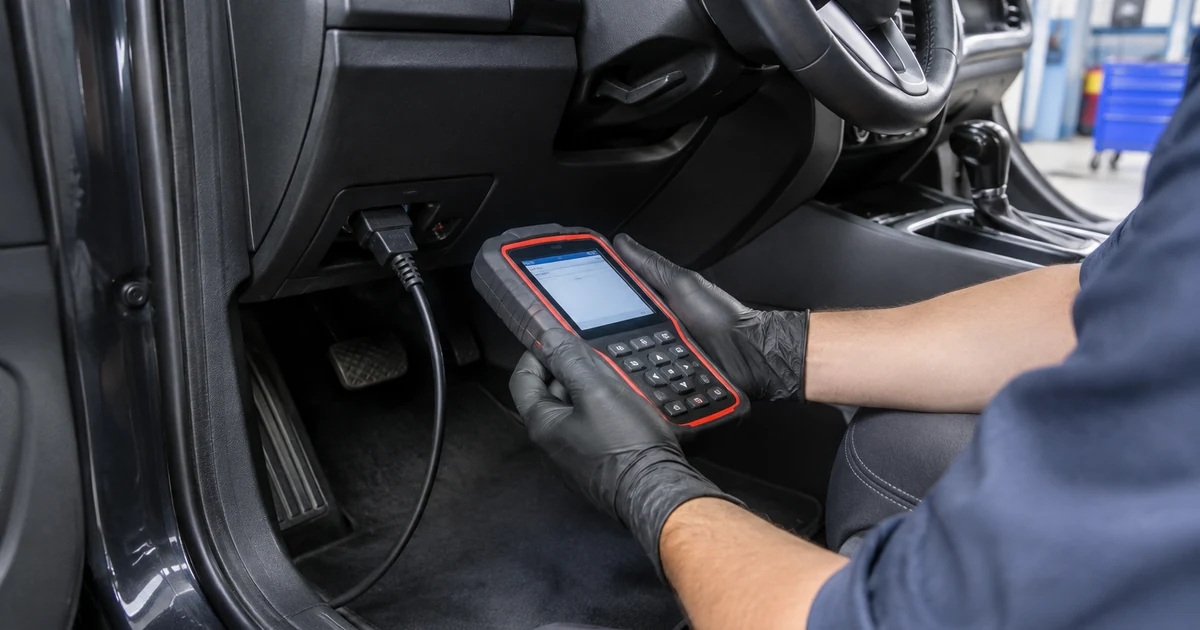
An OBD2 scanner is the first tool. It confirms P0455, shows whether related codes are stored (such as P0446 for a vent valve circuit or P0441 for purge flow), and tells you if the EVAP readiness monitor has completed.
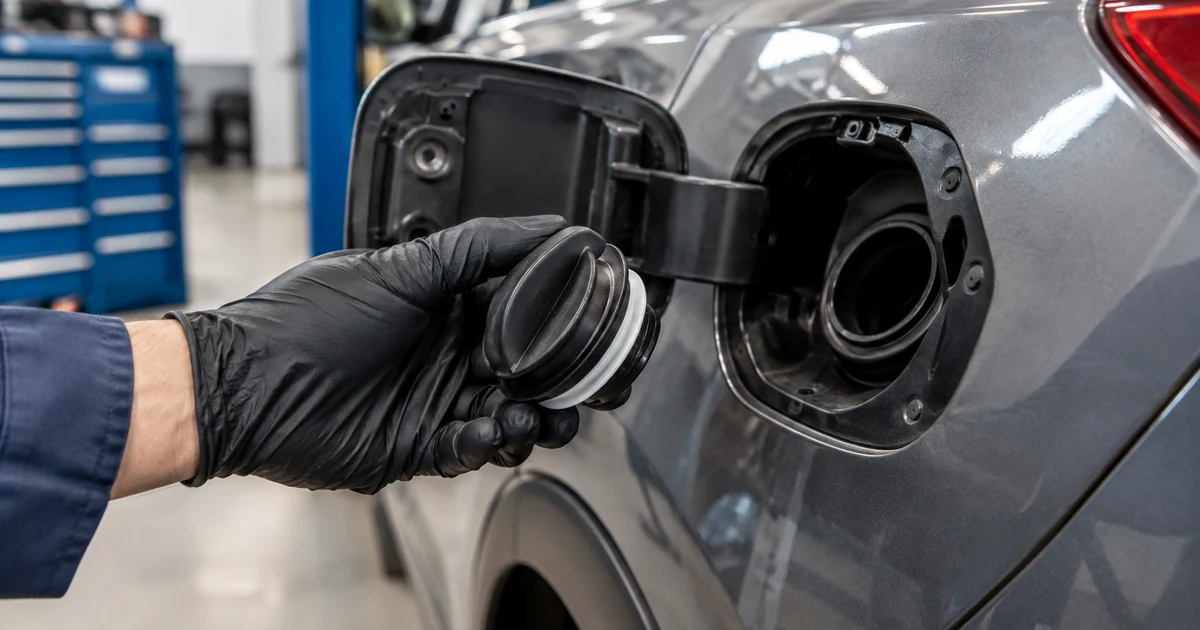
- Inspect the gas cap. Check that it’s there, it clicks when tightened, the rubber seal isn’t torn or flattened, and it’s the correct cap for your vehicle. On capless fillers, look for dirt or debris holding the flap open.
- Look at the filler neck. Rust around the opening, especially on older vehicles in salt-belt states, can stop any cap from sealing.
- Check the visible hoses. Follow the EVAP lines from the engine bay to the canister near the tank. Look for hoses knocked loose during other repairs, cracked connectors, or lines chewed by rodents.
- Test the vent and purge valves. A scan tool with bidirectional controls can command each valve, and a hand vacuum pump shows whether a closed valve holds vacuum. A vent valve stuck open is a frequent P0455 cause.
- Smoke test. If nothing obvious turns up, a shop fills the system with low-pressure visible smoke and watches where it escapes. CarParts.com and OBD Guides both point to smoke testing as the professional way to locate EVAP leaks.
Expect to pay about $80 to $150 for a smoke test with the scan, and ask whether the fee is credited toward the repair.
How to Fix P0455
Work from free and cheap to expensive:
- Tighten or reinstall the gas cap until it clicks. Then drive normally for several days. The code often clears once the EVAP test passes a few times.
- Replace the gas cap if the seal is worn, the ratchet doesn’t click, or the cap isn’t the right one. An OE-fit cap is a small investment and solves many P0455 codes.
- Reconnect or replace any loose or cracked hose. A hose that popped off during other work is a common surprise.
- Replace the failed valve: the vent valve if it’s stuck open, or the purge valve if it leaks.
- Repair bigger components only when testing confirms them: the fuel tank pressure sensor, filler neck or charcoal canister.
- Clear the code and confirm the monitor runs. The EVAP monitor often needs a cold start after the car sits overnight and a fuel level between about a quarter and three-quarters of a tank, so it can take several days to show “ready.”
Cost to Fix P0455 by Cause
The cost to fix P0455 runs from nothing for a loose cap to about $900 for a charcoal canister. When the cap isn’t the answer and a shop does the work, most drivers pay about $285, typically for a vent or purge valve, plus $80 to $150 for the smoke test if it isn’t credited.
| Repair | Parts | Labor | Total at a shop |
|---|---|---|---|
| Gas cap | $20 – $60 | — | $20 – $60 (usually DIY) |
| Smoke test / EVAP diagnosis | — | $80 – $150 | $80 – $150 |
| EVAP hose or line | $30 – $70 | $70 – $230 | $100 – $300 |
| Purge valve | $40 – $150 | $80 – $250 | $120 – $400 |
| Vent valve | $40 – $150 | $100 – $300 | $150 – $450 |
| Fuel tank pressure sensor | $40 – $150 | $140 – $250 | $180 – $400 |
| Filler neck | $60 – $300 | $190 – $500 | $250 – $800 |
| Charcoal canister | $150 – $500 | $150 – $400 | $450 – $900 |
Published repair guides land in the same range. ServiceSage lists $100 to $300 at a shop for a vent or purge valve and $250 to $600 for a canister assembly, and Go-Parts estimates $140 to $400 for a vent valve and $180 to $400 for a fuel tank pressure sensor. Canisters can cost more on some models: RepairPal’s estimates for a Toyota Camry canister range from about $340 to well over $1,000 depending on model year.
Before paying, check your warranty. Federal rules cover many emissions parts on newer vehicles for 2 years or 24,000 miles, and some for longer.
What Affects the Price
Where the leak is
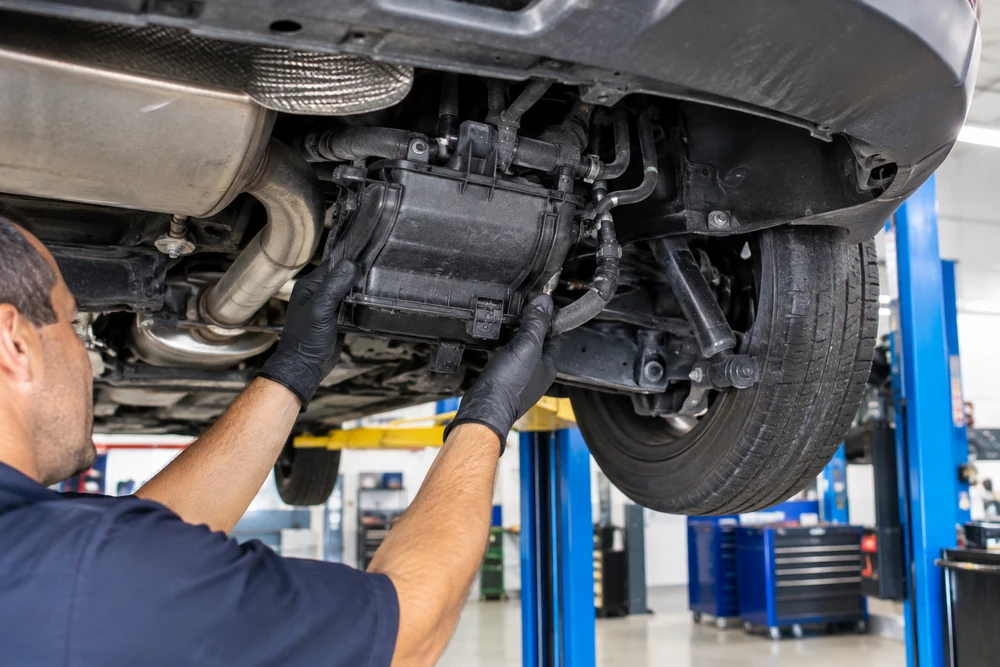
A purge valve or hose in the engine bay is often a short job. Vent valves, canisters, pressure sensors and filler necks sit under the car near the fuel tank. Some require removing a heat shield or lowering the tank, which adds labor hours.
Vehicle type
Pickups and large SUVs have long EVAP lines and bigger canisters. Luxury and European models generally have more expensive parts and higher labor rates at specialist shops.
Part quality
Aftermarket gas caps and valves work well on most cars and cost less. For a canister or vent valve on a newer car, an OEM part may seal and communicate with the computer more reliably.
Shop type and region
Dealers charge more per hour but have factory EVAP test procedures. A good independent shop with a smoke machine is usually the best value out of warranty. Labor rates run highest in the Northeast and on the West Coast.
DIY vs. Taking It to a Shop
A gas cap is a 1 out of 5 job that takes a minute. Reconnecting a loose hose or swapping an engine-bay purge valve is about 2 out of 5 with basic hand tools. Vent valves, canisters and filler necks are 3 out of 5 because you’ll be working under the vehicle near the fuel tank, which needs safe jack stands and care around fuel lines.
Large leaks are friendlier to DIY than small ones, because they’re more often visible: a missing cap, a hose hanging loose, a rusted filler opening. If a careful look turns up nothing, a shop smoke test is usually cheaper than replacing parts by guesswork.
Is It Worth Fixing?
Yes, in almost every case. Most P0455 repairs cost less than a typical brake job, and in emissions-testing states you can’t pass inspection until the leak is fixed and the monitor is ready. Fixing it also frees your check engine light to warn you about the next real problem. Even on an older, high-mileage car, a cap or valve repair makes sense; a $900 canister on a car worth very little is the only case where some owners in non-testing states decide to wait.
How to Save Money on P0455
- Check the cap first, and give the car a few days of driving after tightening or replacing it.
- Buy an OE-fit cap, not the cheapest universal one, so it seals properly.
- Look for loose hoses if the code appeared after recent repair work.
- Pay for a smoke test before parts if the cap isn’t the cause. Guessing at a canister costs more than finding the leak.
- Ask if diagnosis is credited toward the repair.
- Check the emissions warranty on newer vehicles.
- Bundle under-car work. If the fuel tank has to come down for a fuel pump replacement, have EVAP parts near the tank checked at the same time.
Related Codes
- P0456 — EVAP very small leak detected; see our P0456 guide
- P0442 — EVAP small leak detected
- P0457 — EVAP leak detected, fuel cap loose or off (used by some manufacturers)
- P0446 — EVAP vent control circuit problem
- P0441 — EVAP incorrect purge flow
- P0171 / P0174 — System too lean; a purge valve stuck open can contribute. See our P0171 guide.
Frequently Asked Questions
What does code P0455 mean?
P0455 means “Evaporative Emission Control System Leak Detected (Large Leak).” The engine computer sealed the fuel vapor system for a self-test and couldn’t build or hold vacuum, which points to a sizable opening such as a missing cap or a disconnected hose.
Is P0455 always the gas cap?
No, but the cap is the most common cause and the cheapest fix, so check it first. If a good, correctly tightened cap doesn’t clear the code after several days of driving, the next suspects are a stuck-open vent valve, a loose EVAP hose or a leaking purge valve.
How much does it cost to fix a P0455 code?
A gas cap costs $20 to $60. At a shop, an EVAP hose runs about $100 to $300, a purge or vent valve $120 to $450, a fuel tank pressure sensor $180 to $400 and a charcoal canister $450 to $900. A smoke test usually adds $80 to $150.
Can I drive with a P0455 code?
Yes, in most cases. The code doesn’t affect how the engine runs, but you’ll fail an emissions test in states that check stored codes. If you smell strong raw fuel or see fuel dripping, stop driving and get it inspected because that’s a fire risk.
How long does it take for P0455 to clear after replacing the gas cap?
Usually several days of normal driving. The EVAP self-test only runs under specific conditions, often after the car sits overnight with a partly full tank. You can clear the code with a scanner, but the EVAP readiness monitor still needs to complete before an inspection.
What is the difference between P0455, P0442 and P0456?
They’re the same type of fault at different sizes. P0455 is a large leak, P0442 a small leak and P0456 a very small leak. Larger leaks are often easier to find, while the smallest ones usually require a smoke test.
- CarParts.com — P0455 code: EVAP system large leak detected
- Go-Parts — OBD-II code P0455: EVAP system leak detected (large leak)
- ServiceSage — P0455 code: EVAP large leak detected, causes and fix cost
- OBD Guides — P0455: EVAP large leak detected
- RepairPal — Toyota Camry fuel evaporative canister replacement cost