Alternator Replacement Cost by Vehicle
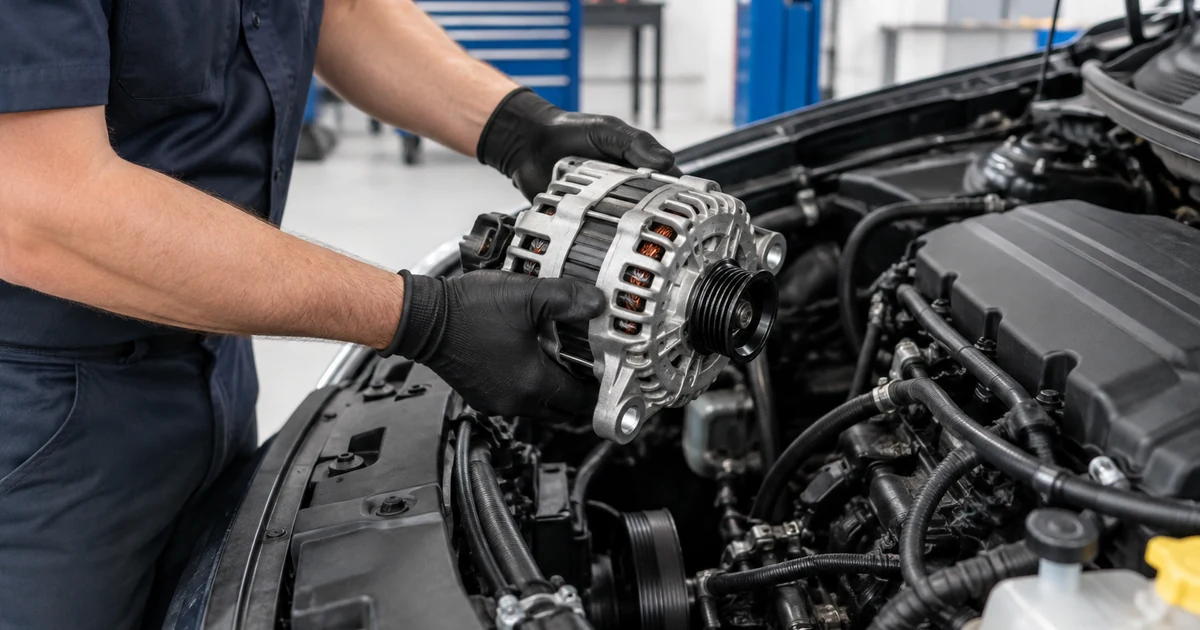
How easy the alternator is to reach matters more than the part itself. On many four-cylinder cars it sits near the top of the engine and comes out in about an hour. On some trucks, SUVs and European models it hides low in the engine bay or behind other components, and labor doubles.
| Vehicle | Parts | Labor | Total at a shop |
|---|---|---|---|
| Ford F-150 | $300 – $650 | $200 – $450 | $500 – $1,100 |
| Chevrolet Silverado 1500 | $250 – $550 | $120 – $300 | $370 – $850 |
| Ram 1500 | $250 – $600 | $150 – $400 | $400 – $1,000 |
| Toyota Camry | $200 – $500 | $150 – $350 | $350 – $850 |
| Toyota RAV4 | $200 – $500 | $150 – $350 | $350 – $850 |
| Honda Civic | $180 – $450 | $120 – $300 | $300 – $750 |
| Honda Accord | $180 – $500 | $150 – $350 | $330 – $850 |
| Honda CR-V | $200 – $500 | $150 – $350 | $350 – $850 |
| Nissan Altima | $180 – $450 | $150 – $350 | $330 – $800 |
| Chevrolet Equinox | $200 – $500 | $150 – $400 | $350 – $900 |
| Jeep Grand Cherokee | $250 – $600 | $200 – $500 | $450 – $1,100 |
| BMW 3 Series | $400 – $900 | $250 – $600 | $650 – $1,500 |
These are estimates for common model years and engines at independent shops. Newer trucks with high-output units and luxury models land at the top of each range, and dealer pricing can run 25–40% higher.
Fully electric cars such as the Tesla Model 3 don’t have an alternator at all. A DC-DC converter charges the 12-volt battery from the main pack instead, so this repair doesn’t apply to them.
Cost Breakdown: Parts vs. Labor
An alternator job is roughly half parts, half labor on an easy car, and tilts toward labor when access is tight.
The alternator itself
- Remanufactured: about $120–$250 for most cars. This is what most shops and parts stores sell by default. A reman unit is your old style of alternator rebuilt with new bearings, brushes, regulator and diodes.
- New aftermarket: about $150–$350, depending on amperage and brand.
- OEM (dealer): about $350–$500 for mainstream brands and $700 or more for BMW, Mercedes and similar models.
Expect a refundable core charge when you buy the part yourself. You get it back when you return the old alternator.
Labor
Book time is usually 1 to 3 hours. At independent-shop rates of roughly $110–$150 an hour, that’s about $120–$450. Dealers bill closer to $150–$220 an hour. Jobs that require removing the intake, an axle, or working from underneath can hit 3–4 hours.
| Where you go | Typical total | What you get |
|---|---|---|
| Dealer | $700 – $1,300 | OEM part, highest labor rate, factory-trained techs |
| Independent shop | $400 – $1,000 | Reman or new aftermarket part, lower labor rate |
| DIY | $150 – $400 | Part only (plus core charge), your time and basic tools |
What Affects the Price
Vehicle and engine layout
A top-mounted alternator on a four-cylinder is a quick swap. A low-mounted unit on a V6 or V8, or one tucked behind the power steering pump or AC compressor, takes much longer. Some vehicles also use water-cooled or very high-output alternators, which cost more on their own.
Amperage and part quality
Trucks, police-package vehicles and cars with lots of electronics often need higher-amperage units. Bigger output means a pricier part. Cheap no-name alternators can fail early, so warranty length is a useful quality signal.
Shop type and region
Dealer labor rates can be $50–$70 an hour higher than an independent’s. Shops in the Northeast and on the West Coast also charge more than those in the South and Midwest. Use the region setting in the estimator above to see the difference.
Diagnosis and extra electrical work
Some shops charge a diagnostic fee, often around $50–$150, to confirm the charging problem. Many credit it toward the repair if you let them do the work. If the real issue is a corroded battery cable, a bad ground strap or a blown fusible link, the fix can cost less than an alternator, which is why testing first matters.
A few newer vehicles also need the battery management system reset or a scan-tool procedure after an electrical repair. That adds a small amount of labor but is worth doing so the new alternator charges correctly.
Parts replaced at the same time
The serpentine belt must come off to swap the alternator, so replacing a worn belt now adds little labor. See our serpentine belt replacement cost guide. A battery that was drained flat by a dying alternator may also need replacing.
Symptoms of a Bad Alternator
- Battery or charging warning light (sometimes shown as “ALT” or “GEN”)
- Dim or flickering headlights and dash lights, especially at idle
- A car that dies while driving, or needs a jump start again and again
- Whining or grinding noise from the front of the engine (worn bearing)
- Burning rubber or hot electrical smell
- Slow power windows, weak blower fan or radio cutting out
A dead battery is often blamed on the alternator and vice versa. Most parts stores will test both for free. A healthy charging system typically shows roughly 13.5–14.5 volts at the battery with the engine running.
Can You Drive With a Bad Alternator?
Only briefly. Once the alternator stops charging, the car runs on battery power alone. Depending on the battery’s health and what’s switched on, that may last minutes or maybe an hour before the engine stalls.
A stall can happen anywhere, including on a highway, and you may lose power steering assist on some vehicles. If the charging light comes on, turn off the AC, heated seats and radio, and drive straight to a shop or home. Don’t start a long trip. If the belt has snapped and it also drives the water pump, stop driving to avoid overheating.
DIY vs. Taking It to a Shop
Difficulty: 2–4 out of 5. On many cars with a top-mounted alternator, this is a reasonable DIY job for someone who has done basic maintenance. You’ll need a socket set, a serpentine belt tool or long breaker bar, and a belt routing diagram. Always disconnect the negative battery cable first.
The basic steps: disconnect the battery, release belt tension and slip the belt off, unplug the electrical connectors, remove the mounting bolts, swap in the new unit, reinstall the belt and reconnect everything. Then check for about 13.5–14.5 volts at the battery with the engine running.
Expect 1–3 hours your first time. Skip DIY if the alternator is buried under the intake, requires removing an axle or suspension parts, or if your vehicle needs a module reset after replacement. Also skip it if you haven’t confirmed the diagnosis: a bad battery, corroded cable or loose ground can mimic a failed alternator.
Is It Worth Fixing?
Almost always. An alternator is a mid-priced repair that can keep a car going for another 100,000 miles or more, and the car won’t run long without one. Even on an older car worth $2,000–$3,000, spending $400–$800 usually makes sense if the engine and transmission are healthy.
The math changes only when the car has other big problems stacking up, like a failing transmission or major rust. In that case, get the full list of needed repairs before putting money into any single one.
How to Save Money on Alternator Replacement
- Confirm the diagnosis first. Get a free charging-system test at a parts store before paying for a new alternator.
- Choose a remanufactured unit. A quality reman with a good warranty costs far less than OEM and is what most shops install anyway.
- Use an independent shop. Labor rates are typically lower than at a dealer.
- Check your warranty. Powertrain warranties usually don’t cover alternators, but bumper-to-bumper and some extended warranties do.
- Return the core. If you buy the part, the core refund is real money.
- Bundle the belt. If the serpentine belt is original or cracked, replace it while it’s already off.
- Get a second quote for anything over about $800 on a mainstream car.
If the car cranks slowly or just clicks but the charging system tests fine, the starter may be the real culprit.
Frequently Asked Questions
How much does it cost to replace an alternator?
Most drivers pay $400 to $1,000 at a shop, with about $650 being typical. Luxury and European models often run $1,000 to $1,500. Doing it yourself costs roughly $150 to $400 for the part.
How long does it take to replace an alternator?
Most alternator replacements take 1 to 3 hours of shop time. Easy-access four-cylinder cars can be done in about an hour, while vehicles where the alternator is mounted low or behind other parts can take 3 to 4 hours.
Is a remanufactured alternator as good as a new one?
A quality remanufactured alternator is rebuilt with new wear parts and tested, and it’s what most shops install by default. Quality varies by rebuilder, so choose one with a solid warranty. OEM units cost more but are sometimes preferred on newer or high-end vehicles.
How long do alternators last?
Many alternators last well over 100,000 miles, often matching or exceeding a car’s first battery or two. Heat, heavy electrical loads, oil or coolant leaks onto the unit, and a failing battery can shorten its life.
How do I know if it's the alternator or the battery?
If the car won’t start but runs fine after a jump and keeps running, the battery is the usual suspect. If it dies again while driving, or the battery light is on, suspect the alternator. Most parts stores will test both for free in a few minutes.
Can a bad alternator ruin a new battery?
Yes. An alternator that undercharges leaves the battery repeatedly drained, which shortens its life, and one that overcharges can damage it too. That’s why it’s smart to fix the charging problem before or along with replacing the battery.
Does car insurance or warranty cover alternator replacement?
Standard car insurance doesn’t cover normal wear like a failed alternator. A new car’s bumper-to-bumper warranty usually does, and some extended warranties or mechanical breakdown policies also cover it, while basic powertrain warranties typically don’t.