Car Battery Replacement Cost by Vehicle
Most gas cars use a standard flooded battery that any parts store can install in minutes. Vehicles with start-stop systems, heavy electronics or batteries hidden under a seat or in the trunk cost more, both for the battery and the labor.
| Vehicle | Common battery type | Battery | Labor | Total at a shop |
|---|---|---|---|---|
| Ford F-150 | Flooded or AGM (start-stop) | $150 – $320 | $30 – $100 | $180 – $420 |
| Chevrolet Silverado 1500 | Flooded or AGM (start-stop) | $170 – $330 | $30 – $120 | $200 – $450 |
| Toyota Camry (gas) | Flooded | $130 – $280 | $30 – $80 | $160 – $360 |
| Toyota RAV4 (gas) | Flooded or AGM | $130 – $280 | $30 – $80 | $160 – $360 |
| Honda Civic | Flooded | $110 – $220 | $30 – $80 | $140 – $300 |
| Honda Accord | Flooded or EFB | $120 – $250 | $30 – $80 | $150 – $330 |
| Honda CR-V | Flooded or EFB | $120 – $260 | $30 – $80 | $150 – $340 |
| Nissan Altima | Flooded | $110 – $230 | $30 – $80 | $140 – $310 |
| Chevrolet Equinox | Flooded or AGM | $150 – $280 | $30 – $100 | $180 – $380 |
| Jeep Wrangler | AGM | $180 – $320 | $40 – $120 | $220 – $440 |
| BMW 3 Series | AGM + registration | $220 – $350 | $70 – $150 | $290 – $500 |
| Tesla Model 3 (12V) | Lead-acid (older) or lithium-ion (newer) | Tesla service | Tesla service | $250 – $350 |
These are estimates for common model years and engines. Exact battery prices depend on group size, cold-cranking amps and warranty length, and some model years switch between flooded and AGM batteries.
Cost Breakdown: Parts vs. Labor
With a car battery, the part is most of the bill. Labor is short on most cars and free at many parts stores.
Battery prices by type
- Standard flooded (lead-acid): about $100–$200. Fine for most older and non-start-stop vehicles.
- EFB (enhanced flooded): about $150–$250. Used on some entry-level start-stop cars.
- AGM (absorbed glass mat): about $200–$300, roughly twice the price of a conventional battery. Required on many cars with start-stop and heavy electrical loads.
- 12V lithium-ion: about $400–$1,000 for aftermarket units, used on some EVs and performance cars.
AGM vs. flooded: which do you need?
If your car came with an AGM battery, replace it with an AGM. Start-stop systems cycle the battery hard, and a conventional battery will wear out quickly and may trigger warnings. If your car came with a flooded battery, you can upgrade to AGM, but it’s rarely necessary. Consumer Reports testing has found that some conventional batteries perform almost as well as AGMs for much less money.
Labor
Most swaps take 15 to 30 minutes. AutoZone and other major parts chains offer free installation on many vehicles when you buy the battery there, with restrictions for hard-to-reach batteries. Independent shops typically charge for a half hour to an hour of labor. Dealers charge the most.
| Where you go | Typical total | Notes |
|---|---|---|
| Dealer | $250 – $500 | OEM battery, handles registration and resets |
| Independent shop | $180 – $350 | Aftermarket battery, quick install |
| Parts store (free install) | $100 – $300 | Battery price only on most cars; some vehicles excluded |
| DIY | $100 – $300 | Battery only; return the old one to avoid a core charge |
What Affects the Price
Battery type and size
AGM batteries cost about twice as much as flooded ones. Trucks and large SUVs often need larger group sizes with higher cold-cranking amps, which also cost more.
Battery location
Under the hood with a simple hold-down is the cheap case. Batteries under the rear seat, in the trunk, under the floor or behind a wheel-well liner take longer, and some parts stores won’t install them.
Registration and programming
Many European vehicles, including BMW, Mercedes-Benz, Audi, Volkswagen, Porsche and Volvo, use a battery management system that needs to be told a new battery was installed. This step is called battery registration. Skipping it can cause the car to charge the new battery as if it were the old, worn one, which shortens its life and can cause electrical glitches or disable start-stop. It requires a scan tool, so expect it to add labor unless you own a capable tool.
Other cars may need a quick relearn after a battery swap, such as window auto-up, the radio code on some older models, or the idle relearn. Your owner’s manual lists what applies.
Shop type and region
Dealer labor rates are the highest, and prices are generally higher in the Northeast and on the West Coast. The region setting in the estimator adjusts for this.
Hybrids and EVs
Hybrids and electric cars still have a 12-volt battery that powers computers, locks and lights, and wakes up the high-voltage system. When it dies, the car won’t “start” even if the big battery is full. Many hybrid 12V batteries are AGM units, sometimes mounted in the trunk or under a rear seat, so they cost more than a basic battery. Tesla and some other EVs have moved to 12V lithium-ion batteries on newer models. This page covers the 12-volt battery only, not the hybrid or EV traction battery.
Symptoms of a Bad Car Battery
- Slow, labored cranking, especially on cold mornings
- Clicking with no crank, or dash lights that dim when you try to start
- Needing jump starts more than once
- Battery warning light or start-stop system not activating
- Swollen or leaking case, or heavy white or blue corrosion on the terminals
- Battery age of 3–5 years or more, especially in hot climates
A free test at a parts store measures the battery’s actual cranking ability, which is more reliable than checking voltage alone.
Can You Drive With a Bad Battery?
If the car starts, a weak battery won’t hurt how it drives. The alternator powers the car once it’s running. The risk is not restarting at your next stop. Replace a battery that tests weak before it strands you, particularly before winter.
If the battery warning light comes on while driving, the problem is more likely the charging system than the battery. See our alternator replacement cost guide. A swollen, cracked or leaking battery should be replaced right away; battery acid is corrosive and a damaged battery can vent flammable gas.
DIY vs. Taking It to a Shop
Difficulty: 1–2 out of 5 on most under-hood batteries, 3 out of 5 for trunk, under-seat or registration-required cars. You’ll need a wrench or socket set (commonly 10 mm), a terminal brush and safety glasses.
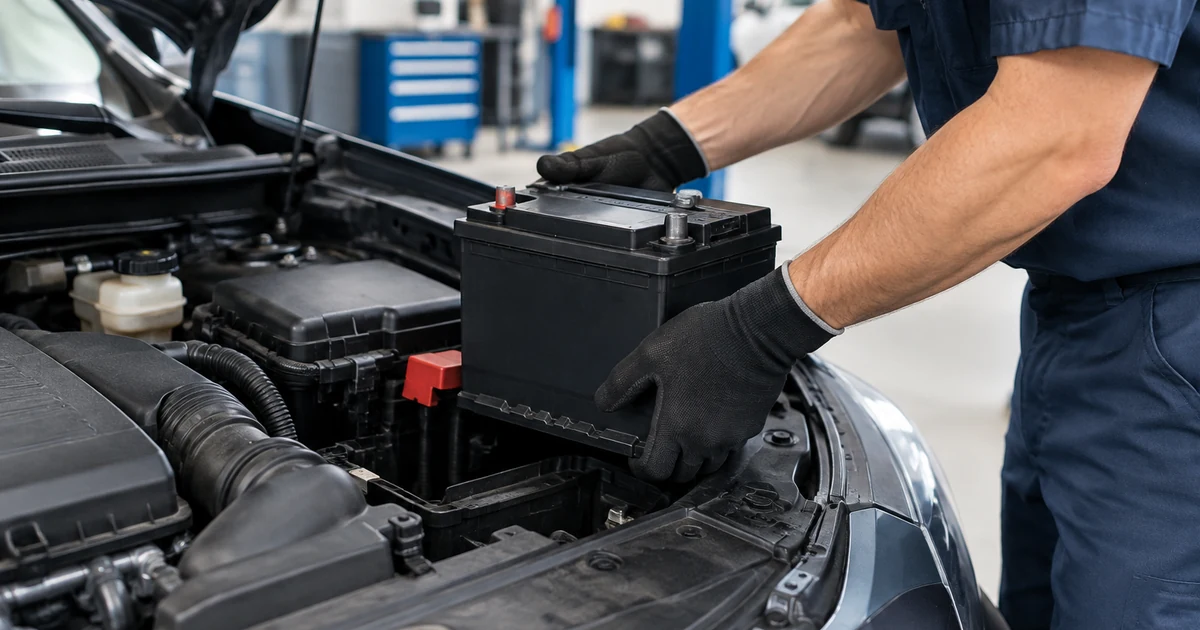
The order matters: disconnect the negative (black) cable first, then the positive. Install the new battery, tighten the hold-down, connect positive first, then negative. Clean corrosion off the cable ends before reconnecting. Many stores will take your old battery for recycling and refund the core charge.
If your car needs registration, you can still do the swap yourself, but you’ll need a scan tool that supports it or a shop visit afterward.
Is It Worth Replacing?
Yes. A battery is one of the cheapest ways to restore reliability, and you can’t skip it: the car won’t start without one. The only real decision is which battery. Match the type your car came with (flooded, EFB or AGM), meet or exceed the original cold-cranking amps, and pick the longest free-replacement warranty that fits your budget.
If you’re replacing the battery more often than every three years, something else is wrong. A parasitic drain, a weak alternator, or lots of very short trips can all kill batteries early.
How to Save Money on Car Battery Replacement
- Test before you buy. Free testing can show whether the battery is truly bad or just needs a charge.
- Use free installation at a parts store if your battery is easy to reach.
- Don’t overbuy. Stick with flooded if that’s what your car came with; AGM is only required if your car shipped with one.
- Check the warranty on the old battery. Many have a free-replacement period of two to three years.
- Return the core to get the core charge back.
- Buy a scan tool if you own a car that needs registration and plan to keep it; it can pay for itself on the next battery.
- Keep terminals clean and use a maintainer on cars that sit for weeks at a time.
If the battery tests good but the car still won’t crank, look at the starter. If your push-button car won’t recognize the key, the fob battery may be the problem rather than the car battery; see our car key replacement cost guide.
Frequently Asked Questions
How much does it cost to replace a car battery?
Most drivers pay $150 to $450 installed, with about $250 being typical. A standard flooded battery with free parts-store installation can be under $200, while an AGM battery at a dealer on a European car can reach $400 to $500.
Is an AGM battery worth the extra money?
If your car came with an AGM battery, yes, you should replace it with another AGM because start-stop systems and heavy electrical loads require it. If your car came with a standard flooded battery, an AGM is optional; Consumer Reports testing has found some conventional batteries perform nearly as well for much less.
Will AutoZone install my battery for free?
AutoZone and other large parts chains offer free battery installation on many vehicles when you buy the battery from them. Restrictions apply, and batteries under seats, in trunks, or behind other parts may be excluded.
How long does a car battery last?
Most car batteries last about three to five years. Hot climates, lots of short trips, and a car that sits unused for long periods all shorten battery life.
Do I need to register a new battery?
Many BMW, Mercedes-Benz, Audi, Volkswagen, Porsche and Volvo models need a new battery registered with a scan tool so the charging system treats it as new. Skipping it can shorten battery life and cause electrical problems. Most mainstream American and Japanese cars don’t require it.
Do hybrids and electric cars have a 12-volt battery?
Yes. Hybrids and EVs use a 12-volt battery to power the computers and wake up the high-voltage system, and a dead 12V battery will leave the car unable to start or drive. It’s a separate, much cheaper part than the hybrid or EV traction battery.
What is a battery core charge?
A core charge is a refundable fee added when you buy a battery without returning an old one. Bring your old battery back to the store and you get the fee refunded, and the old battery gets recycled.