Average Car Battery Lifespan
Most car batteries last 3 to 5 years. AAA puts the typical range at three to five years, noting that batteries in cooler parts of the country often go five years or longer, while batteries in the hot South commonly last only about three years.
Age matters more than miles. A battery wears out from time, heat and vibration, so a car that sits in a hot driveway can kill a battery as fast as one that racks up long commutes.
| Situation | Typical lifespan | Why |
|---|---|---|
| Average US driver | 3 – 5 years | Normal mix of heat, cold and driving |
| Cold northern climate | About 5 years or more | Less heat damage to the internal chemistry |
| Hot southern climate | About 3 years | Under-hood heat speeds up corrosion and water loss |
| Mostly short trips (under 15–20 minutes) | Toward the low end | The alternator never fully recharges the battery |
| Car parked for weeks at a time | Toward the low end | Slow self-discharge and parasitic drain leave it sulfated |
| Regular highway driving | Toward the high end | The battery stays fully charged |
| Start-stop vehicle (AGM or EFB battery) | Similar, 3 – 5 years | Built for heavy cycling, but works harder every day |
These ranges are general guidelines. Battery quality, how well the charging system works and how the car is used all shift where a specific battery lands.
Heat vs. cold: which is worse?
Most people blame winter, because that’s when dead batteries show up. But heat does more of the damage. Consumer Reports, citing AAA data, notes that batteries in the coldest US regions last about 58 months on average, versus less than 41 months in the hottest regions. Under-hood temperatures can exceed 200°F in summer, and that heat speeds up the chemical breakdown and evaporates electrolyte.
Cold weather then exposes the weakness. A cold engine is harder to turn over, and a cold battery delivers less current. A battery that was quietly damaged by two summers of heat often fails on the first cold morning of the year.
That’s why the testing schedule should follow your climate. Consumer Reports suggests having the battery load-tested every year starting after about two years in warm climates, and after about four years in cold ones. When you shop for a replacement in a hot region, look at batteries rated for heat, and match or beat the cold cranking amps (CCA) your owner’s manual calls for. AAA warns never to install a battery with a lower CCA or amp-hour rating than the manufacturer recommends.
What Shortens a Car Battery’s Life
High heat
Heat is the number one enemy. It accelerates corrosion of the internal plates and causes water loss. Parking in a garage or in the shade helps more than most drivers expect.
Short trips
Starting the engine uses a burst of energy, and the alternator needs time to put it back. If most of your drives are a few minutes long, the battery slowly runs down and never gets a full charge.
Sitting unused
Modern cars draw a small amount of power even when off, for alarms, keyless entry and computer memory. Leave a car parked for several weeks and the battery can drain deeply. Each deep discharge does permanent damage.
Vibration and a loose hold-down
AAA lists vibration as one of the main things that kills batteries. A missing or loose hold-down clamp lets the battery bounce, which damages the internal plates. It’s a simple thing to check.
Corroded or loose terminals
Corrosion on the posts adds resistance, so the battery charges poorly and struggles to deliver current. White or blue-green crust on the terminals is a sign to clean them.
A weak charging system
A failing alternator or a slipping belt undercharges the battery every day. A battery that is always partly discharged wears out much faster. If you’re replacing batteries every year or two, have the charging system tested.
Heavy electrical loads
Dash cams wired to run while parked, aftermarket audio, and leaving lights or accessories on with the engine off all pull the battery down.
What Helps a Battery Last Longer
- Regular drives of 20 minutes or more, so the battery reaches a full charge.
- Garage or shaded parking, especially in hot climates.
- A battery maintainer (smart trickle charger) on cars that sit for weeks.
- Clean, tight terminals and a secure hold-down.
- The correct battery type. If your car came with an AGM battery, replace it with an AGM.
- A battery bought fresh. Consumer Reports suggests buying one less than six months old, ideally three months or newer.
Warning Signs Your Car Battery Is Failing
Batteries often give some warning before they leave you stranded. Watch for:
- Slow cranking: the engine turns over sluggishly, especially on cold mornings.
- Clicking when you turn the key: rapid clicking usually means the battery can’t deliver enough current. See our guide to battery replacement cost if it’s time for a new one.
- Battery or charging warning light on the dashboard.
- Dim headlights or interior lights at idle or while cranking.
- Electrical glitches: the radio resets, power windows slow down, or start-stop stops working.
- Corrosion, a swollen case or a rotten-egg smell around the battery.
- Age: a battery over three years old (two in hot climates) is living on borrowed time even if it seems fine.
Keep in mind that a car that won’t start isn’t always a battery problem. A bad starter or a failing alternator can look similar. A dead battery that keeps going flat after a full charge often points to the alternator; see our alternator replacement cost guide.
How to Test a Car Battery
Free test at a parts store
The easiest option. Most major auto parts chains test batteries for free, often right in the parking lot, and will also check your alternator and starter. AAA recommends having a battery tested every year once it reaches its third year.
Check resting voltage with a multimeter
Let the car sit for a few hours with everything off, then measure across the terminals:
| Resting voltage | Approx. state of charge | What to do |
|---|---|---|
| 12.6 V or higher | About 100% | Healthy |
| 12.4 V | About 75% | OK, but drive longer or charge it |
| 12.2 V | About 50% | Recharge it |
| 12.0 V | About 25% | Recharge now, then have it load-tested |
| Below 11.8 V | Deeply discharged | Likely damaged; test and probably replace |
Voltage alone doesn’t tell the whole story. A worn battery can show 12.6 volts and still collapse under load.
Load test
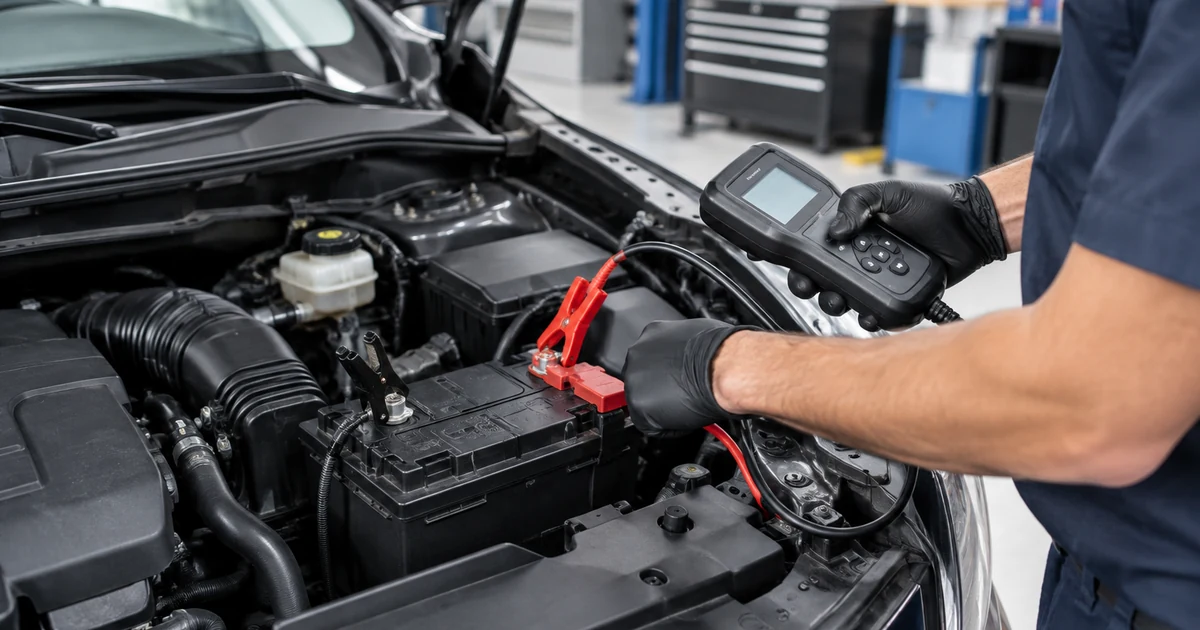
A load test or digital conductance test is the real check. During a classic load test, a healthy battery should stay above about 9.6 volts at 70°F. Digital testers compare the battery’s cold cranking amps (CCA) to its rating and give a pass, charge-and-retest or replace result.
Check the charging system
With the engine running, voltage at the battery should be roughly 13.7 to 14.7 volts. Much lower suggests the alternator or belt isn’t keeping the battery charged.
Car Battery Replacement Cost
When a battery does wear out, replacement runs $150 to $450 installed, and most drivers pay about $250. A standard flooded battery is the cheapest. An AGM battery for a start-stop car costs roughly twice as much. Use the estimator above for your situation, or see the full car battery replacement cost breakdown.
| Battery type | Battery price | Installed at a shop |
|---|---|---|
| Standard flooded | $100 – $200 | $150 – $300 |
| EFB (entry start-stop) | $150 – $250 | $200 – $350 |
| AGM | $200 – $300 | $250 – $450 |
| Luxury / European with registration | $220 – $350 | $290 – $500 |
Labor is short on most cars, usually 15 to 30 minutes, and many parts stores install for free when you buy the battery there. Batteries in the trunk, under a seat or behind panels take longer. Many newer European and some domestic vehicles also need the new battery “registered” with a scan tool so the charging system adjusts to it.
Replace before it fails?
If your battery is 4 to 5 years old and tests weak, replacing it on your schedule is cheaper than a tow or a roadside call. If it’s only a couple of years old and fails, check the warranty first. Many batteries have a free-replacement period, and the store can look it up with your receipt or the date code.
DIY or Shop?
Replacing a battery is one of the easiest DIY jobs on most cars: difficulty 1 out of 5, about 30 minutes, with basic wrenches. Disconnect the negative cable first and reconnect it last, keep tools away from both terminals at once, and wear eye protection. It gets harder on cars that need battery registration, where the battery is buried, or on vehicles that lose radio codes and settings. In those cases a shop or parts store install is worth it.
A few inexpensive tools make it easier to stay ahead of a failing battery:
How to Make Your Car Battery Last Longer
- Have the battery tested every year after year three, or after year two in hot climates.
- Clean corrosion off the terminals with a brush and a baking soda solution, then protect them with anti-corrosion spray.
- Make sure the hold-down clamp is tight so the battery can’t move.
- Take a longer drive at least once a week if you mostly make short trips.
- Use a smart battery maintainer on cars stored for more than a couple of weeks.
- Turn off lights and accessories before shutting off the engine, and don’t sit with the radio on and the engine off.
- Park in a garage or shade during hot months.
- Fix charging problems quickly. A worn serpentine belt or weak alternator will shorten the life of a new battery.
If the car still struggles to start with a good battery, the starter may be the real problem.
Frequently Asked Questions
How long does a car battery last on average?
Most car batteries last 3 to 5 years. AAA says batteries in hot southern climates often last about three years, while batteries in cooler regions can last five years or longer.
Does cold weather kill car batteries?
Cold weather mostly exposes a battery that is already weak. A cold battery delivers less current and a cold engine is harder to crank, so batteries tend to fail on cold mornings. The underlying damage usually comes from summer heat.
How do I know if my car battery is going bad?
Common signs are slow cranking, clicking when you turn the key, dim lights, a battery or charging warning light, and corrosion or a swollen case. A free load test at a parts store will confirm whether the battery is weak.
How many miles does a car battery last?
Battery life is measured in years, not miles. Time, heat and how fully the battery stays charged matter more than mileage. Regular longer drives actually help a battery last, while lots of short trips shorten its life.
Should I replace my car battery at 5 years?
Not automatically, but a 5-year-old battery is near the end of its typical life. Have it load-tested; if it is weak, replacing it before it fails is cheaper than a tow. In hot climates, plan on testing from year two.
Do AGM batteries last longer than regular batteries?
AGM batteries are built to handle deep cycling and start-stop systems, and they often hold up well, but they still typically last in the same 3 to 5 year range. If your car came with an AGM battery, replace it with another AGM.
How much does it cost to replace a car battery?
Most drivers pay $150 to $450 installed, with about $250 typical. A standard flooded battery with free parts-store installation can be under $200, while an AGM battery on a European car with registration can reach $500.