Wheel Bearing Replacement Cost by Vehicle
Prices are for one front wheel bearing or hub assembly at an independent shop with quality aftermarket parts. They are estimates for common model years and drivetrains; 4WD versions, heavy-duty trucks and dealer pricing run higher.
| Vehicle | Parts | Labor | Total |
|---|---|---|---|
| Ford F-150 | $100 – $260 | $150 – $260 | $250 – $520 |
| Chevrolet Silverado 1500 | $120 – $300 | $170 – $280 | $290 – $580 |
| Toyota Camry | $90 – $220 | $200 – $330 | $290 – $550 |
| Toyota RAV4 | $150 – $330 | $280 – $450 | $430 – $780 |
| Toyota Corolla | $80 – $200 | $200 – $320 | $280 – $520 |
| Honda Civic | $70 – $180 | $200 – $320 | $270 – $500 |
| Honda Accord | $90 – $220 | $220 – $330 | $310 – $550 |
| Honda CR-V | $90 – $220 | $220 – $350 | $310 – $570 |
| Nissan Altima | $90 – $220 | $200 – $320 | $290 – $540 |
| Chevrolet Equinox | $100 – $250 | $150 – $260 | $250 – $510 |
| Jeep Grand Cherokee | $150 – $350 | $150 – $260 | $300 – $610 |
| Tesla Model 3 | $150 – $350 | $180 – $300 | $330 – $650 |
| BMW 3 Series | $150 – $380 | $220 – $380 | $370 – $760 |
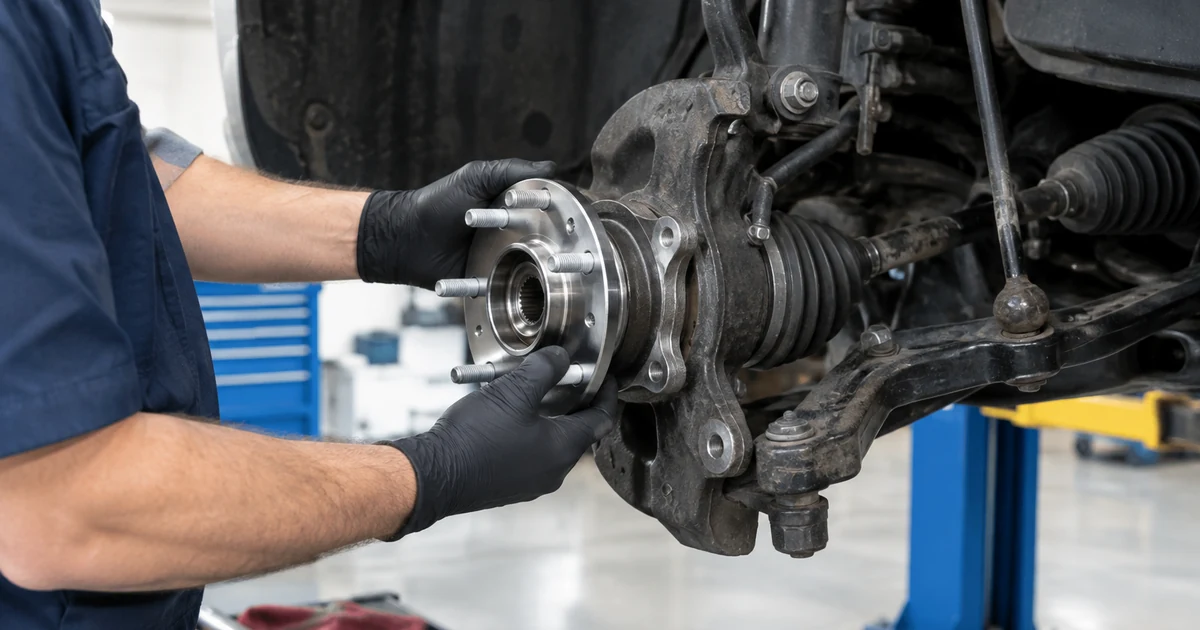
The biggest split is design. Many trucks and SUVs, including the F-150, Silverado, Equinox and Grand Cherokee, use a bolt-on hub assembly: the bearing, hub and often the ABS sensor come as one unit that bolts to the steering knuckle. Many Toyota and Honda cars use a press-in bearing that has to be pressed out of the knuckle with a hydraulic press, which costs less in parts but more in labor.
Cost Breakdown: Parts vs. Labor
Parts usually cost $80 to $350 per wheel, and labor runs about $150 to $400. A bolt-on hub assembly takes roughly 1 to 2 hours; a press-in bearing takes about 2 to 4 hours because the knuckle often has to come off the car.
| Design | Parts (one wheel) | Labor time | Typical total |
|---|---|---|---|
| Bolt-on hub assembly | $90 – $350 | 1 – 2 hrs | $250 – $600 |
| Press-in bearing (bearing only) | $30 – $120 | 2 – 4 hrs | $300 – $700 |
| Press-in bearing + new hub | $80 – $200 | 2 – 4 hrs | $350 – $750 |
Aftermarket vs. OEM
Quality aftermarket hub assemblies and bearings from established bearing makers are the norm at independent shops. OEM parts cost more, often 20% or more on the total. Very cheap no-name hubs are the part most often blamed for early repeat failures, so this is not the place to buy the cheapest option.
Dealer vs. independent vs. DIY
| Option | One front hub assembly | Notes |
|---|---|---|
| Independent shop | $250 – $600 | Aftermarket or OEM, usually 12-month+ warranty |
| Dealership | $330 – $780 | OEM part, highest labor rate |
| DIY | $100 – $240 | Bolt-on hubs only for most home mechanics |
What Affects the Price
Vehicle type and drivetrain
Trucks and 4WD vehicles have larger, pricier hub assemblies. Front-wheel-drive cars need the CV axle nut removed to get the bearing out, and 4WD front hubs can include extra parts. Luxury and European cars cost more for both parts and labor.
Hub assembly vs. press-in bearing
As shown above, bolt-on hubs are faster but cost more in parts; press-in bearings are cheaper parts but require more labor and a press.
Front vs. rear
Front bearings on front-wheel-drive and all-wheel-drive vehicles carry the most load and fail more often. Rear hub assemblies on many cars are simpler and slightly cheaper, since there is often no axle nut to remove. Some models are simply labor-heavy: RepairPal’s estimate for a recent Toyota RAV4, for example, runs well above the midsize average, which is why that row in the table sits at the top of the range.
Shop type
Dealers use OEM parts and charge higher hourly rates, often about 30% more. Independent shops can offer more parts choices.
Region
Labor is the larger part of this bill, so local rates matter. National independent-shop rates are roughly $120 to $160 an hour, with the West Coast and Northeast higher. Set your region in the estimator.
Related parts replaced at the same time
Rust can make the job much longer, especially on older trucks in salt states where hubs seize in the knuckle. If the bearing failed badly, the ABS sensor, CV axle or brake rotor may also need attention. Since the brakes come off for this job anyway, it is a good time to do brake pads and rotors if they are due.
Symptoms of a Bad Wheel Bearing
- Humming, growling or roaring noise that gets louder with speed. It often changes when you turn or change lanes, as weight shifts on and off the bad bearing.
- Grinding or clicking from the wheel area when the bearing is badly worn.
- Play or looseness in the wheel when it is rocked by hand while lifted.
- ABS or traction control warning light, because many hubs contain the wheel speed sensor.
- Steering wheel vibration or a wandering feel.
- Uneven brake pad wear on one side.
Wheel bearings and hubs often last a long time, but water, road salt, grit, potholes and curb impacts shorten their life. A clicking noise that only happens during tight turns is more often a CV joint; see our CV axle replacement cost guide.
Can You Drive With a Bad Wheel Bearing?
For a short time, carefully, if it is only a light hum. But a bearing gets worse, not better. As it wears, heat builds up and play increases, which can damage the hub, the CV axle and the brakes. In the worst case, a failed bearing can seize or let the wheel wobble badly. If you hear loud grinding, feel the steering shake, or notice the wheel is loose, stop driving and have the car towed. Do not plan a road trip on a noisy bearing.
DIY vs. Taking It to a Shop
Difficulty: 3 out of 5 for a bolt-on hub assembly, 4 to 5 out of 5 for a press-in bearing. A bolt-on hub is a reasonable job for an experienced DIYer: remove the wheel, brake caliper and rotor, the axle nut (on driven wheels), and the hub bolts. Expect 2 to 3 hours the first time, longer if things are rusted.
Tools: jack and stands, breaker bar and a large axle-nut socket, torque wrench (axle nuts have high, specific torque values), penetrating oil, and sometimes a hub puller or slide hammer. Press-in bearings need a hydraulic press or a bearing press kit; most home mechanics take the knuckle to a shop to press it. If you are not sure of the design or the torque specs, let a shop do it.
Is It Worth Fixing?
Yes, for almost any car that is otherwise worth driving. A few hundred dollars per wheel is modest compared with the value of a running vehicle, and a failed bearing is a safety problem, so it cannot be ignored. On a very old car with many other expensive faults, weigh the total repair list against the car’s value, but do not keep driving it with a loud bearing.
How to Save Money on Wheel Bearing Replacement
- Confirm which wheel is bad before paying for parts. Ask the shop how they diagnosed it.
- Get a second quote from an independent shop; labor rates vary a lot.
- Choose a quality aftermarket hub instead of OEM, but avoid the very cheapest parts.
- Replace only the bad side unless the other is also worn. Bearings do not have to be replaced in pairs.
- Bundle brake work since the rotor and caliper are already off.
- Check warranties, including powertrain or extended warranties on newer vehicles.
- Fix it early, before a noisy bearing damages the hub or the CV axle.
Hearing clunks over bumps instead of a hum? Read about tie rod replacement cost, or see how we estimate costs.
Frequently Asked Questions
How much does a wheel hub assembly replacement cost?
A bolt-on hub assembly usually costs about $250 to $600 per wheel installed at an independent shop, with the part itself around $90 to $350. Trucks, 4WD vehicles and luxury cars sit at the top of that range or above it.
Do wheel bearings need to be replaced in pairs?
No. Unlike brakes, wheel bearings can be replaced one at a time. Replace the other side only if it is also noisy or shows play, or if it is old and you want to save a second trip.
How long does it take to replace a wheel bearing?
About 1 to 2 hours for a bolt-on hub assembly and 2 to 4 hours for a press-in bearing. Rusted parts can add time, especially on older vehicles in salt states.
How do I know which wheel bearing is bad?
The noise often changes when you turn: if it gets louder turning one way, the bearing on the opposite side is usually taking more load. A mechanic confirms it by checking for play with the wheel lifted and listening while the wheel spins.
Does a wheel bearing replacement need an alignment?
Usually not for a bolt-on hub assembly. If the steering knuckle or other suspension parts are removed for a press-in bearing, the shop may recommend an alignment check.
Is a wheel bearing covered under warranty?
Often, while the car is within its factory warranty, and some extended warranties cover it too. Replacement bearings usually carry a parts warranty, so keep your receipt.