Brake Pads and Rotors Cost by Vehicle
These prices are for new pads and two new rotors on the front axle at an independent shop, using quality aftermarket parts. They are estimates for common model years and trims. Heavy-duty trucks, performance packages and dealer service cost more.
| Vehicle | Parts | Labor | Total |
|---|---|---|---|
| Ford F-150 | $180 – $380 | $180 – $260 | $360 – $640 |
| Chevrolet Silverado 1500 | $200 – $400 | $200 – $280 | $400 – $680 |
| Toyota Camry | $150 – $320 | $160 – $240 | $310 – $560 |
| Toyota RAV4 | $150 – $320 | $160 – $240 | $310 – $560 |
| Toyota Corolla | $130 – $280 | $150 – $230 | $280 – $510 |
| Honda Civic | $150 – $300 | $160 – $250 | $310 – $550 |
| Honda Accord | $160 – $320 | $160 – $250 | $320 – $570 |
| Honda CR-V | $160 – $320 | $160 – $240 | $320 – $560 |
| Nissan Altima | $160 – $330 | $180 – $260 | $340 – $590 |
| Chevrolet Equinox | $160 – $330 | $160 – $250 | $320 – $580 |
| Jeep Grand Cherokee | $220 – $450 | $180 – $270 | $400 – $720 |
| Tesla Model 3 | $250 – $500 | $170 – $270 | $420 – $770 |
| BMW 3 Series | $300 – $600 | $200 – $320 | $500 – $920 |
Rotor size is the main reason for the spread. A compact car rotor is small and cheap, while a half-ton pickup, a Grand Cherokee or a BMW uses larger, heavier rotors, and European cars often need a new wear sensor too. At the extreme, carbon-ceramic brakes on high-end performance cars can cost many thousands per axle and are a different category entirely.
Cost Breakdown: Parts vs. Labor
For one axle, parts usually run $150 to $450: a set of pads ($35 to $150) plus a pair of rotors (roughly $60 to $300 for most cars). Labor adds $150 to $350, based on about 1 to 2 hours of book time at typical independent rates of $120 to $160 an hour, plus hardware and shop supplies.
Brake rotor replacement cost
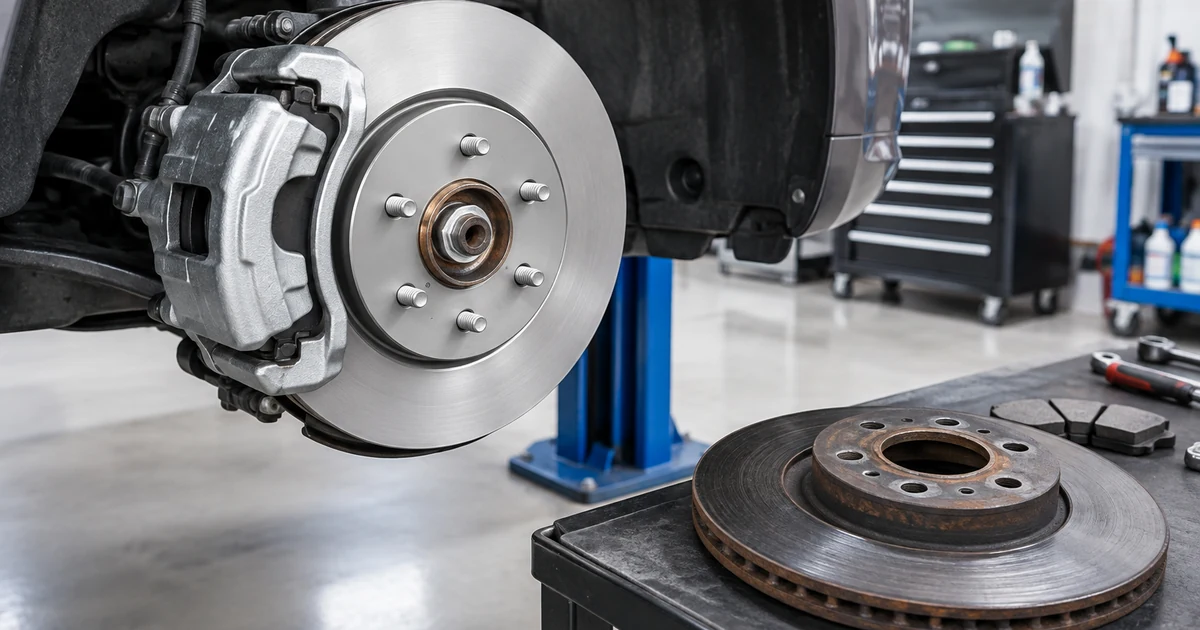
Rotors are almost never replaced without new pads, because old pads are worn to the shape of the old rotor. That is why “brake rotor replacement cost” and a pads-and-rotors job are effectively the same quote in most shops. RepairPal’s national estimate for rotor replacement alone is about $574 to $698 per job, in line with the upper half of the pads-and-rotors range here.
Part quality options
- Economy rotors: the cheapest option, often uncoated, so they rust quickly on the hub and edges. Fine for an older commuter.
- Coated aftermarket rotors: the best value for most drivers. The coating resists rust and the fit is usually as good as OEM.
- OEM rotors and pads: factory parts, usually 10% to 30% more expensive, sometimes required for warranty work.
- Drilled or slotted rotors: mainly a looks and performance upgrade. Most daily drivers do not need them.
Dealer vs. independent vs. DIY
| Option | Typical cost (one axle) | Notes |
|---|---|---|
| Independent shop | $350 – $800 | Aftermarket or OEM parts, flexible on quality |
| Dealership | $450 – $1,040 | OEM parts, highest labor rate |
| DIY | $140 – $320 | Parts only; needs basic tools and a torque wrench |
What Affects the Price
Vehicle type and rotor size
Larger vehicles need larger, heavier rotors and bigger pads. A midsize car sits in the middle of the range, a half-ton truck near the top, and luxury or European cars above it. Some trucks and older vehicles use rotors that are part of the hub, which adds labor.
Part quality
Economy parts can save $50 to $100 per axle, but uncoated rotors rust and cheap pads can be noisy. Coated aftermarket rotors with ceramic pads are the sweet spot for most daily drivers.
Shop type
Dealers use OEM parts and charge the highest hourly rate, so the same job often costs about 30% more. Tire and brake chains can be competitive, but read the quote line by line.
Region
Labor rates vary a lot by state, from roughly $85 to $105 an hour in the cheapest markets to $155 to $175 in California. The region setting in the estimator adjusts for this.
Related parts replaced at the same time
A seized caliper, a torn slide-pin boot or old brake fluid can add to the bill. A single replacement caliper typically adds about $150 to $450 installed when the brakes are already apart. Wear sensors and new hardware add $10 to $80 per axle.
Symptoms of Bad Brake Rotors
- Pulsating brake pedal or a shaking steering wheel when you brake, especially from highway speed.
- Grinding after the pads wore through, which scores the rotor face.
- Deep grooves or a raised lip on the outer edge of the rotor.
- Blue or dark heat spots from overheating, common after towing or mountain driving.
- Squealing that returns soon after a pad-only job, often because the old rotor surface was glazed or uneven.
A shaking steering wheel that happens while cruising, not only while braking, can also be a wheel balance, tie rod or suspension problem. Our tie rod replacement cost guide covers that repair.
Can You Drive With Bad Rotors?
A mild pulsation is uncomfortable but usually not an immediate danger. You should still book a repair soon, because warped or thin rotors reduce braking performance and wear new pads unevenly. If you hear metal-on-metal grinding, feel the car pull hard to one side, smell hot brakes, or the pedal feels soft or sinks, stop driving and get it towed. Brakes are not a system to gamble with.
DIY vs. Taking It to a Shop
Difficulty: 2 to 3 out of 5. On most cars, pads and rotors take 1.5 to 3 hours per axle for a first-timer. The extra step compared with a pad-only job is removing the caliper bracket and sliding the old rotor off, which can be stubborn if it is rusted to the hub.
Tools: jack and jack stands, lug wrench, socket and breaker bar, caliper piston tool, brake cleaner, anti-seize for the hub face, brake grease for the slide pins, and a torque wrench for the caliper bracket bolts and lug nuts. Some rotors are held on by small retaining screws that need an impact driver.
Skip DIY if your rotors are pressed onto the hub, if the caliper bolts are seized, or if you are not comfortable bedding in new pads. A mistake here affects your ability to stop.
Is It Worth Replacing Pads and Rotors on an Older Car?
Yes, in nearly every case. A $350 to $800 brake job is routine maintenance that any car needs to stay safe, and it rarely approaches the value of a running vehicle. Only reconsider if the brake work is one line on a long list of expensive repairs on a car worth very little. Even then, you cannot drive a car with worn-out brakes.
How to Save Money on Pads and Rotors
- Ask for measurements. If the rotors are within spec, pads alone may be enough.
- Get a second written quote that separates pads, rotors, hardware and labor.
- Use an independent shop instead of the dealer once the car is out of warranty.
- Pick coated aftermarket rotors instead of OEM or performance rotors for daily driving.
- Replace pads before they grind next time, so the new rotors last through more than one pad change.
- Look for pad warranties. Some brands and chains replace worn pads for free, and you only pay labor.
- Bundle nearby work such as a brake fluid change or a wheel bearing already on your list, since the wheel is already off.
Only need pads? See our brake pad replacement cost guide. A humming noise that grows with speed is more likely a bad wheel bearing than a brake problem.
Frequently Asked Questions
How much does brake rotor replacement cost?
In practice, rotors are replaced together with pads, which costs about $350 to $800 per axle at an independent shop. The rotors themselves are usually $60 to $300 a pair for most cars, and more for trucks and luxury models.
How much do pads and rotors cost for all four wheels?
Doing both axles usually runs about $680 to $1,550 at an independent shop for a midsize car or SUV. Many drivers only need the front axle, since front brakes do most of the work and wear faster.
Can rotors be resurfaced instead of replaced?
Sometimes. If a rotor is still above its minimum thickness, it can be machined smooth. Many shops have stopped resurfacing because new aftermarket rotors are affordable and machining makes them thinner and more prone to overheating.
How often do rotors need to be replaced?
There is no fixed mileage. Rotors often last through one or two sets of pads, but hard braking, towing, rust and letting pads wear to metal shorten their life. Replace them when they fall below minimum thickness, warp, or are deeply scored.
Should I replace rotors every time I get new pads?
Not automatically. Ask the shop to measure them. If they are within spec and the surface is smooth, new pads on the old rotors are fine.
Why do my new brakes vibrate?
Common causes include uneven lug nut torque, rust or debris between the rotor and the hub, or pads that were not bedded in. A good shop cleans the hub face and torques the wheels to spec to prevent it.
- RepairPal — Brake rotor replacement cost estimate
- Kelley Blue Book — Brake repair questions and answers
- Jerry — Brake pad replacement cost (with rotors)
- CarParts.com — Brake pad replacement cost
- ConsumerAffairs — Cost to replace brake pads and rotors
- AutoLeap — Average automotive repair labor rates by state