Average Brake Pad Lifespan
Most brake pads last 25,000 to 70,000 miles. Firestone says manufacturers typically rate pads for 25,000 to 65,000 miles, and Les Schwab gives a range of 30,000 to 70,000 miles depending on how and where you drive. Many drivers land somewhere around 40,000 miles.
That’s a wide range because brake pads wear based on use, not time. Every stop grinds off a little friction material, so a car that brakes constantly in city traffic goes through pads far faster than one that cruises on the highway.
| Situation | Typical pad life | Notes |
|---|---|---|
| Average driver, mixed driving | 30,000 – 50,000 mi | The most common range |
| Mostly highway miles | 50,000 – 70,000 mi | Few stops, light braking |
| Heavy city / stop-and-go | 20,000 – 35,000 mi | Constant braking from low speed |
| Front pads | 25,000 – 60,000 mi | Do most of the braking work |
| Rear pads | 40,000 – 70,000 mi | Less load, usually outlast the fronts |
| Trucks, towing, heavy SUVs | Toward the low end | More weight to stop every time |
| Hybrids and EVs | Often longer | Regenerative braking does much of the slowing |
These are general ranges. Your owner’s manual, your driving and the pads installed all change where your car lands, which is why inspections matter more than a mileage number.
Front vs. rear brake pads
When you brake, the car’s weight shifts forward, so the front brakes do most of the work. That’s why front pads usually wear out first. On many cars, the rear pads outlast at least one set of front pads. Some vehicles are the exception: cars with electronic stability systems that apply the rear brakes often, and some models with a rear-biased setup, can wear rear pads surprisingly fast.
Hybrids and electric vehicles
Hybrids and EVs use regenerative braking: the electric motor slows the car and recharges the battery, so the friction pads do less of the work. Pads on these vehicles often last well beyond the usual range. The catch is that brakes that are rarely used hard can rust and stick, so regular inspections and slide pin service still matter even when the pads look thick.
Lifespan by pad type
| Pad type | Lifespan | Pros | Cons |
|---|---|---|---|
| Organic (NAO) | Shortest | Quiet, cheap, easy on rotors | Wears fast, more dust |
| Semi-metallic | Medium to long | Strong bite, handles heat and towing | Noisier, more dust, harder on rotors |
| Ceramic | Usually longest | Quiet, low dust, long life | Costs more |
Use the pad type your vehicle was designed for. Trucks that tow often do best with semi-metallic pads, while most commuter cars do well with ceramics.
What Wears Brake Pads Out Faster
City driving
Stop-and-go traffic is the biggest single factor. Each stop from city speed uses the pads, and a short commute with lots of lights can wear pads out in half the time of a highway commute.
Hard or late braking
Braking hard from high speed creates a lot of heat and friction. Drivers who speed up to a red light and then brake late go through pads much faster than drivers who coast and brake gently.
Riding the brakes
Resting a foot on the pedal, or riding the brakes down long hills, keeps the pads in contact with the rotors and overheats them.
Vehicle weight and towing
A heavier vehicle takes more energy to stop. Pickups, large SUVs and anything pulling a trailer or carrying a full load wear pads faster.
Hilly or mountain driving
Long descents put sustained heat into the brakes. Using a lower gear lets the engine help slow the vehicle.
Sticking calipers and dry slide pins
A caliper that doesn’t release fully drags the pad against the rotor all the time. That wears one pad (or one side) much faster and can overheat the brake. Uneven wear between the inner and outer pad is the classic sign; it usually means the slide pins need cleaning and lubrication, or the caliper needs replacing. See our brake caliper replacement cost guide if a caliper is sticking.
Low-quality pads
Bargain pads can wear quickly, fade when hot and make more noise. Mid-grade ceramic or semi-metallic pads usually cost little more and last longer.
Warning Signs Your Brake Pads Are Worn
- Squealing when you brake: many pads have a small metal wear indicator that squeals against the rotor when the pad gets thin. It’s designed to get your attention.
- Grinding: metal-on-metal. The friction material is gone and the backing plate is cutting into the rotor. Get it fixed right away.
- Brake warning light: some cars have electronic pad wear sensors that turn on a dash light.
- Longer stopping distances or a soft pedal.
- Vibration or pulsing in the pedal or steering wheel: often warped or worn rotors.
- Pulling to one side when braking: uneven wear or a sticking caliper.
- Burning smell after normal driving, which can mean a dragging brake.
Can you drive with worn brake pads?
Brakes are a safety system, so be honest with yourself here. A light squeal from the wear indicator means it’s time to book a brake job soon, not to keep driving for months. Grinding, a pedal that sinks toward the floor, a brake warning light combined with a soft pedal, or a car that pulls hard when you brake means stop driving and get it checked. Worn-through pads can damage rotors and calipers within days and seriously increase your stopping distance.
Do brake pads wear out with age?
Mileage is the main factor, but time still matters. Pads on a car that sits a lot, or on a hybrid that barely uses its friction brakes, can be affected by moisture and rust. The pad material can crack or separate, and calipers and slide pins can seize. ClickMechanic suggests a first inspection around year three, even on low-mileage cars, and considering replacement at five to six years if the pads show cracking or corrosion even though they still look thick.
How long do rotors last compared to pads?
Rotors are much thicker steel discs and usually outlast the pads. Many cars go through one or two pad changes before the rotors need replacing, but it depends on rotor size, driving and how long worn pads were left on. Rotors also have a minimum thickness stamped on them. A shop measures them at each pad replacement and will recommend new rotors if they’re below spec, deeply scored or causing a pulsing pedal.
How to Check Your Brake Pads
Look through the wheel
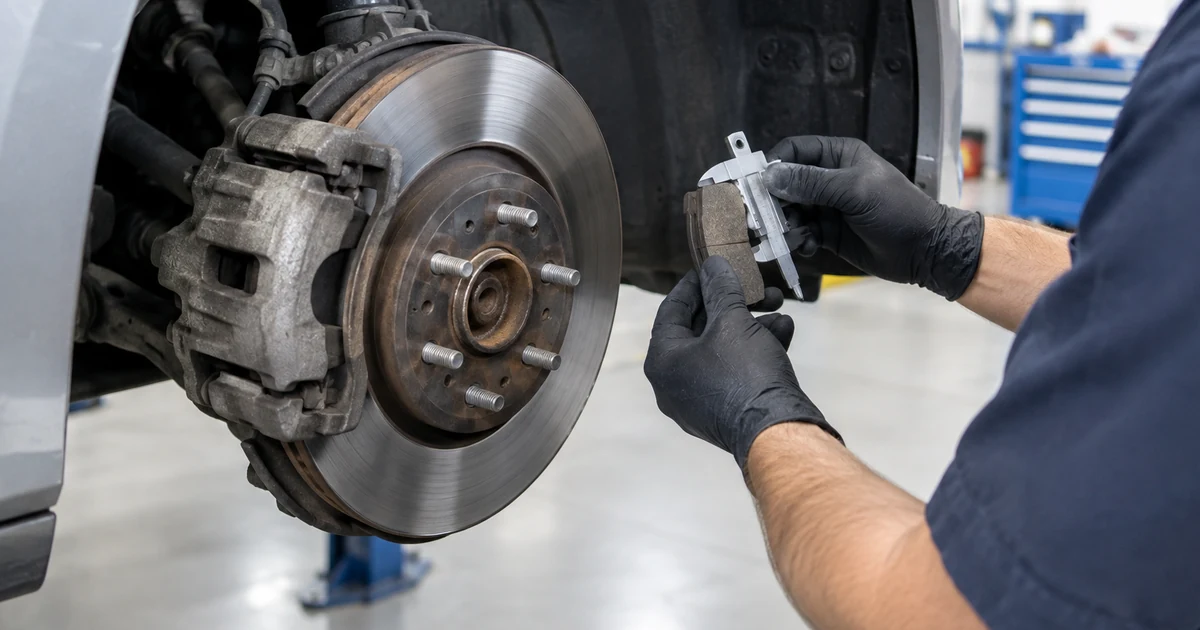
On many cars with open-spoke wheels, you can see the outer pad pressed against the rotor. Use a flashlight. New pads typically have about 10 to 12 millimeters of friction material. If what you see looks about as thick as a pencil eraser is long, or thinner, it’s time to plan a replacement.
When to replace
Most shops recommend replacing pads at about 3 to 4 millimeters (around 1/8 inch) of material. Brakes To Go suggests replacing them once they’re less than 1/4 inch thick, and some mechanics prefer to replace them earlier, around 5 millimeters, to leave a safety margin. Check the inner pad too; it often wears faster than the outer one and you can’t always see it without removing the wheel.
Inspect regularly
Les Schwab recommends checking brakes every 5,000 miles or six months. The easiest time is during a tire rotation, when the wheels are already off. Many tire and brake shops will measure your pads for free.
Brake Pad Replacement Cost
Replacing brake pads costs $150 to $450 per axle at a shop, with most drivers paying about $300. Parts are usually $35 to $150 per axle, and labor runs about $100 to $250. Use the estimator above for your vehicle, or see the full brake pad replacement cost breakdown.
| Brake job | Typical cost at a shop |
|---|---|
| Pads only, one axle | $150 – $450 (about $300) |
| Pads and rotors, one axle | $350 – $800 (about $550) |
| Caliper replacement (each) | $300 – $800 |
| Brake fluid flush | $80 – $200 |
| DIY pads only (parts) | $35 – $150 per axle |
If the rotors are scored, too thin or warped, you’ll need new rotors as well. See brake pads and rotors cost for that job.
How to save on your next brake job
- Replace pads when the wear indicator squeals, before grinding damages the rotors.
- Get a second quote. Brake prices vary widely between shops, and many chains run brake specials.
- Use an independent shop instead of a dealer for an out-of-warranty car.
- Ask for the rotor thickness measurement before agreeing to new rotors.
- Choose quality aftermarket ceramic or semi-metallic pads instead of dealer-brand pads on older cars.
- Bundle a brake fluid flush with the pad job if it’s due, since the wheels are already off.
DIY or Shop?
Replacing brake pads is one of the more DIY-friendly brake jobs: difficulty 2 out of 5, about 1 to 2 hours per axle the first time. You’ll need a jack and jack stands, a lug wrench, a socket set, a caliper piston tool, brake cleaner, caliper grease and a torque wrench. Cars with an electronic parking brake usually need a scan tool to retract the rear calipers. If you’re not confident with brakes, let a shop do it. Mistakes here affect your safety.
How to Make Brake Pads Last Longer
- Look farther ahead and coast toward stops instead of braking late and hard.
- Keep your foot off the brake pedal when you’re not braking.
- Use a lower gear on long downhill grades so the engine helps slow the car.
- Remove heavy cargo you don’t need to carry every day.
- Have the brakes inspected every 5,000 miles or six months, ideally with each tire rotation.
- Have the caliper slide pins cleaned and greased at every pad replacement.
- Flush the brake fluid on the schedule in your owner’s manual; see our brake fluid flush cost guide.
- Choose good-quality ceramic or semi-metallic pads matched to your vehicle.
Frequently Asked Questions
How many miles do brake pads last?
Most brake pads last 25,000 to 70,000 miles. Drivers who mostly use the highway can get 50,000 miles or more, while heavy stop-and-go city driving can wear pads out in 20,000 to 35,000 miles.
Do front or rear brake pads wear out faster?
Front pads usually wear out first because the car’s weight shifts forward when you brake, so the front brakes do most of the work. On many cars, the rear pads outlast at least one set of front pads.
How thick should brake pads be before replacing them?
New pads usually have about 10 to 12 millimeters of friction material. Most shops recommend replacing them at about 3 to 4 millimeters, and some prefer to replace them a little earlier for a safety margin.
Can brake pads last 100,000 miles?
It’s uncommon on a gas car, but some hybrids and EVs get very long pad life because regenerative braking does much of the slowing. Even then, have the brakes inspected regularly, because calipers and slide pins can seize from lack of use.
Is it safe to drive with squeaking brake pads?
A light squeal from the wear indicator means the pads are getting thin and you should book a brake job soon. Grinding, a soft or sinking pedal, or pulling when you brake are signs to stop driving and have the brakes checked right away.
Should I replace rotors every time I replace brake pads?
Not always. If the rotors are above minimum thickness and not scored or warped, many shops will install new pads on the existing rotors. If you waited until the pads were grinding, you’ll likely need new rotors too.
How much does it cost to replace brake pads?
Most drivers pay $150 to $450 per axle at a shop, with about $300 being typical. Adding new rotors brings the job to about $350 to $800 per axle.