Radiator Replacement Cost by Vehicle
The radiator is usually the most expensive single part in the cooling system. Price depends mostly on the size of the radiator, whether it has a built-in transmission cooler, and how much has to come off the front of the car to get it out.
| Vehicle (common years/engine) | Parts | Labor | Total |
|---|---|---|---|
| Toyota Corolla | $200 – $450 | $250 – $400 | $450 – $850 |
| Honda Civic | $200 – $450 | $270 – $420 | $470 – $870 |
| Toyota Camry | $250 – $550 | $280 – $420 | $530 – $970 |
| Honda Accord | $250 – $550 | $280 – $420 | $530 – $970 |
| Honda CR-V | $250 – $600 | $300 – $450 | $550 – $1,050 |
| Toyota RAV4 | $250 – $600 | $300 – $450 | $550 – $1,050 |
| Nissan Altima | $300 – $700 | $300 – $450 | $600 – $1,150 |
| Chevy Equinox | $280 – $650 | $300 – $480 | $580 – $1,130 |
| Jeep Wrangler / Grand Cherokee | $300 – $750 | $330 – $500 | $630 – $1,250 |
| Ford F-150 | $350 – $1,000 | $320 – $500 | $670 – $1,500 |
| Chevy Silverado 1500 | $350 – $1,000 | $330 – $500 | $680 – $1,500 |
| BMW 3 Series | $400 – $1,000 | $380 – $600 | $780 – $1,600 |
These are estimates for common model years and engines at an independent shop, including coolant. The low end assumes an aftermarket radiator; the high end is closer to an OEM part. Your quote can differ with the exact engine, trim and local labor rates.
Cost Breakdown: Parts vs. Labor
Published estimates for this repair vary widely. AutoZone puts most radiator replacements at $400 to $900. RepairPal’s national average is higher, about $1,370 to $1,550, because its figures lean on OEM parts (for example about $1,590 to $1,800 for an F-150 and $940 to $1,130 for a Camry). ConsumerAffairs found $765 to $1,826 across the vehicles it checked. For a typical car or SUV with an aftermarket radiator at an independent shop, about $900 is a realistic middle.
Parts
- Aftermarket radiator: roughly $100 to $400 for most cars and SUVs. Most have an aluminum core with plastic end tanks, just like the original.
- OEM radiator: often $300 to $1,000 or more. Trucks and European cars sit at the top of that range.
- Coolant: $30 to $80 to refill the system, depending on capacity and the coolant type your manufacturer specifies.
- Small parts: radiator cap, clamps and O-rings for the transmission cooler lines, usually under $50.
Remanufactured radiators are not common. When a radiator is bad, it is almost always replaced with a new one.
Labor
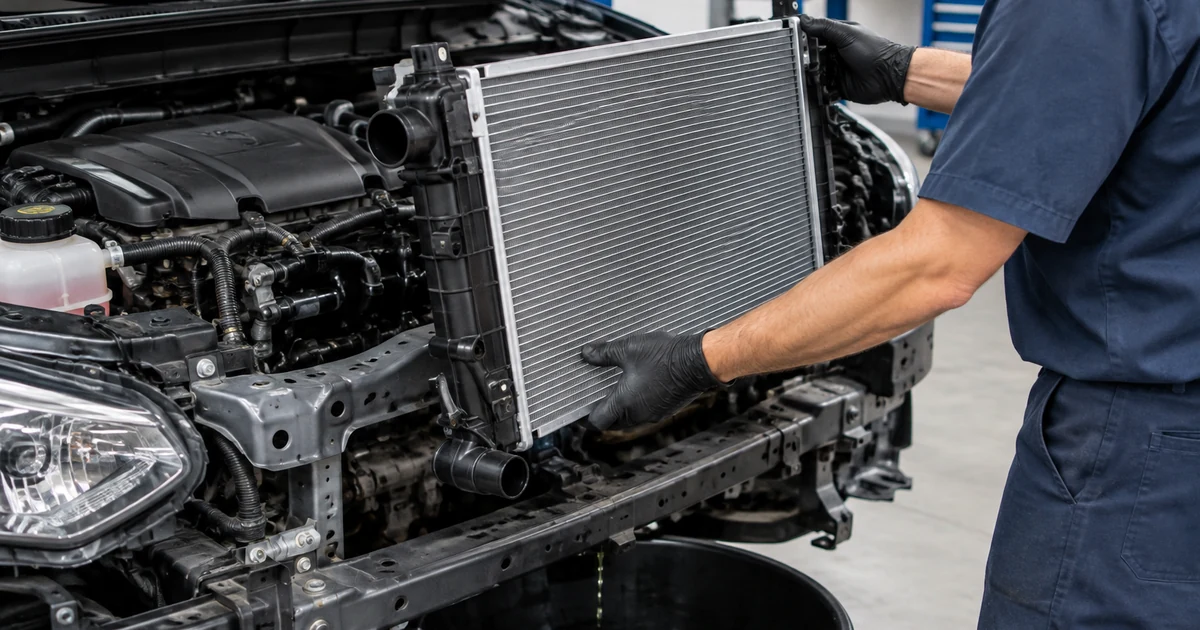
Most radiator jobs take 2 to 3.5 hours: draining coolant, removing the fan shroud and hoses, disconnecting transmission cooler lines on automatics, swapping the radiator, then refilling and bleeding air from the system. At $110 to $150 per hour at an independent shop, labor is usually $250 to $500. Some cars need the bumper cover or the A/C condenser moved, which adds time.
| Where | Typical total | Notes |
|---|---|---|
| Independent shop | $600 – $1,250 | Aftermarket or OEM radiator, $110–$150/hr |
| Dealer | $800 – $1,700 | OEM radiator, $150–$220/hr |
| DIY | $150 – $500 | Radiator, coolant and small parts |
What Affects Radiator Replacement Cost
Vehicle type and engine layout
Compact cars have small radiators and open engine bays. Trucks, large SUVs and towing packages use bigger radiators, often with an integrated transmission or engine oil cooler, and the parts cost more.
Part quality
Aftermarket radiators cost far less and fit well on most popular models. OEM units cost more but match the original exactly, which some owners prefer on newer or luxury cars.
Access
On some cars the radiator lifts straight out after the hoses and fan are removed. On others the front bumper, headlights or A/C condenser mounts have to come off first. That can add an hour or more.
Shop type and region
Dealers charge more per hour and use OEM parts only. Labor rates in the Northeast and on the West Coast run higher than in the South and Midwest.
Related parts replaced at the same time
Radiator hoses, the thermostat and the radiator cap are cheap to add while the system is drained. On older cars, many shops also check the water pump, since a weak pump can cause the same overheating symptoms. A new radiator also comes with fresh coolant, so a separate coolant flush is usually not needed.
Symptoms of a Bad Radiator
- Coolant leaks under the front of the car, often green, orange or pink
- Engine overheating, especially in traffic or on hot days
- Low coolant that keeps needing to be topped off
- Cracked plastic end tanks or crusty residue along the seams
- Sludge or rust in the coolant, which can clog the radiator core
- Bent or blocked fins that restrict airflow
- Milky fluid or shifting problems on automatics, which can mean the internal transmission cooler has failed and is mixing coolant with transmission fluid
Most radiators last many years, but plastic tanks get brittle with age and heat cycles. Old coolant also becomes corrosive and can eat the core from the inside.
Radiator Repair vs. Replacement
Small leaks at a hose neck or a loose clamp can sometimes be fixed for much less. ConsumerAffairs puts general radiator repair at roughly $250 to $750. Stop-leak products may slow a pinhole leak, but they can also clog the core and heater core, so most mechanics see them as a short-term fix at best. Cracked plastic tanks and leaking cores on modern radiators are usually replaced, not repaired, because a new aftermarket radiator often costs about the same as a proper repair.
Can You Drive With a Bad Radiator?
Only for a short distance, and only while you watch the temperature gauge closely. A small seep that loses a little coolant each week can usually be topped off until the repair. A fast leak, overheating or a gauge heading toward red means stop driving. Pull over, turn the engine off and let it cool. Overheating can warp the cylinder head or blow the head gasket, which costs far more than a radiator. Never open the radiator cap on a hot engine; the coolant is under pressure and can cause serious burns.
DIY vs. Taking It to a Shop
Difficulty: 2 to 3 out of 5 on most cars, 4 out of 5 if the bumper or condenser has to come off.
- Time: 2 to 4 hours for most DIYers.
- Tools: socket set, pliers for hose clamps, drain pan, line wrenches for transmission cooler lines, the correct coolant and a spill-free funnel for bleeding air.
- Savings: about $150 to $500 in parts versus $600 to $1,250 at a shop.
- Watch out for: damaging the A/C condenser fins, cross-threading cooler line fittings, mixing coolant types, and air pockets that make the engine overheat after the job.
Old coolant is toxic to pets and children. Collect it and take it to a parts store or recycling center.
Is It Worth Replacing the Radiator?
Usually, yes. A cooling system that cannot hold coolant puts the whole engine at risk. On a car worth a few thousand dollars or more, a $600 to $1,200 radiator is a sensible repair. It gets harder to justify on a very old, high-mileage car that also needs other major work, or if the engine has already overheated and shows head gasket symptoms such as white exhaust smoke, milky oil or unexplained coolant loss. Have those checked before you pay for a new radiator.
How to Save Money on a Radiator Replacement
- Ask for an aftermarket radiator. On most popular models it can save hundreds compared with OEM.
- Get two quotes and check that each includes coolant, hoses if needed and bleeding the system.
- Use an independent shop for out-of-warranty cars.
- Bundle cheap parts like hoses, the thermostat and the cap while the system is drained. See our thermostat replacement cost guide.
- Fix leaks early. A small leak is cheaper to deal with than engine damage from overheating.
- Check your warranty. Newer cars and powertrain or extended warranties may cover it.
- Keep up with coolant changes so the next radiator lasts longer.
Frequently Asked Questions
How much does it cost to replace a radiator?
Most drivers pay $500 to $1,500 at a shop, and about $900 is typical for a car or SUV with an aftermarket radiator. Trucks, luxury cars and OEM parts push the price above $1,200. Doing it yourself usually costs $150 to $500 in parts.
How long does it take to replace a radiator?
Most shops need 2 to 3.5 hours, including draining, refilling and bleeding air from the cooling system. Cars that require bumper or condenser removal can take longer.
Is it better to repair or replace a radiator?
Small leaks at a hose or clamp can be repaired cheaply. Cracked plastic tanks and leaking cores are usually replaced, because a new aftermarket radiator often costs about the same as a proper repair and comes with a warranty.
Can a bad radiator damage the engine?
Yes. If the radiator leaks or clogs, the engine can overheat, which can warp the cylinder head or blow the head gasket. On automatics, a failed internal transmission cooler can also contaminate and damage the transmission.
Should I replace the hoses and thermostat with the radiator?
On an older car it often makes sense. Hoses and thermostats are inexpensive, and the coolant is already drained, so adding them costs little extra labor. On a newer car with healthy hoses, it is optional.
Does radiator stop-leak work?
It can slow a very small leak for a while, but it is not a permanent repair. Some products can clog the radiator and heater core, so use it only as a short-term measure and plan a proper fix.