What the P0456 Code Means
P0456 stands for “Evaporative Emission Control System Leak Detected (Very Small Leak).” The EVAP system traps gasoline vapor from your fuel tank, stores it in a charcoal canister, and later feeds it into the engine to be burned. It’s a sealed system, so the engine computer tests it for leaks on its own.
During the test, the computer closes the vent valve, uses engine vacuum or a small pump to pull or push the system to a set pressure, and watches whether it holds. If pressure drifts slowly, it logs a very small leak. FIXD describes the threshold as a leak smaller than about 0.02 inch across, roughly the size of a pinhole.
Because the leak is so small, P0456 doesn’t affect how the engine runs. It’s an emissions fault: gasoline vapor escapes into the air, and your car will fail an inspection that checks for stored codes.
Common Causes of P0456
| Cause | Likelihood | Typical repair cost |
|---|---|---|
| Loose, worn or wrong gas cap (or worn cap seal) | Most common, check first | $0 – $60 |
| Leaking purge valve (canister purge solenoid) | Common | $120 – $400 |
| Leaking or stuck vent valve (canister vent solenoid) | Common | $150 – $450 |
| Cracked EVAP hose, loose line or bad O-ring | Common | $100 – $300 |
| Cracked charcoal canister | Less common | $450 – $900 |
| Leaking filler neck or fuel tank seal | Less common | $250 – $800 |
Auto Barn and FIXD both rank the gas cap first, followed by the purge and vent valves, EVAP lines and the charcoal canister. On older vehicles, rusted filler necks also show up, especially in states that salt their roads.
Symptoms of P0456
- Check engine light on, usually with no change in how the car drives
- A faint fuel smell near the car, especially around the rear or after filling up
- Failed emissions or smog inspection
- Rough running or hard starting right after refueling, but only if a purge valve is stuck open
Most drivers notice nothing except the light. That’s normal for this code.
Is It Safe to Drive With P0456?
Yes. P0456 is one of the least urgent check engine codes. FIXD’s guidance is that you can keep driving and handle the repair within days or weeks. The engine, brakes and steering aren’t affected.
Two cautions:
- A strong raw-fuel smell or visible fuel leak is not a P0456 problem. Liquid fuel leaks are a fire risk: park the car and get it inspected.
- A lit check engine light hides new problems. While the light is on for P0456, you won’t notice if a more serious code sets. A scanner lets you check for new codes now and then.
You will fail an emissions test in states that read stored codes until the leak is fixed and the EVAP monitor passes.
How to Diagnose P0456
Start with an OBD2 scanner. It confirms P0456, shows any other EVAP codes (such as P0455 for a large leak or P0442 for a small leak), and tells you whether the EVAP readiness monitor has completed. Some scanners with bidirectional controls can also command the purge and vent valves open and closed for testing.
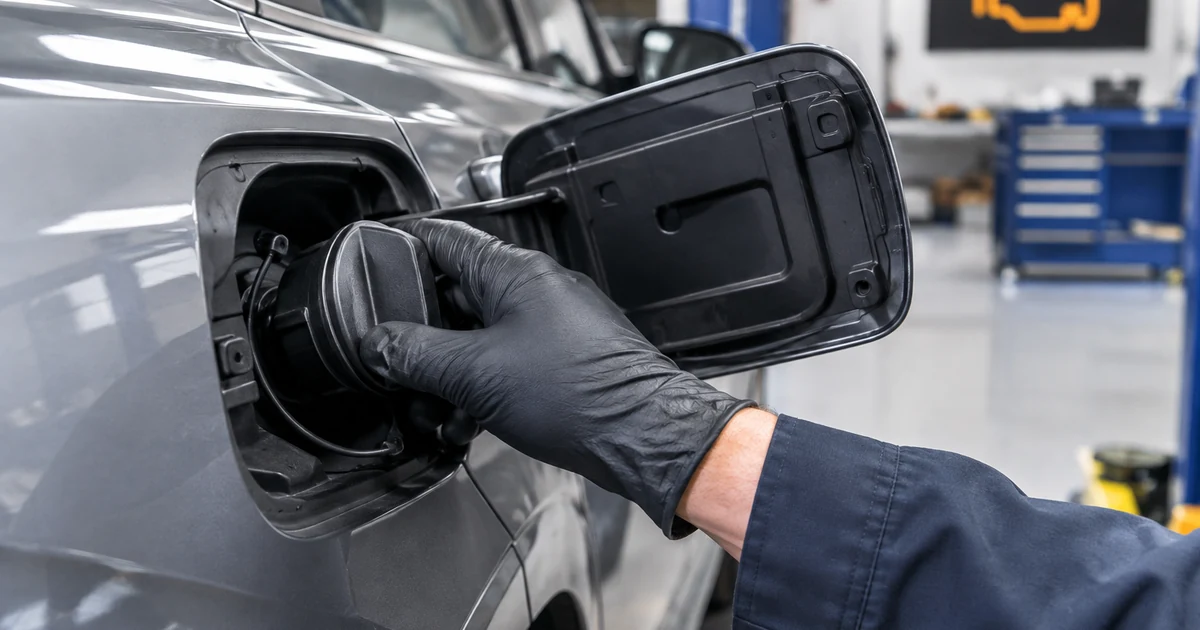
- Check the gas cap. Make sure it clicks, the seal isn’t cracked or flattened, and it’s the correct cap for your vehicle. Capless filler systems can also leak if the flap is dirty.
- Look over the easy-to-see hoses near the engine and under the rear of the car for cracks, loose clamps or disconnected lines.
- Test the purge and vent valves. A purge valve should hold vacuum when closed; a vent valve should seal when commanded shut. A scan tool or hand vacuum pump can check both.
- Do a smoke test. A shop pumps low-pressure, visible smoke into the EVAP system and watches where it escapes. Auto Barn calls this the most reliable way to pinpoint small leaks.
- Test the canister if no external leak shows up.
A smoke test typically costs $80 to $150 with the diagnostic scan included, according to shop pricing guides, and many shops credit it toward the repair.
How to Fix P0456
Work from the free and cheap fixes to the expensive ones:
- Tighten the gas cap until it clicks, then drive normally for several days. The code may clear on its own after a few passing EVAP tests.
- Replace the gas cap if its seal is worn or it doesn’t click. Buy one that matches your vehicle.
- Get a smoke test if the code returns. Guessing at EVAP parts wastes money because the leak can be anywhere from the engine bay to the fuel tank.
- Repair the part the smoke test finds: a cracked hose, a leaking purge valve, a sticking vent valve, a cracked canister or a filler neck.
- Clear the code and let the EVAP monitor run. This monitor needs specific conditions, often a cold start after the car sits overnight with the tank between about a quarter and three-quarters full, so it can take several days.
Cost to Fix P0456 by Cause
The cost to fix P0456 ranges from nothing (a loose cap) to about $900 for a charcoal canister. When a shop has to find and fix the leak, most drivers pay about $250 for a purge or vent valve replacement, plus $80 to $150 for the smoke test if it isn’t credited.
| Repair | Parts | Labor | Total at a shop |
|---|---|---|---|
| Gas cap | $20 – $60 | — | $20 – $60 (usually DIY) |
| Smoke test / EVAP diagnosis | — | $80 – $150 | $80 – $150 |
| EVAP hose or line | $30 – $70 | $70 – $230 | $100 – $300 |
| Purge valve | $40 – $150 | $80 – $250 | $120 – $400 |
| Vent valve | $40 – $150 | $100 – $300 | $150 – $450 |
| Charcoal canister | $150 – $500 | $150 – $400 | $450 – $900 |
| Filler neck or tank seal | $60 – $300 | $190 – $500 | $250 – $800 |
FIXD’s cost data puts shop repairs at about $105–$145 for EVAP lines, $120–$140 for purge or vent valves, and $450–$510 for a canister. J.D. Power lists $100 to $500 for a purge valve replacement, higher on luxury vehicles. Vent valves near the fuel tank or canister under the car tend to cost more in labor than purge valves in the engine bay.
Your car’s federal emissions warranty may help too. Many EVAP components on newer vehicles are covered for 2 years or 24,000 miles, and some are covered longer. Check your warranty booklet before paying.
What Affects the Price
Where the leak is
A purge valve on top of the engine is often a quick job. Vent valves, canisters and filler necks sit under the vehicle near the tank, and some require lowering the fuel tank or removing a heat shield, which adds labor.
Vehicle type
Trucks and SUVs with long EVAP lines and large canisters cost more to repair. Luxury and European models usually have pricier parts.
Part quality
Aftermarket valves and caps work well on most vehicles and cost less than dealer parts. For canisters and valves on newer cars, some owners prefer OEM parts for a guaranteed seal.
Shop type and region
Dealers charge higher labor rates but can run factory EVAP tests. Independent shops with a smoke machine are usually the best value. Labor rates are highest in the Northeast and on the West Coast.
DIY vs. Taking It to a Shop
A gas cap is a 1-out-of-5 DIY job that takes a minute. Replacing an accessible purge valve is about 2 out of 5 with basic hand tools. Vent valves, canisters and filler necks are 3 out of 5 because you’re working under the car near the fuel tank. The hard part isn’t the repair, it’s finding a pinhole leak. Unless you own a smoke machine, paying a shop for a smoke test is usually cheaper than buying parts by guesswork.
Is It Worth Fixing?
Yes, especially if you live in an emissions-testing state. P0456 repairs are among the cheaper check engine fixes, and clearing the code keeps your check engine light free to warn you about new problems. On a very old car in a state without inspections, some owners live with a small EVAP leak, but it still releases fuel vapor and keeps the light on.
How to Save Money on P0456
- Start with the gas cap. It’s the most common cause and the cheapest fix.
- Give the car a few days after tightening or replacing the cap before paying for diagnosis.
- Ask whether the smoke test fee is credited toward the repair.
- Don’t replace parts by guesswork. A smoke test costs less than a wrong canister.
- Check your emissions warranty on newer vehicles.
- Use an independent shop with a smoke machine rather than a dealer for out-of-warranty work.
- Bundle work under the car if the fuel tank has to come down for another repair such as a fuel pump replacement.
Related Codes
- P0455 — EVAP system large leak detected (often a missing or very loose gas cap)
- P0442 — EVAP system small leak detected
- P0441 — EVAP incorrect purge flow
- P0446 — EVAP vent control circuit problem
- P0171 / P0174 — System too lean; a purge valve stuck open can contribute. See our P0171 guide.
- P0420 / P0430 — Catalyst efficiency codes, another common reason for a failed emissions test; see our P0420 guide
Frequently Asked Questions
What does code P0456 mean?
P0456 means “Evaporative Emission Control System Leak Detected (Very Small Leak).” The engine computer sealed the fuel vapor system for a self-test and found it slowly losing pressure or vacuum through a pinhole-size leak.
Can a loose gas cap cause P0456?
Yes, and it’s the most common cause. Tighten the cap until it clicks or replace a worn one, then drive for several days. The code often clears once the EVAP self-test passes a few times.
How much does it cost to fix a P0456 code?
A gas cap costs $20 to $60. At a shop, a hose repair runs about $100 to $300, a purge or vent valve $120 to $450, and a charcoal canister $450 to $900. A smoke test to find the leak usually adds $80 to $150.
Is it safe to drive with a P0456 code?
Yes. It doesn’t affect how the engine runs. Fix it within a few weeks, and note you’ll fail an emissions test in states that read stored codes. A strong fuel smell or visible leak is a different, urgent problem.
Will P0456 clear itself?
It can, if the cause was a loose cap and the EVAP self-test passes on later drives. If there’s a real leak, the code will keep coming back until it’s repaired.
What is an EVAP smoke test?
A shop fills the EVAP system with low-pressure visible smoke and looks for where it escapes. It’s the most reliable way to find very small leaks and typically costs $80 to $150 including the scan.