What the P0420 Code Means
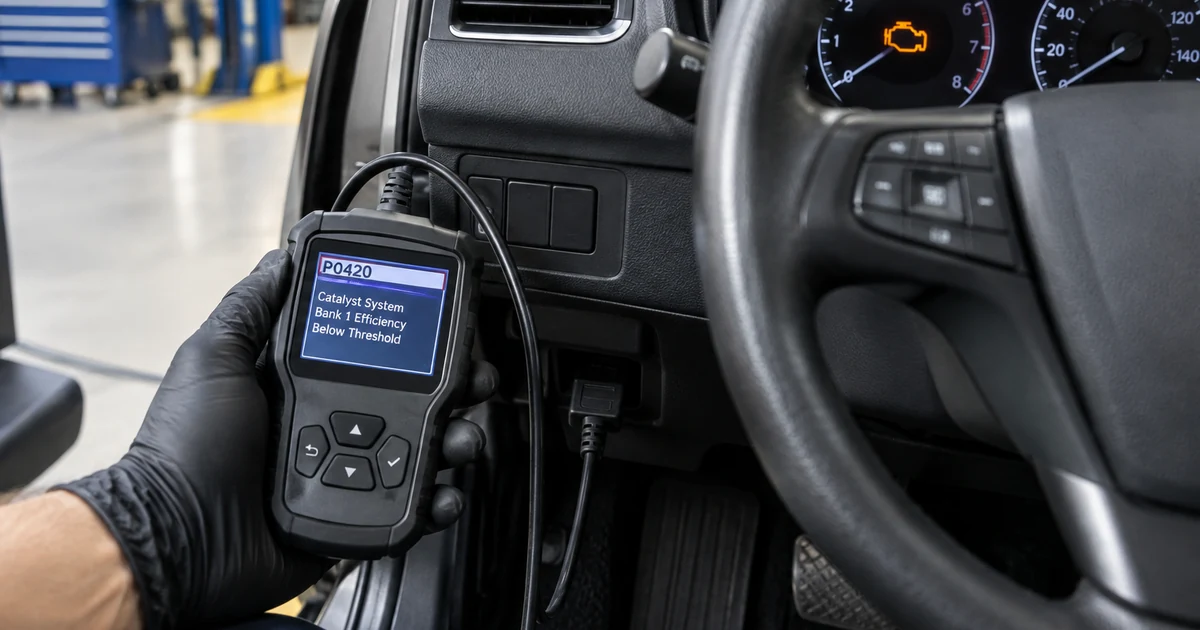
P0420 stands for “Catalyst System Efficiency Below Threshold (Bank 1).” Your engine computer compares two oxygen sensors: one before the catalytic converter and one after it. A healthy converter stores and uses oxygen, so the rear sensor signal stays fairly steady while the front one switches rapidly. When the rear signal starts copying the front one, the computer decides the converter isn’t cleaning the exhaust well enough and sets P0420.
“Bank 1” is the side of the engine with cylinder 1. Four-cylinder engines only have bank 1. On V6 and V8 engines, the same problem on the other side sets P0430.
The code says the converter appears inefficient. It doesn’t prove the converter is bad. Exhaust leaks, a lazy sensor and engine problems can all produce the same reading, which is why diagnosis matters before you spend $1,000 or more.
Common Causes of P0420
| Cause | Likelihood | Typical repair cost |
|---|---|---|
| Worn-out or damaged catalytic converter | Most common | $700 – $1,600 aftermarket, $1,400 – $3,200 OEM |
| Faulty downstream or upstream oxygen sensor | Common | $200 – $560 |
| Exhaust leak before or near the converter | Common | $100 – $600 |
| Engine misfires (bad spark plugs or ignition coil) | Occasional, but often the root cause | $240 – $400 |
| Engine burning oil or coolant (contaminates the converter) | Occasional | Varies widely; fix before replacing converter |
| Sensor wiring damage or an outdated engine software calibration | Less common | $100 – $300 |
Edmunds, YourMechanic and FIXD all list a failed converter as the most frequent cause, followed by oxygen sensors and exhaust leaks. YourMechanic also flags oil contamination, a faulty coolant temperature sensor, and leaking injectors or high fuel pressure as contributing causes.
Symptoms of P0420
- Check engine light on (often the only symptom)
- Failed emissions or smog inspection
- Rotten-egg or sulfur smell from the tailpipe
- Rattling from under the car if the converter’s insides have broken apart
- Reduced power after the engine warms up, if the converter is starting to clog
- Slightly worse fuel economy
Many cars with P0420 drive completely normally. That’s why drivers are tempted to ignore it, and why it so often turns up during an inspection.
Is It Safe to Drive With P0420?
In most cases, yes, for a short time. P0420 on its own doesn’t mean anything is about to break. FIXD’s guidance is to think in days or weeks, not months.
There are exceptions. Stop driving and get help if:
- The check engine light is flashing (active misfire that can overheat the converter)
- The car loses power, stalls or struggles to accelerate (possible clogged converter)
- You smell something burning or see heat damage under the car
Keep in mind you’ll fail emissions testing with P0420 stored, and in testing states that can block your registration renewal.
How to Diagnose P0420
Start with an OBD2 scanner. Even a basic one lets you read the code, check for other codes, and see whether the readiness monitors are complete. A model with live data lets you watch the oxygen sensor signals yourself.
- Read all codes. Misfire codes (P0300–P0306), lean or rich codes (P0171, P0172) or oxygen sensor circuit codes point to a root cause that must be fixed first.
- Check freeze-frame data. It shows the speed, temperature and fuel trims when the code set.
- Watch the O2 sensor graphs. With the engine warm, the upstream sensor should switch rapidly. A healthy converter makes the downstream sensor steady. If both sensors switch the same way, the converter is likely tired.
- Inspect for exhaust leaks at the manifold, flex pipe and joints ahead of the rear sensor. A leak lets outside air in and fools the sensor.
- Check for software updates. Some manufacturers have released updated calibrations or service bulletins for P0420 on specific models.
- Test the converter with a temperature comparison or backpressure test if the shop suspects a clog.
YourMechanic notes that the most common mistake is replacing oxygen sensors before completing a full diagnosis.
How to Fix P0420
Work from the cheapest, most likely checks to the most expensive repair:
- Fix any other codes first. Misfires and fuel trim problems damage converters and can set P0420 on their own.
- Repair exhaust leaks ahead of the downstream sensor.
- Inspect sensor wiring and connectors for heat damage or corrosion.
- Apply any software update the manufacturer offers for your vehicle.
- Replace a lazy downstream or upstream O2 sensor if live data shows it responding slowly.
- Replace the catalytic converter once everything else checks out. Use a CARB-compliant unit if you live in California or a state that follows its rules.
- Clear the code and drive through several normal trips so the catalyst monitor can re-run and confirm the fix.
After the Repair: Passing Inspection
Clearing the code with a scanner doesn’t mean you’re ready for an emissions test. Clearing codes also resets the car’s readiness monitors, and most testing stations will turn you away if the catalyst monitor shows “not ready.”
The catalyst monitor only runs under specific conditions, usually a cold start followed by a mix of steady highway cruising and city driving. Plan on several days of normal driving before it completes. A scanner that shows readiness status tells you when you’re ready to test, so you don’t waste a trip.
If P0420 comes back within a few weeks of a new converter, don’t assume the part is defective. The most common reasons are an upstream problem that was never fixed (misfire, oil burning, a rich-running engine), an exhaust leak, or a low-quality converter with too little catalyst for the application. Ask the shop what warranty the converter carries; many aftermarket units have a limited mileage warranty.
Vehicles That Commonly Get P0420
Any gas vehicle can set P0420 as it ages, but FIXD’s data shows it often on high-volume models such as the Toyota Camry, Corolla and Prius, Ford F-150 and Focus, Chevrolet Silverado 1500 and Equinox, and Nissan Altima and Sentra, along with several Subaru models. That’s mostly a reflection of how many of these vehicles are on the road at high mileage, not a sign they are poorly built.
Two situations make P0420 more likely: engines that have started to burn oil, and cars that ran for a long time with an unrepaired misfire. In both cases, a new converter is only a lasting fix if the engine problem is solved too.
Cost to Fix P0420 by Cause
Because P0420 has several causes, the cost to fix it ranges from about $100 to more than $3,000. When the converter is the culprit, most drivers pay about $1,100 for a legal aftermarket converter installed, or about $2,200 for an OEM converter.
| Repair | Parts | Labor | Total at a shop |
|---|---|---|---|
| Diagnosis | — | $100 – $180 | $100 – $180 (often credited to repair) |
| Software update or wiring repair | $0 – $50 | $100 – $250 | $100 – $300 |
| Exhaust leak repair | $20 – $200 | $80 – $400 | $100 – $600 |
| Oxygen sensor | $40 – $400 | $60 – $200 | $200 – $560 |
| Spark plugs (misfire root cause) | $100 – $130 | $180 – $270 | $290 – $400 |
| Catalytic converter, aftermarket | $200 – $800 | $150 – $450 | $700 – $1,600 |
| Catalytic converter, OEM | $800 – $3,000 | $150 – $450 | $1,400 – $3,200 |
If your car is under 8 years and 80,000 miles, the federal emissions warranty should cover a defective catalytic converter. Check with a dealer before paying for a replacement.
Related Codes
- P0430 — Catalyst system efficiency below threshold, bank 2 (same problem on the other side of a V engine)
- P0421 — Warm-up catalyst efficiency below threshold, bank 1
- P0136–P0141 — Downstream oxygen sensor circuit faults, bank 1
- P0300–P0306 — Engine misfires, a common root cause; see our P0300 guide
- P0171 / P0174 — System too lean, which can also affect converter readings
Frequently Asked Questions
What does code P0420 mean?
P0420 means “Catalyst System Efficiency Below Threshold (Bank 1).” The engine computer compared the oxygen sensors before and after the catalytic converter and decided the converter isn’t reducing emissions as much as it should.
How much does it cost to fix a P0420 code?
It depends on the cause. An exhaust leak or O2 sensor usually costs $100 to $600, while a new catalytic converter costs about $700 to $1,600 for an aftermarket unit or $1,400 to $3,200 for OEM, installed.
Can I drive with a P0420 code?
Usually yes, for days or weeks, if the car runs normally. Stop driving if the check engine light flashes, the car loses power, or you smell burning. You will fail an emissions test until it’s fixed.
Can a bad O2 sensor cause P0420?
Yes. A slow or failing downstream oxygen sensor, or an upstream sensor giving bad readings, can set P0420 even when the converter is fine. Checking sensor data before replacing the converter can save you hundreds.
Will a catalytic converter cleaner fix P0420?
Rarely for good. Additives may help a lightly fouled converter or temporarily clear the light, but they can’t restore a converter that has lost its catalyst. Treat them as a long shot, not a repair.
Is P0420 covered by warranty?
Often, if the car is newer. The federal emissions warranty covers catalytic converters for 8 years or 80,000 miles on 1995 and newer vehicles, as long as the failure is a defect and not damage or tampering.