What the P0174 Code Means
P0174 stands for “System Too Lean (Bank 2).” Gasoline engines run best near 14.7 parts air to 1 part fuel. Upstream oxygen sensors report whether the exhaust is lean (too much air) or rich (too much fuel), and the engine computer adjusts fuel delivery to compensate. Those adjustments are called fuel trims.
When the computer has been adding extra fuel on bank 2 for too long and still can’t bring the mixture back into range, it sets P0174. Either more air is getting into the engine than the computer measured, or less fuel is arriving than it commanded.
“Bank 2” is the side of a V6, V8 or flat (boxer) engine that does not contain cylinder 1. Four-cylinder inline engines only have bank 1, so they set P0171, never P0174. Which side is bank 2 varies by manufacturer, so check a service manual before you start replacing sensors.
P0174 Alone vs. P0171 and P0174 Together
This is the most useful clue you have. P0171 is the same lean fault on bank 1, so whether it’s also stored changes where you look:
- P0171 and P0174 together: both sides of the engine are lean, so look for a cause they share. That means something upstream of where the intake splits, or something that feeds both banks: a dirty or failing mass airflow (MAF) sensor, a large vacuum leak at the intake boot, throttle body, PCV system or brake booster hose, or low fuel pressure from a weak pump, clogged filter or bad regulator. OBD Guides calls the MAF sensor “almost always the first thing to check” when both lean codes appear.
- P0174 alone: the problem is probably specific to bank 2, such as a vacuum leak at a bank 2 intake runner gasket, a bank 2 oxygen sensor that reads wrong, an exhaust leak ahead of that sensor, or a weak injector on that side.
CarParts.com makes the same point: when both codes set, the whole engine is running lean, which suggests a system-wide issue rather than a one-bank problem. See our P0171 guide for the bank 1 side.
Common Causes of P0174
| Cause | Likelihood | Typical repair cost |
|---|---|---|
| Vacuum leak (cracked hose, PCV valve or hose, intake boot) | Most common | $180 – $450 |
| Dirty mass airflow (MAF) sensor | Very common with P0171 + P0174 | $100 – $200 to clean; $240 – $450 to replace |
| Leaking intake manifold gasket | Common on some V6/V8 engines | $400 – $1,200 |
| Low fuel pressure: clogged filter or bad regulator | Occasional | $175 – $400 |
| Weak fuel pump | Occasional (both banks lean) | $900 – $1,700 |
| Bank 2 upstream oxygen / air-fuel sensor | Occasional (P0174 alone) | $200 – $560 |
| Exhaust leak ahead of the bank 2 sensor | Occasional (P0174 alone) | $100 – $600 |
| Clogged or leaking fuel injector(s) | Less common | $300 – $1,500 |
Costs combine our published repair estimates with figures from OBD Guides and AutoNation Mobile Service. As with P0171, air-side problems (vacuum leaks and the MAF sensor) are far more common than fuel-side problems.
Symptoms of P0174
- Check engine light on, often with P0171 stored as well
- Rough or surging idle, sometimes with a hiss from the engine bay
- Hesitation or loss of power when accelerating
- Misfire codes, since lean cylinders burn poorly
- Hard starting or occasional stalling
- Lower fuel economy
Some vehicles show nothing but the light, especially when the lean condition only appears at idle.
Is It Safe to Drive With P0174?
For a short time, usually yes, if the car runs normally. But CarParts.com advises against continued driving because of the risk of engine and catalytic converter damage, and that’s sound advice. A lean engine burns hotter, which is hard on spark plugs, valves and the catalytic converter. Plan to diagnose it within days to a couple of weeks.
Stop driving and arrange a tow if:
- The check engine light is flashing. That means an active misfire that can overheat and ruin the catalytic converter.
- The engine stalls at stops or hesitates badly when you merge or pass.
- You smell raw fuel, which can indicate a leaking fuel line or injector and is a fire risk.
How to Diagnose P0174
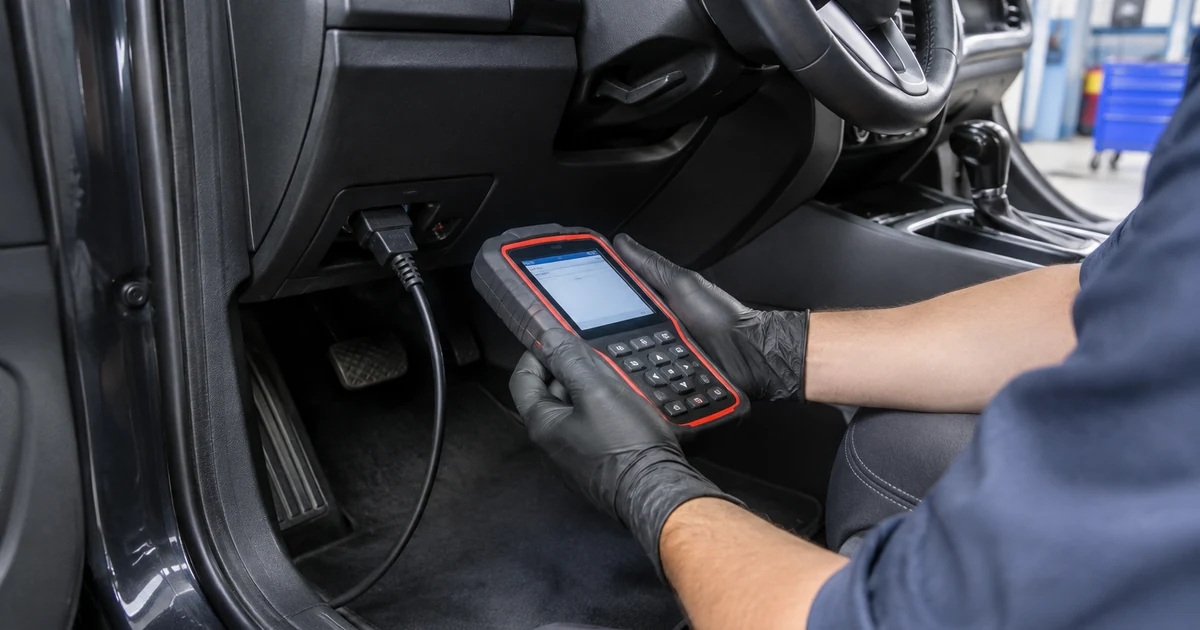
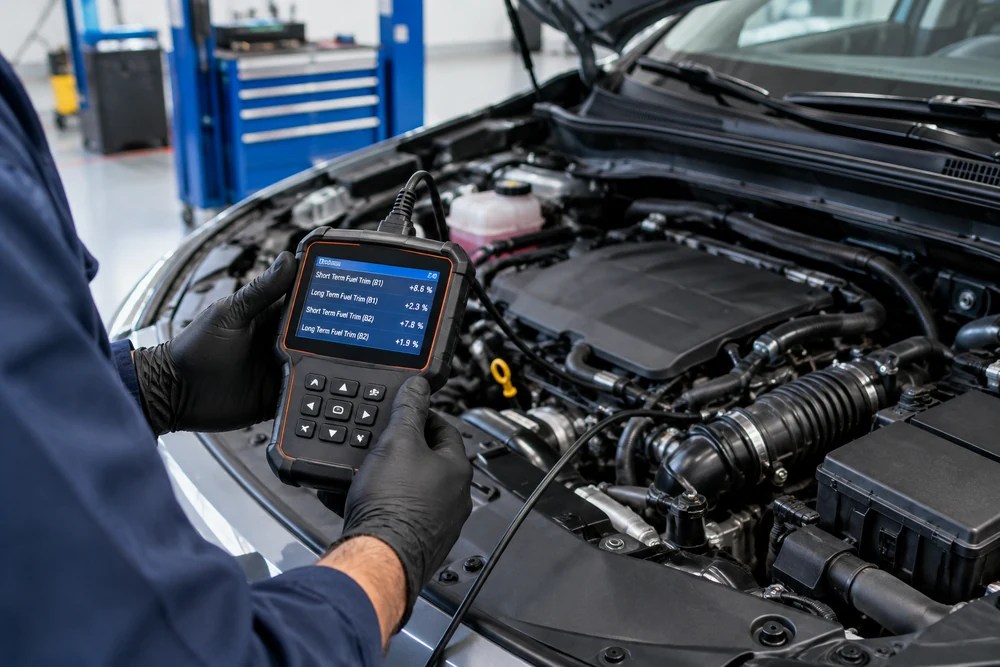
An OBD2 scanner with live data is the best tool for P0174, because fuel trims show whether both banks are affected and when.
- Read all codes. Note P0171, MAF, O2 sensor, misfire and EVAP codes stored alongside P0174.
- Compare long-term fuel trims for bank 1 and bank 2 at idle and around 2,500 rpm. Trims well above +10% mean the computer is adding a lot of fuel. If both banks are similarly high, look for a shared cause. If only bank 2 is high, focus on that side.
- Watch how trims change with rpm. High at idle but closer to normal at higher rpm usually means a vacuum leak. High everywhere points to the MAF sensor or fuel delivery.
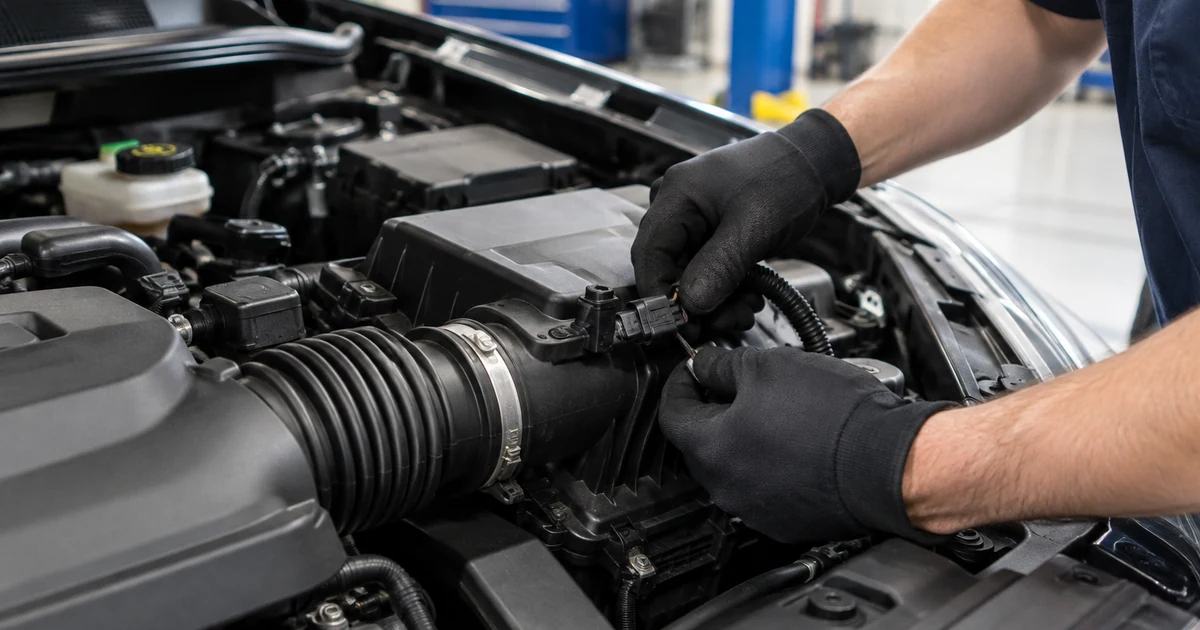
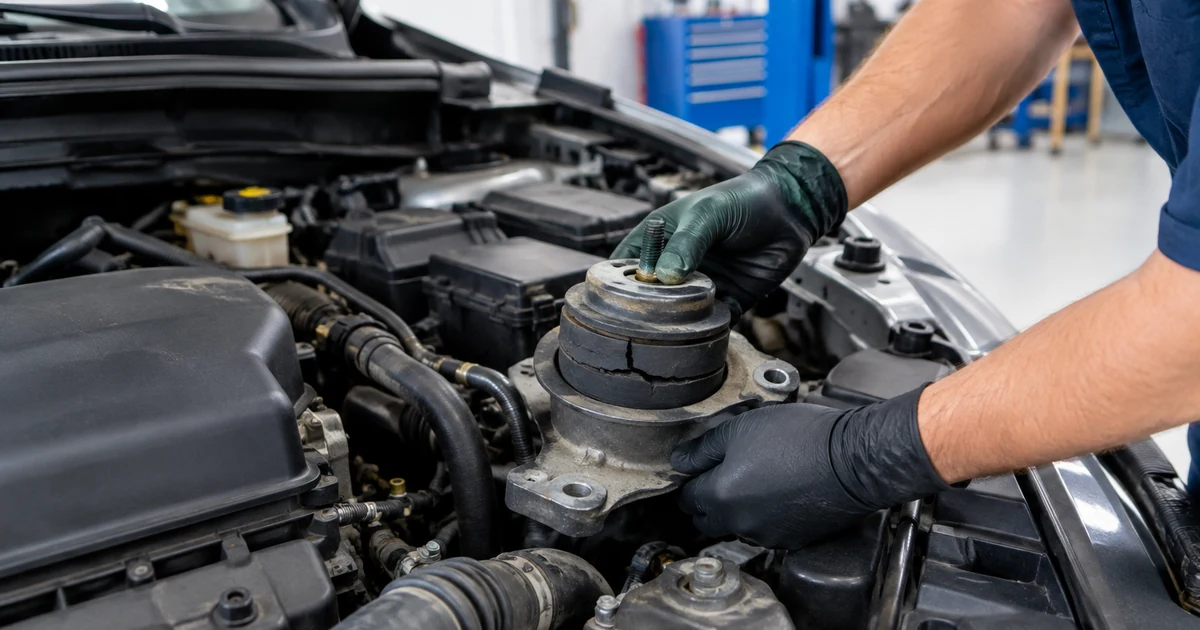
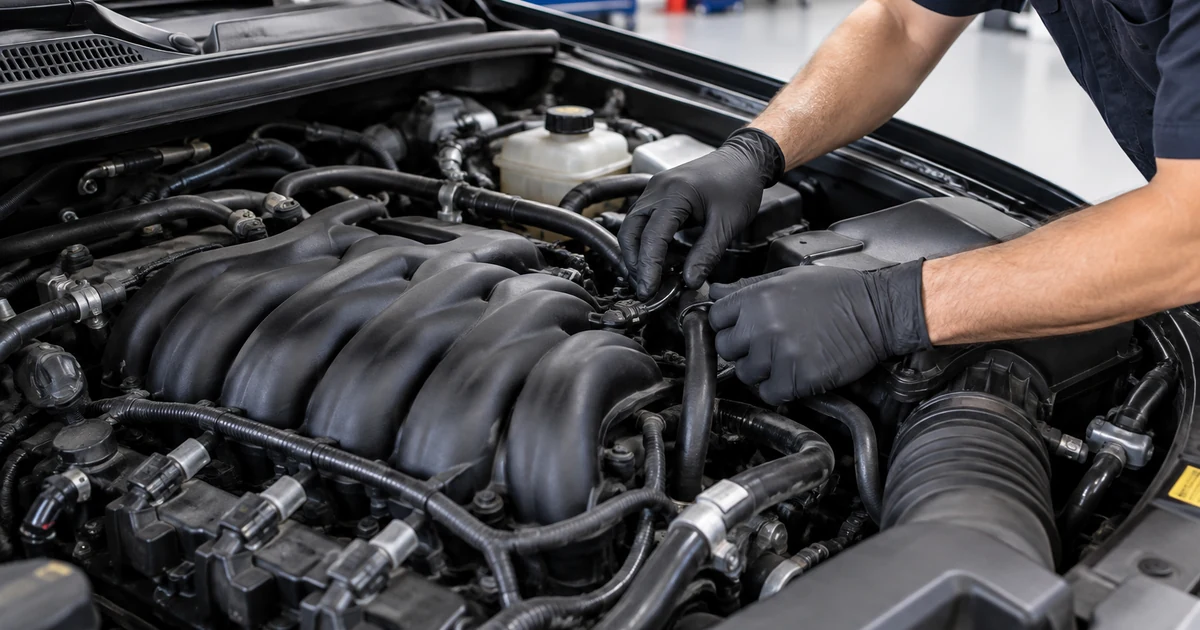
- Inspect for vacuum leaks. Check the intake boot between the air box and throttle body, PCV hoses, the brake booster hose and small vacuum lines.
- Smoke test the intake. A shop pumps visible smoke into the intake to show leaks you can’t hear. Diagnosis with a smoke test usually costs $100 to $200.
- Clean or test the MAF sensor. Compare readings to spec, or clean it with MAF-specific spray and re-check trims.
- Check fuel pressure with a gauge, at idle and under load, if the air side checks out.
How to Fix P0174
Start with the cheapest and most likely fixes, especially when P0171 is also present:
- Check the air intake. Make sure the air box clips are closed and the intake boot is tight and not cracked.
- Clean the MAF sensor with dedicated MAF cleaner. Don’t touch the sensing element, and never use carburetor or brake cleaner.
- Replace cracked vacuum hoses or a failed PCV valve or hose. These are usually inexpensive parts.
- Repair intake leaks found by a smoke test, such as intake manifold or throttle body gaskets.
- If only bank 2 is lean, fix any exhaust leak ahead of the bank 2 upstream sensor and test that sensor’s response.
- Replace the MAF sensor if cleaning didn’t help and readings are out of spec.
- Test and repair fuel delivery: fuel filter, pressure regulator, injectors, then the fuel pump.
- Clear the codes and drive. Fuel trims on both banks should drift back toward zero within a few drive cycles.
Cost to Fix P0174 by Cause
Most drivers pay about $300 to fix P0174, because the usual cause is a vacuum leak. The full range runs from about $100 for a MAF cleaning at a shop to $1,700 for a fuel pump.
| Repair | DIY parts | Shop total |
|---|---|---|
| MAF sensor cleaning | $10 – $20 | $100 – $200 |
| Vacuum hose or PCV valve | $15 – $100 | $180 – $450 |
| Fuel filter | $20 – $100 | $175 – $250 |
| MAF sensor replacement | $60 – $300 | $240 – $450 |
| Fuel pressure regulator | $50 – $195 | $265 – $400 |
| Bank 2 upstream O2 / air-fuel sensor | $40 – $400 | $200 – $560 |
| Intake manifold gasket (V6/V8) | $40 – $350 | $400 – $1,200 |
| Fuel injector(s) | $100 – $800 | $300 – $1,500 |
| Fuel pump | $150 – $1,100 | $900 – $1,700 |
A diagnosis with a smoke test usually adds $100 to $200, though many shops credit it toward the repair. OBD Guides lists $80 to $150 at a shop for a MAF cleaning and $400 to $900 for a GM V6 intake gasket job, while AutoNation Mobile Service lists $1,300 to $1,700 for a fuel pump. A lower intake gasket on a V8, or a full set of direct-injection injectors, can exceed the ranges above.
What Affects the Price
Engine layout
P0174 only appears on V6, V8 and flat engines, and those engines are more crowded. Hoses and gaskets on the back of a transverse V6 or under the intake of a V8 take longer to reach than parts on a four-cylinder.
Which part failed
A cracked PCV hose or a MAF cleaning is cheap. An intake manifold gasket or fuel pump is a much bigger job. That’s why a proper diagnosis matters more than any other factor.
Vehicle type and part quality
Trucks and large SUVs, and luxury or European models with complex PCV systems built into the valve covers, cost more. Aftermarket hoses and gaskets are usually fine; OEM MAF and air-fuel sensors are often worth the extra money because the computer depends on their accuracy.
Shop type and region
Dealers charge more per hour; independent shops with a smoke machine are usually the best value. Labor rates run highest in the Northeast and on the West Coast.
DIY vs. Taking It to a Shop
Difficulty: 2 out of 5 for the first checks, 3 to 4 for gasket or fuel system work.
The first steps are very DIY-friendly. Reading both banks’ fuel trims takes a scanner and a few minutes. Cleaning the MAF sensor takes about 15 minutes and a can of cleaner. A visual hunt for cracked hoses, a loose intake boot or a split PCV hose costs nothing.
It gets harder with small leaks you can’t hear, intake gaskets buried under other parts, and fuel pressure testing, which requires a gauge and care around pressurized fuel. If you’ve cleaned the MAF and checked the hoses and the codes return within a few days, book a smoke test before buying parts.
Is It Worth Fixing?
Yes. Most P0174 repairs cost a few hundred dollars, and leaving a lean condition alone can turn a cheap hose into misfires (see our P0300 guide) or a damaged catalytic converter, which costs far more. Fuel economy suffers the whole time, and any stored code fails an emissions test in states that check. Only a fuel pump or major intake job on an old, low-value vehicle is worth weighing against the car’s value.
How to Save Money on P0174
- Check whether P0171 is also stored. It tells you to look for one shared cause instead of two separate repairs.
- Clean the MAF sensor and inspect the intake boot first. Both cost almost nothing.
- Pay for a smoke test before parts. It’s cheaper than guessing at gaskets or sensors.
- Don’t replace both O2 sensors just because both banks are lean.
- Ask if the diagnostic fee is credited toward the repair.
- Use an independent shop for out-of-warranty work and get a second quote on gasket or fuel pump jobs.
- Bundle work: if the intake manifold comes off, replace brittle vacuum hoses and the PCV valve at the same time.
Related Codes
- P0171 — System too lean, bank 1; see our P0171 guide
- P0172 / P0175 — System too rich, bank 1 / bank 2 (the opposite problem)
- P0101–P0103 — Mass airflow sensor range or circuit problems
- P0300–P0308 — Random or cylinder-specific misfires, which a lean condition can cause
- P0430 — Catalyst efficiency on bank 2, which a long-term lean condition can eventually trigger
Frequently Asked Questions
What does code P0174 mean?
P0174 means “System Too Lean (Bank 2).” The engine computer is adding extra fuel to correct a lean mixture on the bank 2 side of a V6, V8 or flat engine and has reached its limit. Something is letting in unmeasured air or not delivering enough fuel.
What does it mean when P0171 and P0174 appear together?
Both sides of the engine are running lean, so the cause is almost always something they share: a dirty or failing MAF sensor, a large vacuum leak such as a cracked intake boot or PCV hose, or low fuel pressure. It’s rarely two separate failures at once.
How much does it cost to fix P0174?
Most drivers pay $180 to $450 for a vacuum leak repair, about $300 typical. A shop MAF cleaning is $100 to $200, an intake manifold gasket $400 to $1,200, and a fuel pump $900 to $1,700. Diagnosis with a smoke test usually adds $100 to $200.
Can I drive with a P0174 code?
For a short time if the car runs normally, but get it diagnosed within days to a couple of weeks. A lean engine runs hotter and can damage spark plugs and the catalytic converter. Stop driving if the check engine light flashes or the engine stalls.
Which side is bank 2?
Bank 2 is the side of the engine that does not contain cylinder 1. Its location depends on the manufacturer and engine, so check a service manual or a reliable diagram for your vehicle before replacing bank-specific parts like oxygen sensors.
Can a bad oxygen sensor cause P0174?
It can, mainly when P0174 appears without P0171. A slow or skewed bank 2 upstream sensor can make the computer think that side is lean. When both banks are lean, a sensor problem is much less likely than a shared air or fuel issue.