Oxygen Sensor Replacement Cost by Vehicle
Prices below are for replacing one sensor at an independent shop with a direct-fit, OE-quality part. Upstream air-fuel sensors sit at the higher end; downstream sensors at the lower end.
| Vehicle | Parts | Labor | Total (one sensor) |
|---|---|---|---|
| Honda Civic | $90 – $300 | $60 – $140 | $150 – $440 |
| Nissan Altima | $150 – $320 | $60 – $130 | $210 – $450 |
| Toyota Camry | $120 – $600 | $60 – $150 | $180 – $750 |
| Honda Accord | $150 – $480 | $60 – $140 | $370 – $620 |
| Toyota RAV4 | $120 – $450 | $60 – $140 | $180 – $590 |
| Honda CR-V | $120 – $450 | $60 – $140 | $180 – $590 |
| Chevrolet Equinox | $70 – $300 | $60 – $150 | $130 – $450 |
| Ford F-150 | $70 – $600 | $60 – $190 | $130 – $790 |
| Chevrolet Silverado 1500 | $70 – $550 | $60 – $180 | $130 – $730 |
| Jeep Wrangler | $60 – $250 | $60 – $160 | $120 – $410 |
| Jeep Grand Cherokee | $70 – $300 | $70 – $170 | $140 – $470 |
| BMW 3 Series | $150 – $450 | $90 – $250 | $240 – $700 |
| Tesla Model 3 | No oxygen sensors (fully electric) | ||
These are estimates for common model years and engines. Model year matters a lot: RepairPal shows recent F-150s and Camrys at roughly $690 to $800 per job, while older versions of the same trucks and cars come in far lower, because newer engines use pricier wideband air-fuel sensors.
Upstream vs. Downstream O2 Sensor Cost
Every gas car built since 1996 has at least two oxygen sensors, and they do different jobs. Knowing which one failed is the fastest way to predict your bill.
| Sensor | What it does | Typical part | Typical shop total |
|---|---|---|---|
| Upstream (sensor 1) | Measures oxygen before the converter so the computer can set the fuel mixture | $80 – $400 | $260 – $560 |
| Downstream (sensor 2) | Checks the exhaust after the converter to judge converter health | $40 – $150 | $200 – $450 |
| Both on one bank | Common at high mileage or after converter work | $120 – $550 | $450 – $950 |
| All four (V6/V8) | Rarely needed at once | $250 – $1,100 | $850 – $1,700 |
The upstream sensor has the bigger effect on how the engine runs, because the computer uses its signal every second to add or remove fuel. A failing upstream sensor is what usually hurts fuel economy and drivability. A failing downstream sensor usually just sets a code and can make the converter look worse than it is.
How to read the code: “bank 1” is the side of the engine with cylinder 1, “bank 2” is the other side on a V engine, “sensor 1” is upstream and “sensor 2” is downstream. So a code for bank 1 sensor 2 means the downstream sensor on the cylinder-1 side. Four-cylinder engines only have bank 1.
Cost Breakdown: Parts vs. Labor
RepairPal’s national average for an oxygen sensor replacement is $440 to $523, with parts making up most of it. Other sources put a typical shop bill at $275 to $500. Most drivers pay about $400 for one upstream sensor.
Parts
- Downstream (rear) O2 sensor: often $40 to $150. It mainly monitors the catalytic converter.
- Upstream O2 or air-fuel ratio sensor: often $80 to $400. Wideband air-fuel sensors on newer cars are the priciest.
- OEM vs. aftermarket: many factory sensors are made by the same suppliers that sell direct-fit replacements, so an OE-equivalent part from a parts store is usually a safe choice. Cheap universal sensors that need splicing are more hit-and-miss.
There is no remanufactured market for O2 sensors; they are replaced new.
Labor
Book time is typically 0.3 to 1.5 hours per sensor. An accessible downstream sensor takes minutes. A sensor tucked behind the engine on a transverse V6, or one that is rusted into the exhaust, takes much longer. At $120 to $160 per hour, labor usually lands between $60 and $200.
| Where | Typical total (one sensor) | Notes |
|---|---|---|
| Dealer | $350 – $750 | OEM part, higher labor rate, diagnostic fee common |
| Independent shop | $200 – $560 | OE-equivalent parts, often waives diagnosis with repair |
| DIY | $40 – $400 (part only) | Needs an O2 sensor socket and a code reader |
What Affects the Price
Sensor position and count
Four-cylinder engines usually have two sensors, one before and one after the catalytic converter. V6 and V8 engines usually have four, one pair per bank. The code tells you which one failed (for example “bank 1 sensor 1” is upstream on the bank with cylinder 1), so you rarely need to replace them all.
Vehicle and engine layout
Trucks often have easy access from underneath. Some compact and midsize cars with transverse V6 engines hide the rear-bank upstream sensor against the firewall, which adds labor.
Part quality
Budget sensors save money but can respond slowly and bring the check engine light back. For upstream sensors especially, a direct-fit OE-equivalent part is worth the extra.
Shop type and region
Dealer labor rates can be 30% or more above independent shops. Northeast and West Coast rates run higher than the South and Midwest.
Related parts and seized sensors
Sensors that have been in place for 10 years may snap or strip the threads. Thread repair adds $50 to $200. If you’re already replacing a catalytic converter, doing aging sensors at the same time saves labor.
Symptoms of a Bad Oxygen Sensor
- Check engine light with codes such as P0130–P0167 (sensor circuit faults), or fuel trim codes like P0171
- Noticeably worse fuel economy
- Rough idle, hesitation or stalling
- Black smoke or a rich fuel smell from the exhaust
- A P0420 code, which a lazy downstream sensor can sometimes trigger
- Failed emissions test
Oxygen sensors on 1996-and-newer vehicles often last 100,000 miles or more. Contamination from oil, coolant or silicone sealant is a common reason they fail early.
Can You Drive With a Bad Oxygen Sensor?
Usually yes, for a short time. The car will run, but the computer may fall back to a rich default fuel mixture. That wastes fuel and, over weeks or months, can overheat and damage the catalytic converter, a far more expensive part. Plan to fix it within days or weeks, not months.
If the engine is stalling, hesitating badly in traffic, or the check engine light is flashing, there’s a bigger problem. A flashing light means an active misfire; stop driving and have it towed or diagnosed.
DIY vs. Taking It to a Shop
Difficulty: 2 out of 5 for most sensors, 3 to 4 if the sensor is hard to reach or seized.
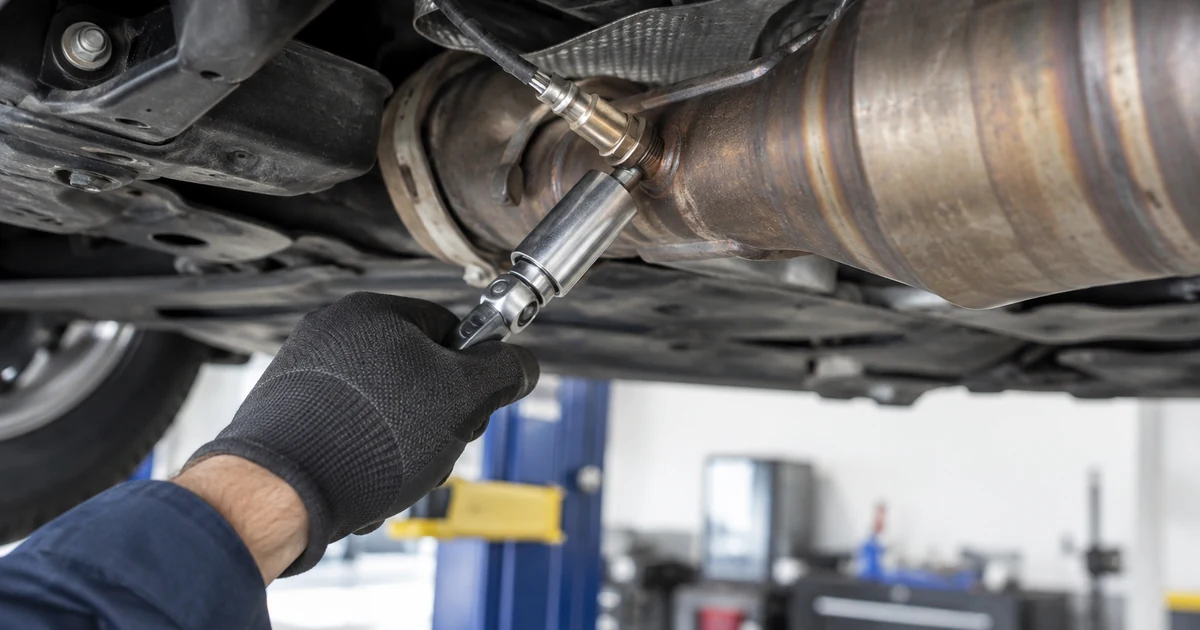
- Tools: an OBD2 scanner to read the code and clear it, an oxygen sensor socket (slotted for the wire), a breaker bar, penetrating oil, anti-seize compound (many new sensors come pre-coated).
- Time: 20 minutes to 1.5 hours.
- Tip: sensors come out easiest when the exhaust is warm, not hot. Let the engine run a few minutes, then shut it off and wear gloves.
- Savings: roughly $60 to $200 per sensor in labor, plus any diagnostic fee.
Buy the sensor by exact position (bank and sensor number) and confirm the connector matches before you start.
Is It Worth Fixing?
Almost always. An O2 sensor is a few hundred dollars at most, and ignoring it risks a failed emissions test, poor fuel economy and a damaged catalytic converter. Even on an older, high-mileage car, it’s one of the cheapest ways to keep the engine running right. On a car still within 8 years or 80,000 miles, check whether the federal emissions warranty applies to your sensor; coverage varies by part and manufacturer.
How to Save Money
- Read the code yourself with an inexpensive OBD2 scanner, or at a parts store that offers free scans.
- Replace only the failed sensor. The code tells you which bank and position.
- Use a direct-fit OE-equivalent part instead of a dealer part.
- Go to an independent shop; many will apply the diagnostic fee to the repair.
- Bundle it with other exhaust work, like a converter or spark plug job, to save on labor.
- Do it yourself if the sensor is accessible; it’s one of the easier DIY jobs on a car.
Frequently Asked Questions
How much does it cost to replace an O2 sensor?
Most drivers pay $200 to $560 for one sensor at an independent shop, with about $400 typical for an upstream sensor. RepairPal’s national average is $440 to $523. Doing it yourself costs only the part, usually $40 to $400.
What is the difference between upstream and downstream O2 sensors?
The upstream sensor sits before the catalytic converter and tells the computer how to adjust the fuel mixture. The downstream sensor sits after the converter and checks how well the converter is working. Upstream sensors usually cost more.
Should I replace all oxygen sensors at once?
Not usually. Replace the one the code points to. Some owners replace both sensors on a bank at very high mileage to save labor later, but it isn’t required.
How long do oxygen sensors last?
On most 1996-and-newer vehicles, oxygen sensors often last 100,000 miles or more. Oil burning, coolant leaks and silicone sealant can contaminate them and shorten their life.
Can a bad O2 sensor damage the catalytic converter?
Yes. A faulty upstream sensor can make the engine run rich, and the extra fuel can overheat and ruin the catalytic converter over time. That’s why it’s worth fixing within days or weeks.
Can I replace an oxygen sensor myself?
Yes, on most cars. You need an O2 sensor socket, a ratchet or breaker bar, penetrating oil and a code reader to clear the light. Hard-to-reach or seized sensors are better left to a shop.